Thank you for visiting SNEWPapers!
Sign up free
The New Hampshire Gazette
Portsmouth, Rockingham County, New Hampshire
What is this article about?
Agricultural advice from Philadelphia on optimal wheat harvesting: cut early to avoid rust and mildew damage, based on observations and experiments showing better grain quality when sheltered to ripen gradually.
Clipping
OCR Quality
Full Text
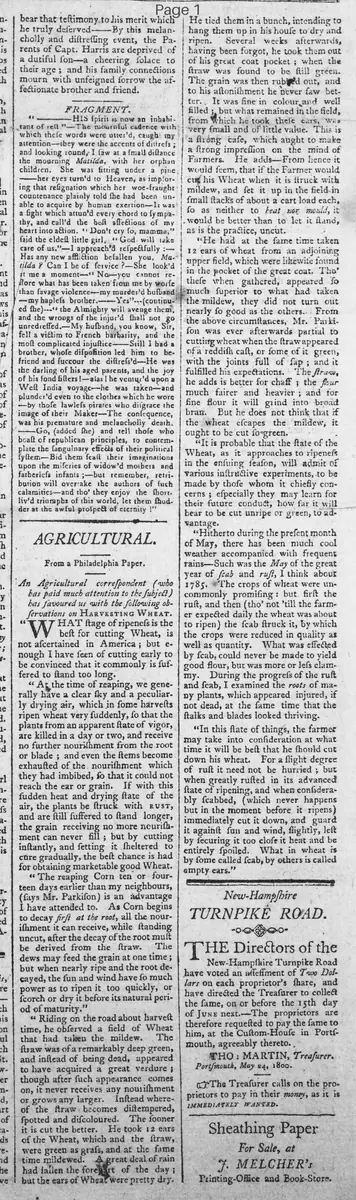
From a Philadelphia Paper.
An Agricultural correspondent (who has paid much attention to the subject) has favoured us with the following observations on Harvesting WHEAT.
WHAT stage of ripeness is the best for cutting Wheat, is not ascertained in America; but enough I have seen of cutting early to be convinced that it commonly is suffered to stand too long.
" At the time of reaping, we generally have a clear sky and a peculiarly drying air, which in some harvests ripen wheat very suddenly, so that the plants from an apparent state of vigor, are killed in a day or two, and receive no further nourishment from the root or blade ; and even the stems become exhausted of the nourishment which they had imbibed, so that it could not reach the ear or grain. If with this sudden heat and drying state of the air, the plants be struck with Rust, and are still suffered to stand longer, the grain receiving no more nourishment can never fill ; but by cutting instantly, and setting it sheltered to cure gradually, the best chance is had for obtaining marketable good Wheat.
" The reaping Corn ten or fourteen days earlier than my neighbours, (says Mr. Parkinson) is an advantage I have attended to. As Corn begins to decay first at the root, all the nourishment it can receive, while standing uncut, after the decay of the root must be derived from the straw. The dews may feed the grain at one time; but when nearly ripe and the root decayed, the sun and wind have so much power as to ripen it too quickly, or scorch or dry it before its natural period of maturity."
" Riding on the road about harvest time, he observed a field of Wheat that had taken the mildew. The straw was of a remarkably deep green, and instead of being dead, appeared to have acquired a great verdure ; though after such appearance comes on, it never receives any nourishment or grows any larger. Instead whereof the straw becomes distempered, spotted and discoloured. The sooner it is cut the better. He took 12 ears of the Wheat, which and the straw, were green as grass, and at the same time mildewed. A great deal of rain had fallen the forepart of the day; but the ears of Wheat were pretty dry.
He tied them in a bunch, intending to hang them up in his house to dry and ripen. Several weeks afterwards, having been forgot, he took them out of his great coat pocket ; when the straw was found to be still green. The grain was then rubbed out, and to his astonishment he never saw better.. It was fine in colour and well filled ; but what remained in the field, from which he took these ears, was very small and of little value. This is a strong case, which ought to make a strong impression on the mind of Farmers. He adds--From hence it would seem, that if the Farmer would cut his Wheat when it is struck with mildew, and set it up in the field in small stacks of about a cart load each, so as neither to beat nor mould, it would be better than to let it stand, as is the practice, uncut.
"He had at the same time taken 12 ears of wheat from an adjoining upper field, which were likewise found in the pocket of the great coat. Tho' these when gathered, appeared so much superior to what had taken the mildew, they did not turn out nearly so good as the others. : From the above circumstances, Mr. Parkinson was ever afterwards partial to cutting wheat when the straw appeared of a reddish cast, or some of it green, with the joints full of sap; and it fulfilled his expectations. The straw, he adds is better for chaff ; the flour much fairer and heavier : and for fine flour it will grind into broad bran. But he does not think that if the wheat escapes the mildew, it ought to be cut so green.
"It is probable that the state of the Wheat, as it approaches to ripeness in the ensuing season, will admit of various instructive experiments, to be made by those whom it chiefly concerns ; especially they may learn for their future conduct, how far it will bear to be cut unripe or green, to advantage.
"Hitherto during the present month of May, there has been much cool weather accompanied with frequent rains--Such was the May of the great year of smut and rust, I think about 1785. The crops of wheat were uncommonly promising: but first the rust, and then (tho' not 'till the farmer expected daily the wheat was about to ripen) the smut struck it, by which the crops were reduced in quality as well as quantity. What was affected by smut, could never be made to yield good flour, but was more or less clammy. During the progress of the rust and smut, I examined the roots of many plants, which appeared injured, if not dead, at the same time that the stalks and blades looked thriving.
"In this state of things, the farmer may take into consideration at what time it will be best that he should cut down his wheat. For a slight degree of rust it need not be hurried ; but when greatly rusted in its advanced state of ripening, and when considerably smutted, (which never happens but in the moment before it ripens) immediately cut it down, and guard it against sun and wind, slightly, lest by securing it too close it heat and be entirely spoiled. What in wheat is by some called smut, by others is called empty ears."
What sub-type of article is it?
What keywords are associated?
What entities or persons were involved?
Where did it happen?
Domestic News Details
Primary Location
Philadelphia
Key Persons
Outcome
cutting wheat early when affected by rust or mildew results in better quality grain, fuller ears, fairer and heavier flour; leaving it standing leads to small, low-value grain and poor flour.
Event Details
An agricultural correspondent advises on the best stage of ripeness for cutting wheat, recommending earlier harvesting to prevent issues from sudden ripening, rust, and mildew. Observations include experiments showing mildewed wheat ripening well when cut and sheltered, and historical notes on weather impacts like the 1785 smut and rust year.