Thank you for visiting SNEWPapers!
Sign up free
Literary
April 9, 1958
The Nome Nugget
Nome, Nome County, Alaska
What is this article about?
Article discusses the history and advancements in antibiotics, comparing early discoveries to explorations. It covers control of diseases like blood poisoning and pneumonia, improvements in penicillin, and new enhancements like glucosamine with Tetracyn for faster bloodstream absorption. Glucosamine is a natural substance found in nature and the body.
Merged-components note: Images overlap spatially with literary text (bbox overlaps for both images with literary); merged as likely illustrations for the science article.
Clipping
OCR Quality
95%
Excellent
Full Text
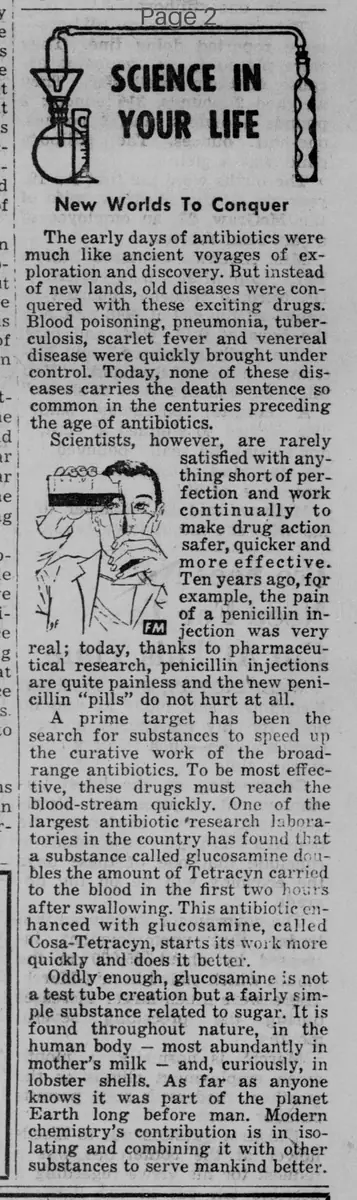
SCIENCE IN YOUR LIFE
New Worlds To Conquer
The early days of antibiotics were much like ancient voyages of exploration and discovery. But instead of new lands, old diseases were conquered with these exciting drugs.
Blood poisoning, pneumonia, tuberculosis, scarlet fever and venereal disease were quickly brought under control. Today, none of these diseases carries the death sentence so common in the centuries preceding the age of antibiotics.
Scientists, however, are rarely satisfied with anything short of perfection and work continually to make drug action safer, quicker and more effective.
Ten years ago, for example, the pain of a penicillin injection was very real; today, thanks to pharmaceutical research, penicillin injections are quite painless and the new penicillin "pills" do not hurt at all.
A prime target has been the search for substances to speed up the curative work of the broad-range antibiotics. To be most effective, these drugs must reach the blood-stream quickly. One of the largest antibiotic research laboratories in the country has found that a substance called glucosamine doubles the amount of Tetracyn carried to the blood in the first two hours after swallowing. This antibiotic enhanced with glucosamine, called Cosa-Tetracyn, starts its work more quickly and does it better.
Oddly enough, glucosamine is not a test tube creation but a fairly simple substance related to sugar. It is found throughout nature, in the human body - most abundantly in mother's milk - and, curiously, in lobster shells. As far as anyone knows it was part of the planet Earth long before man. Modern chemistry's contribution is in isolating and combining it with other substances to serve mankind better.
New Worlds To Conquer
The early days of antibiotics were much like ancient voyages of exploration and discovery. But instead of new lands, old diseases were conquered with these exciting drugs.
Blood poisoning, pneumonia, tuberculosis, scarlet fever and venereal disease were quickly brought under control. Today, none of these diseases carries the death sentence so common in the centuries preceding the age of antibiotics.
Scientists, however, are rarely satisfied with anything short of perfection and work continually to make drug action safer, quicker and more effective.
Ten years ago, for example, the pain of a penicillin injection was very real; today, thanks to pharmaceutical research, penicillin injections are quite painless and the new penicillin "pills" do not hurt at all.
A prime target has been the search for substances to speed up the curative work of the broad-range antibiotics. To be most effective, these drugs must reach the blood-stream quickly. One of the largest antibiotic research laboratories in the country has found that a substance called glucosamine doubles the amount of Tetracyn carried to the blood in the first two hours after swallowing. This antibiotic enhanced with glucosamine, called Cosa-Tetracyn, starts its work more quickly and does it better.
Oddly enough, glucosamine is not a test tube creation but a fairly simple substance related to sugar. It is found throughout nature, in the human body - most abundantly in mother's milk - and, curiously, in lobster shells. As far as anyone knows it was part of the planet Earth long before man. Modern chemistry's contribution is in isolating and combining it with other substances to serve mankind better.
What sub-type of article is it?
Essay
What themes does it cover?
Death Mortality
Medical Research
Scientific Discovery
What keywords are associated?
Antibiotics
Penicillin
Tetracyn
Glucosamine
Medical Research
Disease Conquest
Literary Details
Title
Science In Your Life New Worlds To Conquer
Key Lines
Blood Poisoning, Pneumonia, Tuberculosis, Scarlet Fever And Venereal Disease Were Quickly Brought Under Control.
Ten Years Ago, For Example, The Pain Of A Penicillin Injection Was Very Real; Today, Thanks To Pharmaceutical Research, Penicillin Injections Are Quite Painless And The New Penicillin "Pills" Do Not Hurt At All.
One Of The Largest Antibiotic Research Laboratories In The Country Has Found That A Substance Called Glucosamine Doubles The Amount Of Tetracyn Carried To The Blood In The First Two Hours After Swallowing.