Thank you for visiting SNEWPapers!
Sign up free
Story
March 8, 1823
New Hampshire Statesman
Concord, Merrimack County, New Hampshire
What is this article about?
A political article from the Washington Republican critiques William H. Crawford's claimed Republican consistency by revealing his 1798 support for Federalist President John Adams, as shown in an Augusta address signed by Crawford, challenging his presidential candidacy.
Clipping
OCR Quality
98%
Excellent
Full Text
POLITICAL:
From the Washington Republican.
MR. CRAWFORD.
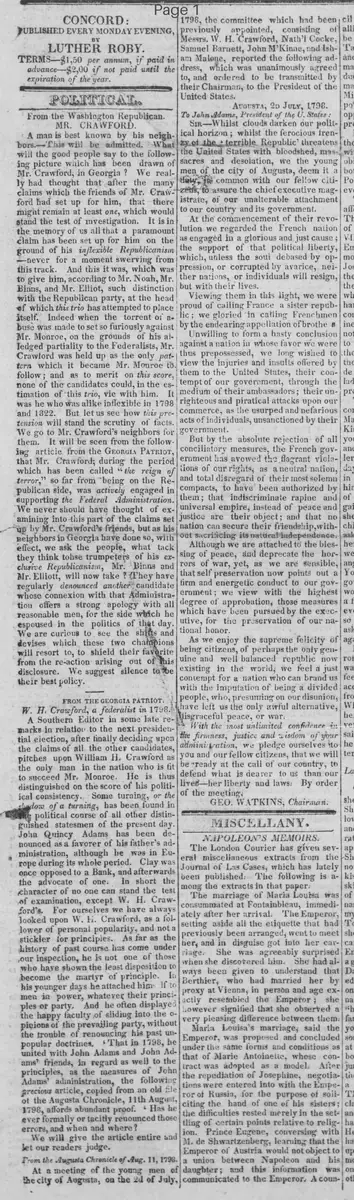
A man is best known by his neighbors. This will be admitted. What will the good people say to the following picture which has been drawn of Mr. Crawford, in Georgia? We really had thought that after the many claims which the friends of Mr. Crawford had set up for him, that there might remain at least one, which would stand the test of investigation. It is in the memory of us all that a paramount claim has been set up for him on the ground of his inflexible Republicanism--never for a moment swerving from this track. And this it was, which was to give him, according to Mr. Noah, Mr. Binns, and Mr. Elliot, such distinction with the Republican party, at the head of which this trio has attempted to place itself. Indeed when the torrent of abuse was made to set so furiously against Mr. Monroe, on the grounds of his alleged partiality to the Federalists, Mr. Crawford was held up as the only pattern which it became Mr. Monroe to follow; and as to merit on this score, none of the candidates could, in the estimation of this trio, vie with him. It was he who was alike inflexible in 1798 and 1822. But let us see how this pretension will stand the scrutiny of facts. We go to Mr. Crawford's neighbors for them. It will be seen from the following article from the GEORGIA PATRIOT, that Mr. Crawford, during the period which has been called "the reign of terror," so far from being on the Republican side, was actively engaged in supporting the Federal Administration. We never should have thought of examining into this part of the claims set up by Mr. Crawford's friends, but as his neighbors in Georgia have done so, with effect, we ask the people, what tack those trumpeters of his exclusive Republicanism, Mr. Binns and Mr. Elliott, will now take? They have regularly denounced another candidate whose connexion with that Administration offers a strong apology with all reasonable men, for the side which he espoused in the politics of that day. We are curious to see the shifts and devices which these two champions will resort to, to shield their favorite from the re-action arising out of this disclosure. We suggest silence to be their best policy.
FROM THE GEORGIA PATRIOT.
W. H. Crawford, a federalist in 1798.
A Southern Editor in some late remarks in relation to the next presidential election, after finally deciding upon the claims of all the other candidates, pitches upon William H. Crawford as the only man in the nation who is fit to succeed Mr. Monroe. He is thus distinguished on the score of his political consistency. Some turning, or the shadow of a turning, has been found in the political course of all other distinguished statesmen of the present day. John Quincy Adams has been denounced as a favorer of his father's administration, although he was in Europe during its whole period. Clay was once opposed to a Bank, and afterwards the advocate of one. In short the character of no one can stand the test of examination, except W. H. Crawford's. For ourselves we have always looked upon W. H. Crawford as a follower of personal popularity, and not a stickler for principles. As far as the history of past course has come under our inspection, he is not one of those who have shown the least disposition to become the martyr of principle. In his younger days he attached himself to men in power, whatever their principles or party. And he often displayed the happy faculty of sliding into the opinions of the prevailing party, without the trouble of renouncing his past unpopular doctrines. That in 1798, he united with John Adams and John Adams' friends, in regard as well to the principles, as the measures of John Adams' administration, the following precious article, copied from an old file of the Augusta Chronicle, 11th August, 1798, affords abundant proof. Has he ever formally or tacitly renounced those errors, and when and where? We will give the article entire and let our readers judge.
From the Augusta Chronicle of Aug. 11, 1798.
At a meeting of the young men of the city of Augusta, on the 2d of July, 1798, the committee which had been previously appointed, consisting of Messrs. W. H. Crawford, Nath'l Cocke, Samuel Barnett, John M'Kinne, and Isham Malone, reported the following address, which was unanimously agreed to, and ordered to be transmitted by their Chairman, to the President of the United States.
AUGUSTA, 2D JULY, 1798.
To John Adams, President of the U. States:
SIR--Whilst clouds darken our political horizon; whilst the ferocious frenzy of the terrible Republic threatens the United States with bloodshed, massacres and desolation, we the young men of the city of Augusta, deem it a duty in common with our fellow citizens, to assure the chief executive magistrate, of our unalterable attachment to our country and its government. At the commencement of their revolution we regarded the French nation as engaged in a glorious and just cause; the support of that political liberty, which, unless the soul debased by oppression, or corrupted by avarice, neither nations, or individuals will resign, but with their lives. Viewing them in this light, we were proud of calling France a sister republic; we gloried in calling Frenchmen by the endearing appellation of brother. Unwilling to form a hasty conclusion against a nation in whose favor we were thus prepossessed, we long wished to view the injuries and insults offered by them to the United States, their contempt of our government, through the medium of their ambassadors; their unrighteous and piratical attacks upon our commerce, as the usurped and nefarious acts of individuals, unsanctioned by their government. But by the absolute rejection of all conciliatory measures, the French government has avowed the flagrant violations of our rights, as a neutral nation, and total disregard of their most solemn compacts, to have been authorized by them; that indiscriminate rapine and universal empire; instead of peace and justice are their object; and that no nation can secure their friendship, without sacrificing its natural independence. Although we are attached to the blessings of peace, and deprecate the horrors of war, yet, as we are sensible, that self preservation now points out a firm and energetic conduct to our government; we view with the highest degree of approbation, those measures which have been pursued by the executive, for the preservation of our national honor. As we enjoy the supreme felicity of being citizens, of perhaps the only genuine and well balanced republic now existing in the world: we feel a just contempt for a nation who can brand us with the imputation of being a divided people, who, presuming on our disunion, have left us the only awful alternative. Disgraceful peace, or war. With the most unlimited confidence in the firmness, justice and wisdom of your administration, we pledge ourselves to you and our fellow citizens, that we will be ready at the call of our country, to defend what is dearer to us than our lives--her liberty and laws.
By order of the meeting,
GEO. WATKINS, Chairman.
From the Washington Republican.
MR. CRAWFORD.
A man is best known by his neighbors. This will be admitted. What will the good people say to the following picture which has been drawn of Mr. Crawford, in Georgia? We really had thought that after the many claims which the friends of Mr. Crawford had set up for him, that there might remain at least one, which would stand the test of investigation. It is in the memory of us all that a paramount claim has been set up for him on the ground of his inflexible Republicanism--never for a moment swerving from this track. And this it was, which was to give him, according to Mr. Noah, Mr. Binns, and Mr. Elliot, such distinction with the Republican party, at the head of which this trio has attempted to place itself. Indeed when the torrent of abuse was made to set so furiously against Mr. Monroe, on the grounds of his alleged partiality to the Federalists, Mr. Crawford was held up as the only pattern which it became Mr. Monroe to follow; and as to merit on this score, none of the candidates could, in the estimation of this trio, vie with him. It was he who was alike inflexible in 1798 and 1822. But let us see how this pretension will stand the scrutiny of facts. We go to Mr. Crawford's neighbors for them. It will be seen from the following article from the GEORGIA PATRIOT, that Mr. Crawford, during the period which has been called "the reign of terror," so far from being on the Republican side, was actively engaged in supporting the Federal Administration. We never should have thought of examining into this part of the claims set up by Mr. Crawford's friends, but as his neighbors in Georgia have done so, with effect, we ask the people, what tack those trumpeters of his exclusive Republicanism, Mr. Binns and Mr. Elliott, will now take? They have regularly denounced another candidate whose connexion with that Administration offers a strong apology with all reasonable men, for the side which he espoused in the politics of that day. We are curious to see the shifts and devices which these two champions will resort to, to shield their favorite from the re-action arising out of this disclosure. We suggest silence to be their best policy.
FROM THE GEORGIA PATRIOT.
W. H. Crawford, a federalist in 1798.
A Southern Editor in some late remarks in relation to the next presidential election, after finally deciding upon the claims of all the other candidates, pitches upon William H. Crawford as the only man in the nation who is fit to succeed Mr. Monroe. He is thus distinguished on the score of his political consistency. Some turning, or the shadow of a turning, has been found in the political course of all other distinguished statesmen of the present day. John Quincy Adams has been denounced as a favorer of his father's administration, although he was in Europe during its whole period. Clay was once opposed to a Bank, and afterwards the advocate of one. In short the character of no one can stand the test of examination, except W. H. Crawford's. For ourselves we have always looked upon W. H. Crawford as a follower of personal popularity, and not a stickler for principles. As far as the history of past course has come under our inspection, he is not one of those who have shown the least disposition to become the martyr of principle. In his younger days he attached himself to men in power, whatever their principles or party. And he often displayed the happy faculty of sliding into the opinions of the prevailing party, without the trouble of renouncing his past unpopular doctrines. That in 1798, he united with John Adams and John Adams' friends, in regard as well to the principles, as the measures of John Adams' administration, the following precious article, copied from an old file of the Augusta Chronicle, 11th August, 1798, affords abundant proof. Has he ever formally or tacitly renounced those errors, and when and where? We will give the article entire and let our readers judge.
From the Augusta Chronicle of Aug. 11, 1798.
At a meeting of the young men of the city of Augusta, on the 2d of July, 1798, the committee which had been previously appointed, consisting of Messrs. W. H. Crawford, Nath'l Cocke, Samuel Barnett, John M'Kinne, and Isham Malone, reported the following address, which was unanimously agreed to, and ordered to be transmitted by their Chairman, to the President of the United States.
AUGUSTA, 2D JULY, 1798.
To John Adams, President of the U. States:
SIR--Whilst clouds darken our political horizon; whilst the ferocious frenzy of the terrible Republic threatens the United States with bloodshed, massacres and desolation, we the young men of the city of Augusta, deem it a duty in common with our fellow citizens, to assure the chief executive magistrate, of our unalterable attachment to our country and its government. At the commencement of their revolution we regarded the French nation as engaged in a glorious and just cause; the support of that political liberty, which, unless the soul debased by oppression, or corrupted by avarice, neither nations, or individuals will resign, but with their lives. Viewing them in this light, we were proud of calling France a sister republic; we gloried in calling Frenchmen by the endearing appellation of brother. Unwilling to form a hasty conclusion against a nation in whose favor we were thus prepossessed, we long wished to view the injuries and insults offered by them to the United States, their contempt of our government, through the medium of their ambassadors; their unrighteous and piratical attacks upon our commerce, as the usurped and nefarious acts of individuals, unsanctioned by their government. But by the absolute rejection of all conciliatory measures, the French government has avowed the flagrant violations of our rights, as a neutral nation, and total disregard of their most solemn compacts, to have been authorized by them; that indiscriminate rapine and universal empire; instead of peace and justice are their object; and that no nation can secure their friendship, without sacrificing its natural independence. Although we are attached to the blessings of peace, and deprecate the horrors of war, yet, as we are sensible, that self preservation now points out a firm and energetic conduct to our government; we view with the highest degree of approbation, those measures which have been pursued by the executive, for the preservation of our national honor. As we enjoy the supreme felicity of being citizens, of perhaps the only genuine and well balanced republic now existing in the world: we feel a just contempt for a nation who can brand us with the imputation of being a divided people, who, presuming on our disunion, have left us the only awful alternative. Disgraceful peace, or war. With the most unlimited confidence in the firmness, justice and wisdom of your administration, we pledge ourselves to you and our fellow citizens, that we will be ready at the call of our country, to defend what is dearer to us than our lives--her liberty and laws.
By order of the meeting,
GEO. WATKINS, Chairman.
What sub-type of article is it?
Biography
Historical Event
What themes does it cover?
Deception
Justice
What keywords are associated?
William H Crawford
Federalist
Republican
Political Consistency
John Adams
1798
Augusta Chronicle
Presidential Election
What entities or persons were involved?
W. H. Crawford
John Adams
Mr. Monroe
Mr. Noah
Mr. Binns
Mr. Elliott
John Quincy Adams
Clay
Nath'l Cocke
Samuel Barnett
John M'kinne
Isham Malone
Geo. Watkins
Where did it happen?
Augusta, Georgia
Story Details
Key Persons
W. H. Crawford
John Adams
Mr. Monroe
Mr. Noah
Mr. Binns
Mr. Elliott
John Quincy Adams
Clay
Nath'l Cocke
Samuel Barnett
John M'kinne
Isham Malone
Geo. Watkins
Location
Augusta, Georgia
Event Date
1798
Story Details
The article from the Washington Republican, quoting the Georgia Patriot, exposes William H. Crawford's participation in a 1798 pro-Federalist address to President John Adams in Augusta, contradicting claims of his lifelong Republican consistency and suitability for presidency.