Thank you for visiting SNEWPapers!
Sign up free
The Virginia Gazette
Williamsburg, Virginia
What is this article about?
In a letter to the London Livery dated October 1773, Michael Lovel defends against John Wilkes' public accusation of a caning incident, attributing it to a dispute with a young West Indian ward. Lovel counters by accusing Wilkes of defrauding the Foundling Hospital of nearly £1000, for which Lovel personally contributed to restitution during Wilkes' imprisonment.
Clipping
OCR Quality
Full Text
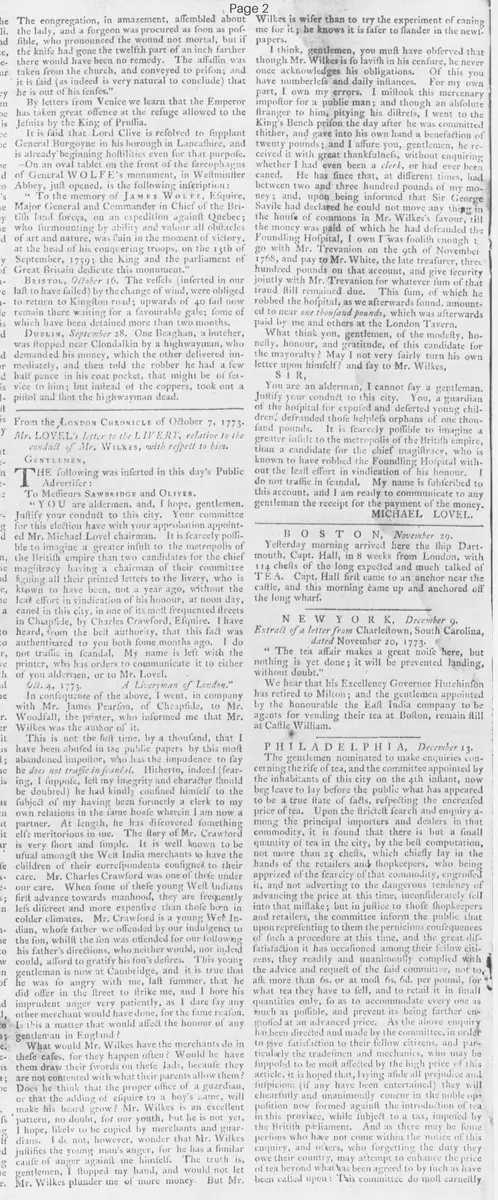
Mr. LOVEL's letter to the LIVERY, relative to the conduct of Mr. Wilkes, with respect to him.
GENTLEMEN,
The following was inserted in this day's Public Advertiser:
To Messieurs Sawbridge and Oliver.
"YOU are aldermen, and, I hope, gentlemen. Justify your conduct to this city. Your committee for this election have with your approbation appointed Mr. Michael Lovel chairman. It is scarcely possible to imagine a greater insult to the metropolis of the British empire than two candidates for the chief magistracy having a chairman of their committee signing all their printed letters to the livery, who is known to have been, not a year ago, without the least effort in vindication of his honour, at noon day, caned in this city, in one of its most frequented streets in Cheapside, by Charles Crawford, Esquire. I have heard, from the best authority, that this fact was authenticated to you both some months ago. I do not traffic in scandal. My name is left with the printer, who has orders to communicate it to either of you aldermen, or to Mr. Lovel.
Oct. 4, 1773.
A Liveryman of London."
In consequence of the above, I went, in company with Mr. James Pearson, of Cheapside, to Mr. Woodfall, the printer, who informed me that Mr. Wilkes was the author of it.
This is not the first time, by a thousand, that I have been abused in the public papers by this most abandoned impostor, who has the impudence to say he does not traffic in scandal. Hitherto, indeed (fearing, I suppose, lest my integrity and character should be doubted) he had kindly confined himself to the subject of my having been formerly a clerk to my own relations in the same house wherein I am now a partner. At length, he has discovered something else meritorious in me. The story of Mr. Crawford is very short and simple. It is well known to be usual amongst the West India merchants to have the children of their correspondents consigned to their care. Mr. Charles Crawford was one of those under our care. When some of these young West Indians first advance towards manhood, they are frequently less discreet and more expensive than those born in colder climates. Mr. Crawford is a young West Indian, whose father we offended by our indulgence to the son, whilst the son was offended for our following his father's directions, who neither would, nor indeed could, afford to gratify his son's desires. This young gentleman is now at Cambridge, and it is true that he was so angry with me, last summer, that he did offer in the street to strike me, and I bore his imprudent anger very patiently, as I dare say any other merchant would have done, for the same reason.
Is this a matter that would affect the honour of any gentleman in England?
What would Mr. Wilkes have the merchants do in these cases, for they happen often? Would he have them draw their swords on these lads, because they are not contented with what their parents allow them? Does he think that the proper office of a guardian, or that the adding of esquire to a boy's name, will make his beard grow? Mr. Wilkes is an excellent pattern, no doubt, for our youth, but he is not yet, I hope, likely to be copied by merchants and guardians. I do not, however, wonder that Mr. Wilkes justifies the young man's anger, for he has a similar cause of anger against me himself. The truth is, gentlemen, I stopped my hand, and would not let Mr. Wilkes plunder me of more money. But Mr. Wilkes is wiser than to try the experiment of caning me for it; he knows it is safer to slander in the newspapers.
I think, gentlemen, you must have observed that though Mr. Wilkes is so lavish in his censure, he never once acknowledges his obligations. Of this you have numberless and daily instances. For my own part, I own my errors. I mistook this mercenary impostor for a public man; and though an absolute stranger to him, pitying his distress, I went to the King's Bench prison the day after he was committed thither, and gave into his own hand a benefaction of twenty pounds; and I assure you, gentlemen, he received it with great thankfulness, without enquiring whether I had even been a clerk, or had ever been caned. He has since that, at different times, had between two and three hundred pounds of my money; and, upon being informed that Sir George Savile had declared he could not move any thing in the house of commons in Mr. Wilkes's favour, till the money was paid of which he had defrauded the Foundling Hospital, I own I was foolish enough to go with Mr. Trevanion on the 9th of November 1768, and pay to Mr. White, the late treasurer, three hundred pounds on that account, and give security jointly with Mr. Trevanion for whatever sum of that fraud still remained due. This sum, of which he robbed the hospital, as we afterwards found, amounted to near one thousand pounds, which was afterwards paid by me and others at the London Tavern.
What think you, gentlemen, of the modesty, honesty, honour, and gratitude, of this candidate for the mayoralty? May I not very fairly turn his own letter upon himself? and say to Mr. Wilkes,
SIR,
You are an alderman, I cannot say a gentleman. Justify your conduct to this city. You, a guardian of the hospital for exposed and deserted young children, defrauded those helpless orphans of one thousand pounds. It is scarcely possible to imagine a greater insult to the metropolis of the British empire, than a candidate for the chief magistracy, who is known to have robbed the Foundling Hospital without the least effort in vindication of his honour. I do not traffic in scandal. My name is subscribed to this account, and I am ready to communicate to any gentleman the receipt for the payment of the money.
MICHAEL LOVEL.
What sub-type of article is it?
What themes does it cover?
What keywords are associated?
What entities or persons were involved?
Letter to Editor Details
Author
Michael Lovel
Recipient
Gentlemen (The Livery)
Main Argument
michael lovel defends his character against john wilkes' accusation of being publicly caned, explaining it as a patient response to a young ward's anger, and counters by exposing wilkes' fraud against the foundling hospital, for which lovel provided financial restitution.
Notable Details