Thank you for visiting SNEWPapers!
Sign up free
Editorial
August 29, 1789
Gazette Of The United States
New York, New York County, New York
What is this article about?
Continuation of an essay defending a proposed insensible tax method against objections of potential overproduction leading to corruption, suggesting state surpluses as remedy. Argues against foreign loans, citing high true costs and negative impacts on industry and luxury, contrasting with Spain and Holland examples.
Clipping
OCR Quality
95%
Excellent
Full Text
An Essay on Free Trade and Finances.
[Continued from No. XXXII.]
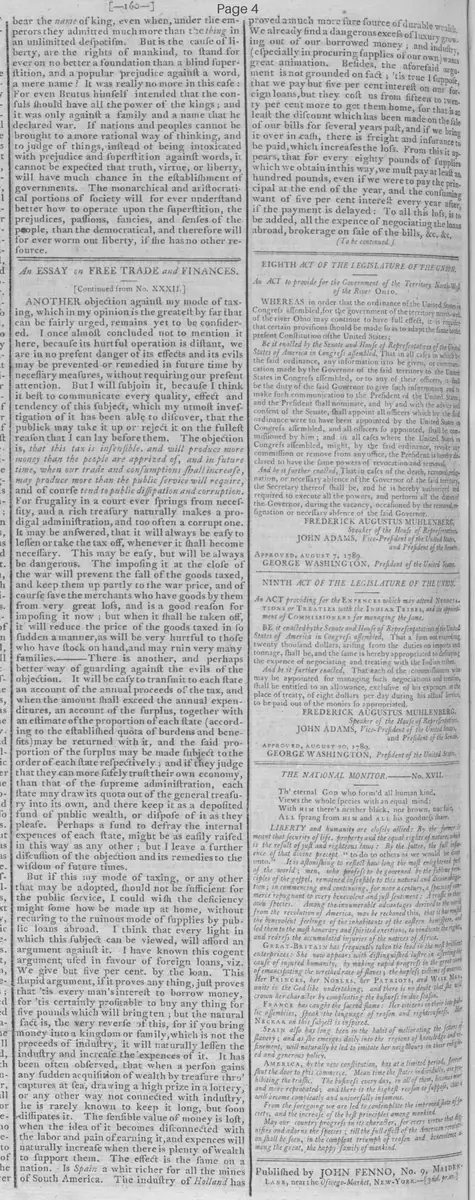
ANOTHER objection against my mode of taxing, which in my opinion is the greatest by far that can be fairly urged, remains yet to be considered. I once almost concluded not to mention it here, because its hurtful operation is distant, we are in no present danger of its effects and its evils may be prevented or remedied in future time by necessary measures, without requiring our present attention. But I will subjoin it, because I think it best to communicate every quality, effect and tendency of this subject, which my utmost investigation of it has been able to discover, that the public may take it up or reject it on the fullest reason that I can lay before them. The objection is, that this tax is insensible, and will produce more money than the people are apprised of, and in future time, when our trade and consumptions shall increase, may produce more than the public service will require, and of course tend to public dissipation and corruption. For frugality in a court ever springs from necessity, and a rich treasury naturally makes a prodigal administration, and too often a corrupt one. It may be answered, that it will always be easy to lessen or take the tax off, whenever it shall become necessary. This may be easy, but will be always dangerous. The imposing it at the close of the war will prevent the fall of the goods taxed, and keep them up partly to the war price, and of course save the merchants who have goods by them from very great loss, and is a good reason for imposing it now; but when it shall be taken off, it will reduce the price of the goods taxed in so sudden a manner, as will be very hurtful to those who have stock on hand, and may ruin very many families.— There is another, and perhaps better way of guarding against the evils of the objection. It will be easy to transmit to each state an account of the annual proceeds of the tax, and when the amount shall exceed the annual expenditures, an account of the surplus, together with an estimate of the proportion of each state (according to the established quota of burdens and benefits) may be returned with it, and the said proportion of the surplus may be made subject to the order of each state respectively; and if they judge that they can more safely trust their own economy, than that of the supreme administration, each state may draw its quota out of the general treasury into its own, and there keep it as a deposited fund of public wealth, or dispose of it as they please. Perhaps a fund to defray the internal expenses of each state, might be as easily raised in this way as any other; but I leave a further discussion of the objection and its remedies to the wisdom of future times. But if this my mode of taxing, or any other that may be adopted, should not be sufficient for the public service, I could wish the deficiency might some how be made up at home, without recurring to the ruinous mode of supplies by public loans abroad. I think that every light in which this subject can be viewed, will afford an argument against it. I have known this cogent argument used in favour of foreign loans, viz. We give but five per cent. by the loan. This stupid argument, if it proves any thing, just proves that 'tis every man's interest to borrow money, for 'tis certainly profitable to buy any thing for five pounds which will bring ten; but the natural fact is, the very reverse of this, for if you bring money into a kingdom or family, which is not the proceeds of industry, it will naturally lessen the industry and increase the expenses of it. It has been often observed, that when a person gains any sudden acquisition of wealth by treasure thro' captures at sea, drawing a high prize in a lottery, or any other way not connected with industry, he is rarely known to keep it long, but soon dissipates it. The sensible value of money is lost, when the idea of it becomes disconnected with the labor and pain of earning it, and expenses will naturally increase when there is plenty of wealth to support them. The effect is the same on a nation. - Is Spain a whit richer for all the mines of South America. The industry of Holland has proved a much more sure source of durable wealth We already find a dangerous excess of luxury growing out of our borrowed money; and industry, (especially in procuring supplies of our own) wants great animation. Besides, the aforesaid argument is not grounded on fact; 'tis true I suppose, that we pay but five per cent interest on our foreign loans, but they cost us from fifteen to twenty per cent more to get them home, for that is at least the discount which has been made on the sale of our bills for several years past, and if we bring it over in cash, there is freight and insurance to be paid, which increases the loss. From this it appears, that for every eighty pounds of supplies which we obtain in this way, we must pay at least an hundred pounds, even if we were to pay the principal at the end of the year, and the consuming want of five per cent interest every year after, if the payment is delayed: To all this loss, is to be added, all the expense of negotiating the loans abroad, brokerage on sale of the bills, &c. &c.
(To be continued.)
[Continued from No. XXXII.]
ANOTHER objection against my mode of taxing, which in my opinion is the greatest by far that can be fairly urged, remains yet to be considered. I once almost concluded not to mention it here, because its hurtful operation is distant, we are in no present danger of its effects and its evils may be prevented or remedied in future time by necessary measures, without requiring our present attention. But I will subjoin it, because I think it best to communicate every quality, effect and tendency of this subject, which my utmost investigation of it has been able to discover, that the public may take it up or reject it on the fullest reason that I can lay before them. The objection is, that this tax is insensible, and will produce more money than the people are apprised of, and in future time, when our trade and consumptions shall increase, may produce more than the public service will require, and of course tend to public dissipation and corruption. For frugality in a court ever springs from necessity, and a rich treasury naturally makes a prodigal administration, and too often a corrupt one. It may be answered, that it will always be easy to lessen or take the tax off, whenever it shall become necessary. This may be easy, but will be always dangerous. The imposing it at the close of the war will prevent the fall of the goods taxed, and keep them up partly to the war price, and of course save the merchants who have goods by them from very great loss, and is a good reason for imposing it now; but when it shall be taken off, it will reduce the price of the goods taxed in so sudden a manner, as will be very hurtful to those who have stock on hand, and may ruin very many families.— There is another, and perhaps better way of guarding against the evils of the objection. It will be easy to transmit to each state an account of the annual proceeds of the tax, and when the amount shall exceed the annual expenditures, an account of the surplus, together with an estimate of the proportion of each state (according to the established quota of burdens and benefits) may be returned with it, and the said proportion of the surplus may be made subject to the order of each state respectively; and if they judge that they can more safely trust their own economy, than that of the supreme administration, each state may draw its quota out of the general treasury into its own, and there keep it as a deposited fund of public wealth, or dispose of it as they please. Perhaps a fund to defray the internal expenses of each state, might be as easily raised in this way as any other; but I leave a further discussion of the objection and its remedies to the wisdom of future times. But if this my mode of taxing, or any other that may be adopted, should not be sufficient for the public service, I could wish the deficiency might some how be made up at home, without recurring to the ruinous mode of supplies by public loans abroad. I think that every light in which this subject can be viewed, will afford an argument against it. I have known this cogent argument used in favour of foreign loans, viz. We give but five per cent. by the loan. This stupid argument, if it proves any thing, just proves that 'tis every man's interest to borrow money, for 'tis certainly profitable to buy any thing for five pounds which will bring ten; but the natural fact is, the very reverse of this, for if you bring money into a kingdom or family, which is not the proceeds of industry, it will naturally lessen the industry and increase the expenses of it. It has been often observed, that when a person gains any sudden acquisition of wealth by treasure thro' captures at sea, drawing a high prize in a lottery, or any other way not connected with industry, he is rarely known to keep it long, but soon dissipates it. The sensible value of money is lost, when the idea of it becomes disconnected with the labor and pain of earning it, and expenses will naturally increase when there is plenty of wealth to support them. The effect is the same on a nation. - Is Spain a whit richer for all the mines of South America. The industry of Holland has proved a much more sure source of durable wealth We already find a dangerous excess of luxury growing out of our borrowed money; and industry, (especially in procuring supplies of our own) wants great animation. Besides, the aforesaid argument is not grounded on fact; 'tis true I suppose, that we pay but five per cent interest on our foreign loans, but they cost us from fifteen to twenty per cent more to get them home, for that is at least the discount which has been made on the sale of our bills for several years past, and if we bring it over in cash, there is freight and insurance to be paid, which increases the loss. From this it appears, that for every eighty pounds of supplies which we obtain in this way, we must pay at least an hundred pounds, even if we were to pay the principal at the end of the year, and the consuming want of five per cent interest every year after, if the payment is delayed: To all this loss, is to be added, all the expense of negotiating the loans abroad, brokerage on sale of the bills, &c. &c.
(To be continued.)
What sub-type of article is it?
Economic Policy
Taxation
Trade Or Commerce
What keywords are associated?
Free Trade
Taxation Mode
Foreign Loans
Public Finance
Industry Vs Luxury
State Surpluses
What entities or persons were involved?
States
Supreme Administration
Spain
Holland
Editorial Details
Primary Topic
Objections To Insensible Tax And Arguments Against Foreign Loans
Stance / Tone
Defensive Of Proposed Tax With Remedies, Strongly Against Foreign Loans
Key Figures
States
Supreme Administration
Spain
Holland
Key Arguments
Insensible Tax May Produce Surplus Leading To Corruption But Can Be Remedied By Distributing To States
Removing Tax Suddenly Harms Merchants
Foreign Loans Reduce Industry And Increase Luxury
True Cost Of Foreign Loans Exceeds 15 20% Due To Discounts, Freight, Insurance
Industry Like Holland's Is Better Than Sudden Wealth Like Spain's Mines
Borrowed Money Not From Industry Leads To Dissipation