Thank you for visiting SNEWPapers!
Sign up free
Editorial
July 8, 1795
Gazette Of The United States
Philadelphia, Philadelphia County, Pennsylvania
What is this article about?
An editorial defending the Jay Treaty with Great Britain against critics, dismissing opposition as foolish clamor from factions like Democratic Societies. It argues for realistic expectations in negotiations with a powerful nation and expresses satisfaction with the Senate-ratified version.
Clipping
OCR Quality
95%
Excellent
Full Text
For the GAZETTE of the UNITED STATES.
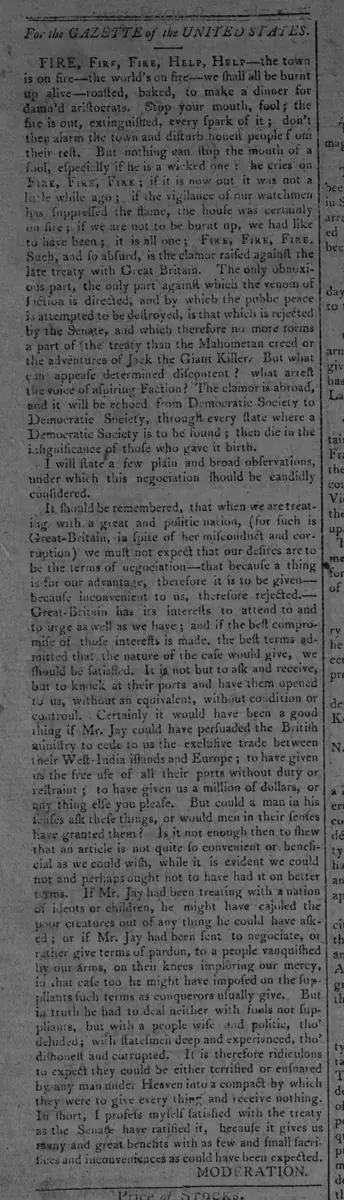
FIRE, Fire, Fire, Help, Help—the town is on fire—the world's on fire—we shall all be burnt up alive—roasted, baked, to make a dinner for damn'd aristocrats. Stop your mouth, fool; the fire is out, extinguished, every spark of it; don't then alarm the town and disturb honest people from their rest. But nothing can stop the mouth of a fool, especially if he is a wicked one & he cries on FIRE, Fire, FIRE; if it is now out it was not a little while ago; if the vigilance of our watchmen has suppressed the flame, the house was certainly on fire; if we are not to be burnt up, we had like to have been; it is all one; Fire, Fire, FIRE.
Such, and so absurd, is the clamor raised against the late treaty with Great Britain. The only obnoxious part, the only part against which the venom of faction is directed, and by which the public peace is attempted to be destroyed, is that which is rejected by the Senate, and which therefore no more forms a part of the treaty than the Mahometan creed or the adventures of Jack the Giant Killer. But what can appease determined discontent? what arrest the voice of aspiring Faction? The clamor is abroad, and it will be echoed from Democratic Society to Democratic Society, through every lane where a Democratic Society is to be found; then die in the insignificance of those who gave it birth.
I will state a few plain and broad observations, under which this negociation should be candidly considered.
It should be remembered, that when we are treating with a great and polite nation, (for such is Great-Britain, in spite of her misconduct and corruption) we must not expect that our desires are to be the terms of negociation—that because a thing is for our advantage, therefore it is to be given—because inconvenient to us, therefore rejected. Great-Britain has its interests to attend to and to urge as well as we have; and if the best compromise of those interests is made, the best terms admitted that the nature of the case would give, we should be satisfied. It is not but to ask and receive, but to knock at their ports and have them opened to us, without an equivalent, without condition or control. Certainly it would have been a good thing if Mr. Jay could have persuaded the British ministry to cede to us the exclusive trade between their West-India islands and Europe; to have given us the free use of all their ports without duty or restraint; to have given us a million of dollars, or any thing else you please. But could a man in his senses ask these things, or would men in their senses have granted them? Is it not enough then to shew that an article is not quite so convenient or beneficial as we could wish, while it is evident we could not and perhaps ought not to have had it on better terms. If Mr. Jay had been treating with a nation of idiots or children, he might have cajoled the poor creatures out of any thing he could have asked; or if Mr. Jay had been sent to negociate, or rather give terms of pardon, to a people vanquished by our arms, on their knees imploring our mercy, in that case too he might have imposed on the suppliants such terms as conquerors usually give. But in truth he had to deal neither with fools nor suppliants, but with a people wise and politic, tho' deluded; with statesmen deep and experienced, tho' dishonest and corrupted. It is therefore ridiculous to expect they could be either terrified or ensnared by any man under Heaven into a compact by which they were to give every thing and receive nothing.
In short, I profess myself satisfied with the treaty as the Senate have ratified it, because it gives us many and great benefits with as few and small sacrifices and inconveniences as could have been expected.
MODERATION.
FIRE, Fire, Fire, Help, Help—the town is on fire—the world's on fire—we shall all be burnt up alive—roasted, baked, to make a dinner for damn'd aristocrats. Stop your mouth, fool; the fire is out, extinguished, every spark of it; don't then alarm the town and disturb honest people from their rest. But nothing can stop the mouth of a fool, especially if he is a wicked one & he cries on FIRE, Fire, FIRE; if it is now out it was not a little while ago; if the vigilance of our watchmen has suppressed the flame, the house was certainly on fire; if we are not to be burnt up, we had like to have been; it is all one; Fire, Fire, FIRE.
Such, and so absurd, is the clamor raised against the late treaty with Great Britain. The only obnoxious part, the only part against which the venom of faction is directed, and by which the public peace is attempted to be destroyed, is that which is rejected by the Senate, and which therefore no more forms a part of the treaty than the Mahometan creed or the adventures of Jack the Giant Killer. But what can appease determined discontent? what arrest the voice of aspiring Faction? The clamor is abroad, and it will be echoed from Democratic Society to Democratic Society, through every lane where a Democratic Society is to be found; then die in the insignificance of those who gave it birth.
I will state a few plain and broad observations, under which this negociation should be candidly considered.
It should be remembered, that when we are treating with a great and polite nation, (for such is Great-Britain, in spite of her misconduct and corruption) we must not expect that our desires are to be the terms of negociation—that because a thing is for our advantage, therefore it is to be given—because inconvenient to us, therefore rejected. Great-Britain has its interests to attend to and to urge as well as we have; and if the best compromise of those interests is made, the best terms admitted that the nature of the case would give, we should be satisfied. It is not but to ask and receive, but to knock at their ports and have them opened to us, without an equivalent, without condition or control. Certainly it would have been a good thing if Mr. Jay could have persuaded the British ministry to cede to us the exclusive trade between their West-India islands and Europe; to have given us the free use of all their ports without duty or restraint; to have given us a million of dollars, or any thing else you please. But could a man in his senses ask these things, or would men in their senses have granted them? Is it not enough then to shew that an article is not quite so convenient or beneficial as we could wish, while it is evident we could not and perhaps ought not to have had it on better terms. If Mr. Jay had been treating with a nation of idiots or children, he might have cajoled the poor creatures out of any thing he could have asked; or if Mr. Jay had been sent to negociate, or rather give terms of pardon, to a people vanquished by our arms, on their knees imploring our mercy, in that case too he might have imposed on the suppliants such terms as conquerors usually give. But in truth he had to deal neither with fools nor suppliants, but with a people wise and politic, tho' deluded; with statesmen deep and experienced, tho' dishonest and corrupted. It is therefore ridiculous to expect they could be either terrified or ensnared by any man under Heaven into a compact by which they were to give every thing and receive nothing.
In short, I profess myself satisfied with the treaty as the Senate have ratified it, because it gives us many and great benefits with as few and small sacrifices and inconveniences as could have been expected.
MODERATION.
What sub-type of article is it?
Foreign Affairs
Partisan Politics
What keywords are associated?
Jay Treaty
Great Britain
Democratic Societies
Faction
Negotiation
Senate Ratification
West India Trade
What entities or persons were involved?
Mr. Jay
Great Britain
Senate
Democratic Societies
British Ministry
Editorial Details
Primary Topic
Defense Of The Jay Treaty
Stance / Tone
Supportive Of The Treaty And Critical Of Factional Opposition
Key Figures
Mr. Jay
Great Britain
Senate
Democratic Societies
British Ministry
Key Arguments
Opposition To The Treaty Is Absurd Clamor Over A Rejected Article.
Negotiations With Britain Require Compromise, Not One Sided Demands.
Britain Is A Wise And Powerful Nation, Not To Be Easily Outmaneuvered.
The Ratified Treaty Provides Significant Benefits With Minimal Sacrifices.
Factional Discontent From Democratic Societies Will Fade Into Insignificance.