Thank you for visiting SNEWPapers!
Sign up free
Letter to Editor
March 29, 1871
The Newberry Herald
Newberry, Newberry County, South Carolina
What is this article about?
A letter explaining the recent congressional acts of 1868 and 1871 that allow former Confederates and those affected by the 14th Amendment to hold office by taking a modified oath, removing political disabilities from the Civil War era. Signed by Alpha Pi from Newberry, S.C., dated March 20, 1871.
Clipping
OCR Quality
95%
Excellent
Full Text
For the Herald.
The Test Oath.
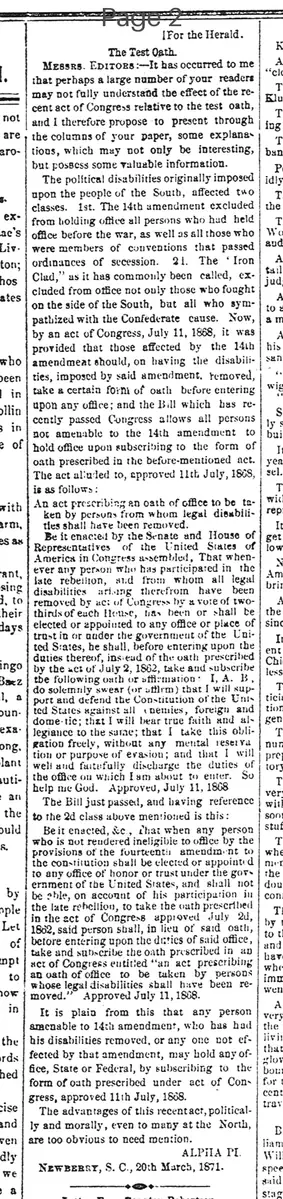
Messrs. Editors: It has occurred to me that perhaps a large number of your readers may not fully understand the effect of the recent act of Congress relative to the test oath, and I therefore propose to present through the columns of your paper, some explanations, which may not only be interesting, but possess some valuable information.
The political disabilities originally imposed upon the people of the South, affected two classes. 1st. The 14th amendment excluded from holding office all persons who had held office before the war, as well as all those who were members of conventions that passed ordinances of secession. 2d. The 'Iron Clad,' as it has commonly been called, excluded from office not only those who fought on the side of the South, but all who sympathized with the Confederate cause. Now, by an act of Congress, July 11, 1868, it was provided that those affected by the 14th amendment should, on having the disabilities, imposed by said amendment, removed, take a certain form of oath before entering upon any office; and the Bill which has recently passed Congress allows all persons not amenable to the 14th amendment to hold office upon subscribing to the form of oath prescribed in the before-mentioned act.
The act alluded to, approved 11th July, 1868, is as follows:
An act prescribing an oath of office to be taken by persons from whom legal disabilities shall have been removed.
Be it enacted by the Senate and House of Representatives of the United States of America in Congress assembled, That whenever any person who has participated in the late rebellion, and from whom all legal disabilities arising therefrom have been removed by act of Congress by a vote of two-thirds of each house, has been or shall be elected or appointed to any office or place of trust in or under the government of the United States, he shall, before entering upon the duties thereof, in stead of the oath prescribed by the act of July 2, 1862, take and subscribe the following oath or affirmation: I, A. B., do solemnly swear (or affirm) that I will support and defend the Constitution of the United States against all enemies, foreign and domestic; that I will bear true faith and allegiance to the same; that I take this obligation freely, without any mental reservation or purpose of evasion; and that I will well and faithfully discharge the duties of the office on which I am about to enter. So help me God. Approved, July 11, 1868.
The Bill just passed, and having reference to the 2d class above mentioned is this:
Be it enacted, &c., that whenever any person who is not rendered ineligible to office by the provisions of the fourteenth amendment to the constitution shall be elected or appointed to any office of honor or trust under the government of the United States, and shall not be able, on account of his participation in the late rebellion, to take the oath prescribed in the act of Congress approved July 2d, 1862, said person shall, in lieu of said oath, before entering upon the duties of said office, take and subscribe the oath prescribed in an act of Congress entitled "an act prescribing an oath of office to be taken by persons whose legal disabilities shall have been removed." Approved July 11, 1868.
It is plain from this that any person amenable to 14th amendment, who has had his disabilities removed, or any one not affected by that amendment, may hold any office, State or Federal, by subscribing to the form of oath prescribed under act of Congress, approved 11th July, 1868.
The advantages of this recent act, politically and morally, even to many at the North, are too obvious to need mention.
ALPHA PI.
Newberry, S. C., 20th March, 1871.
The Test Oath.
Messrs. Editors: It has occurred to me that perhaps a large number of your readers may not fully understand the effect of the recent act of Congress relative to the test oath, and I therefore propose to present through the columns of your paper, some explanations, which may not only be interesting, but possess some valuable information.
The political disabilities originally imposed upon the people of the South, affected two classes. 1st. The 14th amendment excluded from holding office all persons who had held office before the war, as well as all those who were members of conventions that passed ordinances of secession. 2d. The 'Iron Clad,' as it has commonly been called, excluded from office not only those who fought on the side of the South, but all who sympathized with the Confederate cause. Now, by an act of Congress, July 11, 1868, it was provided that those affected by the 14th amendment should, on having the disabilities, imposed by said amendment, removed, take a certain form of oath before entering upon any office; and the Bill which has recently passed Congress allows all persons not amenable to the 14th amendment to hold office upon subscribing to the form of oath prescribed in the before-mentioned act.
The act alluded to, approved 11th July, 1868, is as follows:
An act prescribing an oath of office to be taken by persons from whom legal disabilities shall have been removed.
Be it enacted by the Senate and House of Representatives of the United States of America in Congress assembled, That whenever any person who has participated in the late rebellion, and from whom all legal disabilities arising therefrom have been removed by act of Congress by a vote of two-thirds of each house, has been or shall be elected or appointed to any office or place of trust in or under the government of the United States, he shall, before entering upon the duties thereof, in stead of the oath prescribed by the act of July 2, 1862, take and subscribe the following oath or affirmation: I, A. B., do solemnly swear (or affirm) that I will support and defend the Constitution of the United States against all enemies, foreign and domestic; that I will bear true faith and allegiance to the same; that I take this obligation freely, without any mental reservation or purpose of evasion; and that I will well and faithfully discharge the duties of the office on which I am about to enter. So help me God. Approved, July 11, 1868.
The Bill just passed, and having reference to the 2d class above mentioned is this:
Be it enacted, &c., that whenever any person who is not rendered ineligible to office by the provisions of the fourteenth amendment to the constitution shall be elected or appointed to any office of honor or trust under the government of the United States, and shall not be able, on account of his participation in the late rebellion, to take the oath prescribed in the act of Congress approved July 2d, 1862, said person shall, in lieu of said oath, before entering upon the duties of said office, take and subscribe the oath prescribed in an act of Congress entitled "an act prescribing an oath of office to be taken by persons whose legal disabilities shall have been removed." Approved July 11, 1868.
It is plain from this that any person amenable to 14th amendment, who has had his disabilities removed, or any one not affected by that amendment, may hold any office, State or Federal, by subscribing to the form of oath prescribed under act of Congress, approved 11th July, 1868.
The advantages of this recent act, politically and morally, even to many at the North, are too obvious to need mention.
ALPHA PI.
Newberry, S. C., 20th March, 1871.
What sub-type of article is it?
Informative
Political
Persuasive
What themes does it cover?
Politics
Constitutional Rights
What keywords are associated?
Test Oath
14th Amendment
Political Disabilities
Confederate Sympathizers
Congress Act 1868
Civil War Rebellion
Oath Of Office
What entities or persons were involved?
Alpha Pi
Messrs. Editors
Letter to Editor Details
Author
Alpha Pi
Recipient
Messrs. Editors
Main Argument
recent congressional acts allow individuals affected by civil war political disabilities, including those under the 14th amendment and the 'iron clad' oath, to hold office by taking a modified oath prescribed in the 1868 act, rather than the stricter 1862 oath.
Notable Details
Quotes Full Text Of 1868 Act Prescribing Oath
References 14th Amendment And 'Iron Clad' Oath
Mentions Recent Bill Passed By Congress
Discusses Advantages Politically And Morally