Thank you for visiting SNEWPapers!
Sign up free
The New Hampshire Gazette
Portsmouth, Rockingham County, New Hampshire
What is this article about?
Speculative analysis of premature reports on French forces potentially capturing Amsterdam, highlighting local dissatisfaction with the Stadtholder, reluctance to use inundation defenses due to agricultural damage, and severe economic consequences including bank failure and disruption of currency affecting global merchants and the poor.
Clipping
OCR Quality
Full Text
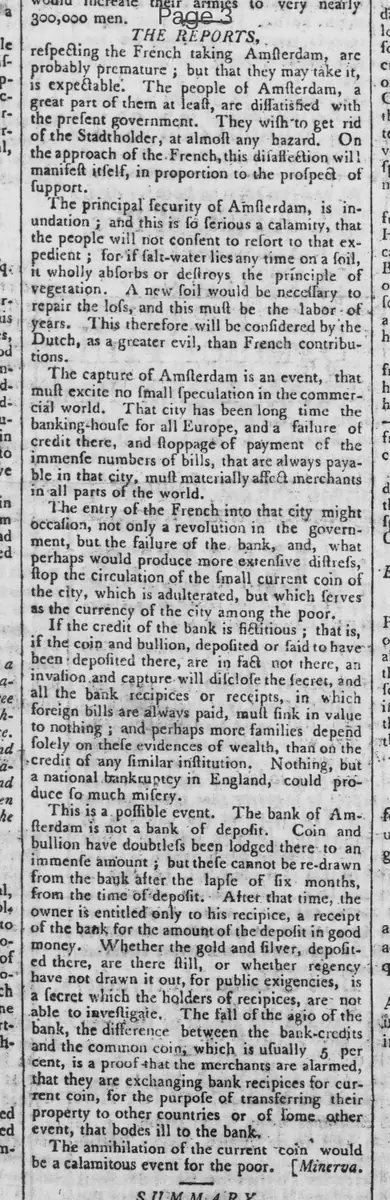
The principal security of Amsterdam, is inundation ; and this is so serious a calamity, that the people will not consent to resort to that expedient ; for if salt-water lies any time on a soil, it wholly absorbs or destroys the principle of vegetation. A new soil would be necessary to repair the loss, and this must be the labor -of years. This therefore will be considered by the Dutch, as a greater evil, than French contributions.
The capture of Amsterdam is an event, that must excite no small speculation in the commercial world. That city has been long time the banking-house for all Europe, and a failure of credit there, and stoppage of payment cf the immense numbers of bills, that are always payable in that city, must materially affect merchants in all parts of the world.
The entry of the French into that city might occasion, not only a revolution in the government, but the failure of the, bank, and, what perhaps would produce more extensive distress, stop the circulation of the small current coin of the city, which is adulterated, but which serves as the currency of the city among the poor.
If the credit of the bank is fictitious ; that is, if the coin and bullion, deposited or said to have been deposited there, are in fact not there, an invasion and capture will disclose the secret, and all the bank receipts or receipts, in which foreign bills are always paid, must sink in value to nothing ; and perhaps more families depend solely on these evidences of wealth, than on the credit of any similar institution. Nothing, but a national bankruptcy in England, could produce so much misery.
This is a possible event. The bank of Amsterdam is not a bank of deposit. Coin and bullion have doubtless been lodged there to an immense amount ; but these cannot be re-drawn from the bank after the lapse of six months, from the time of deposit. After that time, the owner is entitled only to his receipt, a receipt of the bank for the amount of the deposit in good money. Whether the gold and silver, deposited there, are there still, or whether regency have not drawn it out, for public exigencies, is a secret which the holders of receipts, are not able to investigate. The fall of the agio of the bank, the difference between the bank-credits and the common coin; which is usually 5 per cent, is a proof that the merchants are alarmed, that they are exchanging bank receipts for current coin, for the purpose of transferring their property to other countries or of some, other event, that bodes ill to the bank.
The annihilation of the current coin would be a calamitous event for the poor. [Minerva.
What sub-type of article is it?
What keywords are associated?
What entities or persons were involved?
Where did it happen?
Foreign News Details
Primary Location
Amsterdam
Key Persons
Outcome
potential revolution in government, failure of the bank, stoppage of current coin circulation, national bankruptcy-like misery, disclosure of fictitious bank credit
Event Details
Reports of French taking Amsterdam are premature but expectable due to dissatisfaction with the present government and desire to remove the Stadtholder. Inundation defense unlikely due to soil destruction. Capture would cause revolution, bank failure, and economic distress affecting global merchants and the poor, with possible revelation of missing deposits after six months.