Thank you for visiting SNEWPapers!
Sign up free
Story
March 16, 1921
The Guthrie Daily Leader
Guthrie, Logan County, Oklahoma
What is this article about?
The mule's vital role in U.S. farming is highlighted, noting its ruggedness for hilly areas, rising popularity over horses, and statistical growth in numbers and value from 1870 to 1920, with ongoing demand for mule ranches.
Clipping
OCR Quality
95%
Excellent
Full Text
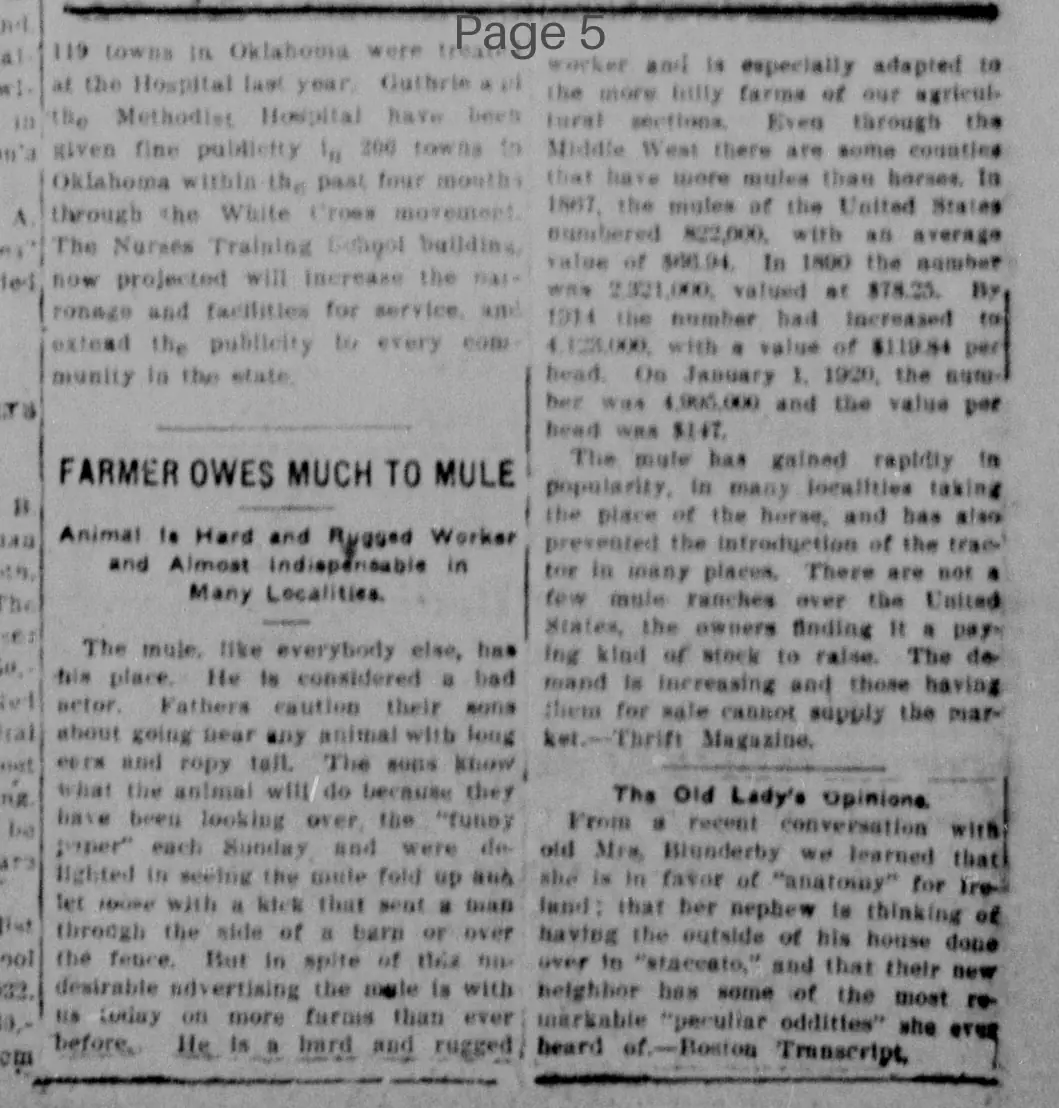
FARMER OWES MUCH TO MULE
Animal Is Hard and Rugged Worker and Almost Indispensable in Many Localities.
The mule, like everybody else, has his place. He is considered a bad actor. Fathers caution their sons about going near any animal with long ears and ropy tail. The boys know that the animal will do because they have been looking over the "funny paper" each Sunday and were delighted in seeing the mule fold up and let loose with a kick that sent a man through the side of a barn or over the fence.
But in spite of this undesirable advertising the mule is with us today on more farms than ever before. He is a hard and rugged worker and is especially adapted to the more hilly farms of our agricultural sections. Even through the Middle West there are some localities that have more mules than horses. In 1870 the mules of the United States numbered 822,000, with an average value of $94. In 1900 the number was 2,815,000 valued at $178.21. In 1914 the number had increased to 4,130,000 with a value of $116.84 per head. On January 1, 1920, the number was 3,248,000 and the value per head was $117.
The mule has gained rapidly in popularity, in many localities taking the place of the horse, and has also prevented the introduction of the tractor in many places.
There are not a few mule ranches over the United States, the owners finding it a paying kind of stock to raise.
The demand is increasing and those having them for sale cannot supply the market.—Thrift Magazine.
Animal Is Hard and Rugged Worker and Almost Indispensable in Many Localities.
The mule, like everybody else, has his place. He is considered a bad actor. Fathers caution their sons about going near any animal with long ears and ropy tail. The boys know that the animal will do because they have been looking over the "funny paper" each Sunday and were delighted in seeing the mule fold up and let loose with a kick that sent a man through the side of a barn or over the fence.
But in spite of this undesirable advertising the mule is with us today on more farms than ever before. He is a hard and rugged worker and is especially adapted to the more hilly farms of our agricultural sections. Even through the Middle West there are some localities that have more mules than horses. In 1870 the mules of the United States numbered 822,000, with an average value of $94. In 1900 the number was 2,815,000 valued at $178.21. In 1914 the number had increased to 4,130,000 with a value of $116.84 per head. On January 1, 1920, the number was 3,248,000 and the value per head was $117.
The mule has gained rapidly in popularity, in many localities taking the place of the horse, and has also prevented the introduction of the tractor in many places.
There are not a few mule ranches over the United States, the owners finding it a paying kind of stock to raise.
The demand is increasing and those having them for sale cannot supply the market.—Thrift Magazine.
What sub-type of article is it?
Curiosity
Historical Event
What themes does it cover?
Nature
Triumph
What keywords are associated?
Mule Farming
Agricultural Workers
Livestock Statistics
Hilly Farms
Tractor Alternative
Where did it happen?
United States, Middle West
Story Details
Location
United States, Middle West
Event Date
1870 1920
Story Details
The mule is a hard and rugged worker indispensable on many farms, especially hilly ones, gaining popularity over horses and preventing tractor adoption. U.S. mule numbers grew from 822,000 in 1870 to 4,130,000 in 1914, then 3,248,000 in 1920, with increasing values. Mule ranches are profitable, and demand exceeds supply.