Thank you for visiting SNEWPapers!
Sign up free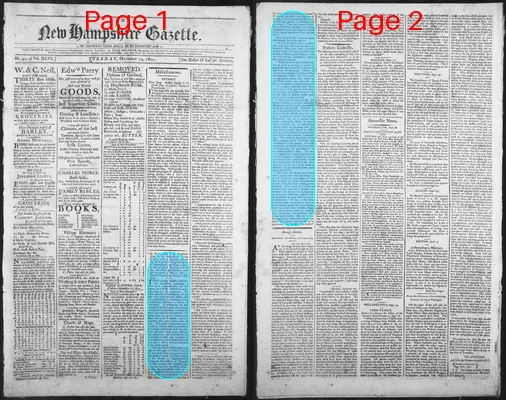
Editorial
October 13, 1801
The New Hampshire Gazette
Portsmouth, Rockingham County, New Hampshire
What is this article about?
Review of a pamphlet analyzing President Jefferson's reply to the New-Haven Remonstrance, criticizing his removals from office and recess appointments as unconstitutional abuses of power favoring political factions over public good.
Merged-components note: Continuation across pages of an opinionated analysis of the President's reply, better classified as editorial.
Clippings
1 of 2
OCR Quality
95%
Excellent
Full Text
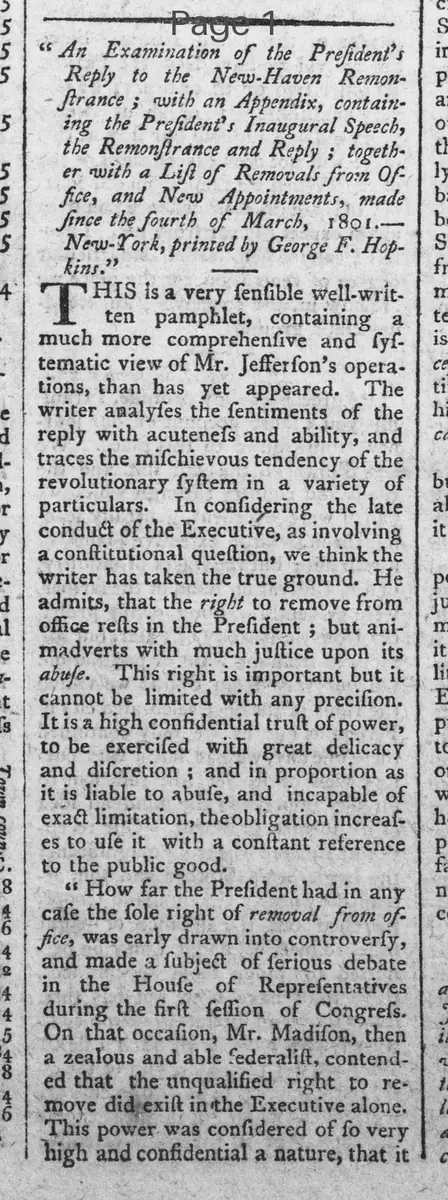
"An Examination of the President's Reply to the New-Haven Remonstrance; with an Appendix, containing the President's Inaugural Speech, the Remonstrance and Reply; together with a List of Removals from Office, and New Appointments, made since the fourth of March, 1801.--New-York, printed by George F. Hopkins."
THIS is a very sensible well-written pamphlet, containing a much more comprehensive and systematic view of Mr. Jefferson's operations, than has yet appeared. The writer analyses the sentiments of the reply with acuteness and ability, and traces the mischievous tendency of the revolutionary system in a variety of particulars. In considering the late conduct of the Executive, as involving a constitutional question, we think the writer has taken the true ground. He admits, that the right to remove from office rests in the President; but animadverts with much justice upon its abuse. This right is important but it cannot be limited with any precision. It is a high confidential trust of power, to be exercised with great delicacy and discretion; and in proportion as it is liable to abuse, and incapable of exact limitation, the obligation increases to use it with a constant reference to the public good.
"How far the President had in any case the sole right of removal from office, was early drawn into controversy, and made a subject of serious debate in the House of Representatives during the first session of Congress. On that occasion, Mr. Madison, then a zealous and able federalist, contended that the unqualified right to remove did exist in the Executive alone. This power was considered of so very high and confidential a nature, that it was not yielded without much objection and difficulty; but at length the construction advocated by Mr. Madison was adopted, and has ever since prevailed.
"Not so the power of appointment to office; the constitution has not left that a constructive power.
"The second article of the constitution vests in the President the right of appointing "officers of the United States, by and with the advice and consent of the Senate." Had the article stopped here, there could be no pretence that the President alone could in any case appoint to office. It was however foreseen, that vacancies might happen in the recess of the Senate, which the exigencies of the public would demand to be filled before that body could be convened, and consulted-Therefore in the same section it is provided, that "the President shall have power to fill up vacancies that may happen during the recess of the Senate, by granting commissions, which shall expire at the end of their next session."
The evident intent of this provision in the constitution is, the appointment to office shall be the joint act of the President and Senate; with the single exception, that in case of vacancies happening during the recess, the President alone may appoint.
"To provide for this casualty, so that the public service should not suffer, the clause was added, empowering the President alone to fill such vacancy. The terms employed in the constitution import casualty--And it is observable, that such a jealous solicitude was entertained respecting the exercise of this power; such apprehension, that it might possibly be made use of to create Executive influence, that it is immediately added, that all "commissions thus granted should expire at the end of the next session."
Appointments by the President alone, being thus predicated on casualty, and by way of exception to a general rule, it may be taken as a sound position, that the general rule should never give way but in cases which come fairly within the exception stated.
"Resignation and death are each plain instances of casualty; delinquency may also, without a forced construction, be added. These are the cases, in which public convenience requires the exercise of this extraordinary power of the President.
"But-for the Executive to undertake, voluntarily and deliberately, to create vacancies in the recess of the Senate, for the express purpose of filling them himself-for him thus to displace entire classes of officers, without any charge of delinquency, and without even a shadow of pretence that the public service required it; merely on the vague, speculative notion of balancing the emoluments of office between two contending political Sects, is not only a striking deviation from good sense and propriety, but a material departure both from the letter and spirit of the constitution. It is nothing short of converting the exception into the general rule. To justify this exercise of power, will drive him to a solecism--it is to create a casualty.
"It is therefore, emphatically an abuse of power; and inasmuch as it is also attended with individual injury, it is Tyranny.*
"But if the manner in which this power has lately been employed, be justifiable, then so far from its being made subservient to the public weal, it becomes an active instrument of political intolerance in the hands of the Executive, whenever he may be unprincipled enough to devote himself to the views of a faction. It will only be for the President, either to wait for a recess of the Senate before he thus creates a vacancy for the purpose of filling it up more to his satisfaction; or when circumstances will not admit of this delay, he may proceed to nominate, and, "by and with the advice and consent of the Senate" appoint, as usual.
*Besides, it may be observed, that even admitting the principle adopted by Mr. Jefferson to be correct, the practice upon it, as it respected the public service might-without materially affecting the end intended, has been delayed till the next regular meeting of the Senate, to be exercised according to the decision and provision of the constitution.
To appoint the officer they approve of and in the first moments of the recess, dismiss him, merely to substitute his favourite. Thus the controul which the constitution intended the Senate should have over appointments, should be in a great measure, if not entirely lost."
After some further remarks upon this subject, the writer asks—
"Is it in the spirit of the constitution and laws which he has sworn to support? With plain men, unaccustomed to the subtleties taught in the school of modern philosophy, it cannot fail of being considered a palpable violation of both.
"If such practice may be tolerated, it is in vain to attempt to guard against the encroachments of power by any form of language. Utterly in vain is it to attempt to frame written constitutions. They will only serve to conceal the chains with which an ambitious despot may manacle our liberties whenever it suits his humour.
"It is easy to resist the open force of an enemy, but against those insidious attacks, where the hand is concealed while it strikes, neither prudence nor courage can avail.
"Those who have placed Mr. Jefferson in office, have been uniformly clamorous against ideal innovations upon the constitution. Scarcely an act of the government out of the ordinary course of business, that has not been declared by them to be unconstitutional. But on a sudden they make a bountiful display of regard and veneration for an instrument, which, before its adoption, they did every thing in their power to vilify, and the administration of which they have left no effort untried to calumniate. The moment they fancy themselves masters of the "honours and confidence" of the people, all is safe and secure; power in their hands loses its terrors, and the apprehension of its abuse is lulled to sleep. The man of the people may trample upon private rights at pleasure; invade the sacred provisions of the constitution; insult and disfranchise one half of the community; yet all this can be endured without a single murmur from these fierce Republicans.
"We have also of late years been often entertained with invectives against Executive patronage; it has been a theme on which the patriotic orators of the day have exultingly declaimed. How much is it to be lamented, that they have already exhausted their rhetoric on an imaginary grievance, whilst the reality is suffered quietly to pass without notice or observation! If they could have restrained their declamatory fervour to the present period they would have found in a few short months abundant materials on which to employ their eloquence, strengthened and supported by truth. But this is not the purpose for which their talents are called into action; they startle at its approach—they vanish at its touch."
THIS is a very sensible well-written pamphlet, containing a much more comprehensive and systematic view of Mr. Jefferson's operations, than has yet appeared. The writer analyses the sentiments of the reply with acuteness and ability, and traces the mischievous tendency of the revolutionary system in a variety of particulars. In considering the late conduct of the Executive, as involving a constitutional question, we think the writer has taken the true ground. He admits, that the right to remove from office rests in the President; but animadverts with much justice upon its abuse. This right is important but it cannot be limited with any precision. It is a high confidential trust of power, to be exercised with great delicacy and discretion; and in proportion as it is liable to abuse, and incapable of exact limitation, the obligation increases to use it with a constant reference to the public good.
"How far the President had in any case the sole right of removal from office, was early drawn into controversy, and made a subject of serious debate in the House of Representatives during the first session of Congress. On that occasion, Mr. Madison, then a zealous and able federalist, contended that the unqualified right to remove did exist in the Executive alone. This power was considered of so very high and confidential a nature, that it was not yielded without much objection and difficulty; but at length the construction advocated by Mr. Madison was adopted, and has ever since prevailed.
"Not so the power of appointment to office; the constitution has not left that a constructive power.
"The second article of the constitution vests in the President the right of appointing "officers of the United States, by and with the advice and consent of the Senate." Had the article stopped here, there could be no pretence that the President alone could in any case appoint to office. It was however foreseen, that vacancies might happen in the recess of the Senate, which the exigencies of the public would demand to be filled before that body could be convened, and consulted-Therefore in the same section it is provided, that "the President shall have power to fill up vacancies that may happen during the recess of the Senate, by granting commissions, which shall expire at the end of their next session."
The evident intent of this provision in the constitution is, the appointment to office shall be the joint act of the President and Senate; with the single exception, that in case of vacancies happening during the recess, the President alone may appoint.
"To provide for this casualty, so that the public service should not suffer, the clause was added, empowering the President alone to fill such vacancy. The terms employed in the constitution import casualty--And it is observable, that such a jealous solicitude was entertained respecting the exercise of this power; such apprehension, that it might possibly be made use of to create Executive influence, that it is immediately added, that all "commissions thus granted should expire at the end of the next session."
Appointments by the President alone, being thus predicated on casualty, and by way of exception to a general rule, it may be taken as a sound position, that the general rule should never give way but in cases which come fairly within the exception stated.
"Resignation and death are each plain instances of casualty; delinquency may also, without a forced construction, be added. These are the cases, in which public convenience requires the exercise of this extraordinary power of the President.
"But-for the Executive to undertake, voluntarily and deliberately, to create vacancies in the recess of the Senate, for the express purpose of filling them himself-for him thus to displace entire classes of officers, without any charge of delinquency, and without even a shadow of pretence that the public service required it; merely on the vague, speculative notion of balancing the emoluments of office between two contending political Sects, is not only a striking deviation from good sense and propriety, but a material departure both from the letter and spirit of the constitution. It is nothing short of converting the exception into the general rule. To justify this exercise of power, will drive him to a solecism--it is to create a casualty.
"It is therefore, emphatically an abuse of power; and inasmuch as it is also attended with individual injury, it is Tyranny.*
"But if the manner in which this power has lately been employed, be justifiable, then so far from its being made subservient to the public weal, it becomes an active instrument of political intolerance in the hands of the Executive, whenever he may be unprincipled enough to devote himself to the views of a faction. It will only be for the President, either to wait for a recess of the Senate before he thus creates a vacancy for the purpose of filling it up more to his satisfaction; or when circumstances will not admit of this delay, he may proceed to nominate, and, "by and with the advice and consent of the Senate" appoint, as usual.
*Besides, it may be observed, that even admitting the principle adopted by Mr. Jefferson to be correct, the practice upon it, as it respected the public service might-without materially affecting the end intended, has been delayed till the next regular meeting of the Senate, to be exercised according to the decision and provision of the constitution.
To appoint the officer they approve of and in the first moments of the recess, dismiss him, merely to substitute his favourite. Thus the controul which the constitution intended the Senate should have over appointments, should be in a great measure, if not entirely lost."
After some further remarks upon this subject, the writer asks—
"Is it in the spirit of the constitution and laws which he has sworn to support? With plain men, unaccustomed to the subtleties taught in the school of modern philosophy, it cannot fail of being considered a palpable violation of both.
"If such practice may be tolerated, it is in vain to attempt to guard against the encroachments of power by any form of language. Utterly in vain is it to attempt to frame written constitutions. They will only serve to conceal the chains with which an ambitious despot may manacle our liberties whenever it suits his humour.
"It is easy to resist the open force of an enemy, but against those insidious attacks, where the hand is concealed while it strikes, neither prudence nor courage can avail.
"Those who have placed Mr. Jefferson in office, have been uniformly clamorous against ideal innovations upon the constitution. Scarcely an act of the government out of the ordinary course of business, that has not been declared by them to be unconstitutional. But on a sudden they make a bountiful display of regard and veneration for an instrument, which, before its adoption, they did every thing in their power to vilify, and the administration of which they have left no effort untried to calumniate. The moment they fancy themselves masters of the "honours and confidence" of the people, all is safe and secure; power in their hands loses its terrors, and the apprehension of its abuse is lulled to sleep. The man of the people may trample upon private rights at pleasure; invade the sacred provisions of the constitution; insult and disfranchise one half of the community; yet all this can be endured without a single murmur from these fierce Republicans.
"We have also of late years been often entertained with invectives against Executive patronage; it has been a theme on which the patriotic orators of the day have exultingly declaimed. How much is it to be lamented, that they have already exhausted their rhetoric on an imaginary grievance, whilst the reality is suffered quietly to pass without notice or observation! If they could have restrained their declamatory fervour to the present period they would have found in a few short months abundant materials on which to employ their eloquence, strengthened and supported by truth. But this is not the purpose for which their talents are called into action; they startle at its approach—they vanish at its touch."
What sub-type of article is it?
Constitutional
Partisan Politics
What keywords are associated?
Jefferson Removals
Executive Power
Constitutional Appointments
Political Patronage
Senate Consent
What entities or persons were involved?
President Jefferson
Mr. Madison
Senate
New Haven Remonstrance
Editorial Details
Primary Topic
Critique Of Jefferson's Executive Removals And Appointments
Stance / Tone
Critical Of Executive Power Abuse
Key Figures
President Jefferson
Mr. Madison
Senate
New Haven Remonstrance
Key Arguments
The Right To Remove From Office Exists In The President But Must Be Exercised With Discretion For The Public Good
Appointments Require The Advice And Consent Of The Senate Except For Recess Vacancies
Jefferson's Creation Of Vacancies During Senate Recess To Appoint Favorites Deviates From Constitutional Intent
Such Practices Convert Exceptions Into General Rules And Constitute An Abuse Of Power
This Enables Political Intolerance And Undermines Senate Control Over Appointments