Thank you for visiting SNEWPapers!
Sign up free
Editorial
November 23, 1836
Morning Star
Limerick, York County, Maine
What is this article about?
An 1836 editorial from Dover discusses the Lord's Supper, its various names and spiritual significance, the refreshing effects on believers, and criticizes infrequent administration in some churches. It advocates for more regular communion, ideally monthly where preaching is settled, and calls for quarterly meetings to aid destitute churches.
Clipping
OCR Quality
95%
Excellent
Full Text
118
DOVER:
WEDNESDAY, NOVEMBER 23, 1836
The Lord's Supper:
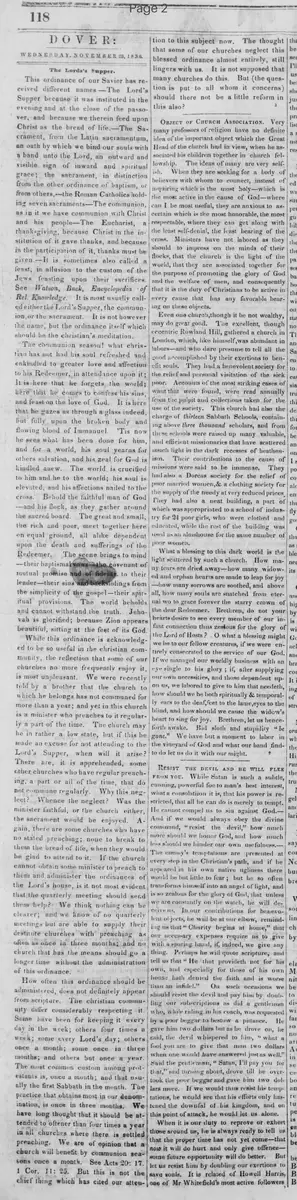
This ordinance of our Savior has received different names—The Lord's Supper because it was instituted in the evening and at the close of the passover, and because we therein feed upon Christ as the bread of life.—The Sacrament, from the Latin sacramentum, an oath by which we bind our souls with a band unto the Lord, an outward and visible sign of inward and spiritual grace; the sacrament, in distinction from the other ordinance of baptism, or from others,—the Roman Catholies holding seven sacraments—The communion, as in it we have communion with Christ and his people—The Eucharist, a thanksgiving, because Christ in the institution of it gave thanks, and because in the participation of it, thanks must be given.—It is sometimes also called a feast, in allusion to the custom of the Jews feasting upon their sacrifices. See Watson, Buck, Encyclopedia of Rel. Knowledge. It is most usually called either the Lord's Supper, the communion, or the sacrament. It is not however the name, but the ordinance itself which should be the christian's meditation.
The communion season! what christian has not had his soul refreshed and enkindled to greater love and affection to his Redeemer, in attendance upon it; It is here that he forgets the world; here that he comes to confess his sins, and feast on the love of God. It is here that he gazes as through a glass indeed, but fully upon the broken body and flowing blood of Immanuel. 'Tis now he sees what has been done for him, and for a world, his soul yearns for others salvation, and his zeal for God is kindled anew. The world is crucified to him and he to the world; his soul is elevated, and his affections nailed to the cross. Behold the faithful man of God—and his flock, as they gather around the sacred board. The great and small, the rich and poor, meet together here on equal ground, all alike dependent upon the death and sufferings of the Redeemer. The scene brings to mind—their baptismal vows the covenant of mutual promise and of fidelity to their leader—their sins and backslidings from the simplicity of the gospel—their spiritual provisions. The world beholds and cannot withstand the truth. Jehovah is glorified; because Zion appears beautiful, sitting at the feet of its God.
While this ordinance is acknowledged to be so useful in the christian community, the reflection that some of our churches no more frequently enjoy it, is most unpleasant. We were recently told by a brother that the church to which he belongs has not communed for more than a year; and yet in this church is a minister who preaches to it regularly a part of the time. The church may be in rather a low state, but if this be made an excuse for not attending to the Lord's Supper, when will it arise? There are, it is apprehended, some other churches who have regular preaching, a part or all of the time, that do not commune regularly. Why this neglect? Whence the neglect? Was the minister faithful, or the church either, the sacrament would be enjoyed. Again, there are some churches who have no stated preaching; none to break to them the bread of life, when they would be glad to attend to it. If the church cannot obtain some minister to preach to them and administer the ordinances of the Lord's house, is it not most evident that the quarterly meeting should send them help? We think nothing can be clearer; and we know of no quarterly meetings but are able to supply their destitute churches with preaching as often as once in three months; and no church that has the means should go a longer time without the administration of this ordinance.
How often this ordinance should be administered, does not definitely appear from scripture. The christian community differ considerably respecting it. Some have been for keeping it every day in the week; others four times a week; some every Lord's day; others once a month; some once in three months; and others but once a year. The most common custom among protestants is, once a month; and that usually the first Sabbath in the month. The practice that obtains most in our denomination, is once in three months. We have long thought that it should be attended to oftener than our times a year in all churches where there is settled preaching. We are of opinion that a church will benefit by communion seasons once a month. See Acts 20: 7. 1 Cor. 11: 26. But this is not the chief thing which has cited our attention to this subject now. The thought that some of our churches neglect this blessed ordinance almost entirely, still lingers with us. It is not supposed that many churches do this. But (the question is put to all whom it concerns) should there not be a little reform in this also?
DOVER:
WEDNESDAY, NOVEMBER 23, 1836
The Lord's Supper:
This ordinance of our Savior has received different names—The Lord's Supper because it was instituted in the evening and at the close of the passover, and because we therein feed upon Christ as the bread of life.—The Sacrament, from the Latin sacramentum, an oath by which we bind our souls with a band unto the Lord, an outward and visible sign of inward and spiritual grace; the sacrament, in distinction from the other ordinance of baptism, or from others,—the Roman Catholies holding seven sacraments—The communion, as in it we have communion with Christ and his people—The Eucharist, a thanksgiving, because Christ in the institution of it gave thanks, and because in the participation of it, thanks must be given.—It is sometimes also called a feast, in allusion to the custom of the Jews feasting upon their sacrifices. See Watson, Buck, Encyclopedia of Rel. Knowledge. It is most usually called either the Lord's Supper, the communion, or the sacrament. It is not however the name, but the ordinance itself which should be the christian's meditation.
The communion season! what christian has not had his soul refreshed and enkindled to greater love and affection to his Redeemer, in attendance upon it; It is here that he forgets the world; here that he comes to confess his sins, and feast on the love of God. It is here that he gazes as through a glass indeed, but fully upon the broken body and flowing blood of Immanuel. 'Tis now he sees what has been done for him, and for a world, his soul yearns for others salvation, and his zeal for God is kindled anew. The world is crucified to him and he to the world; his soul is elevated, and his affections nailed to the cross. Behold the faithful man of God—and his flock, as they gather around the sacred board. The great and small, the rich and poor, meet together here on equal ground, all alike dependent upon the death and sufferings of the Redeemer. The scene brings to mind—their baptismal vows the covenant of mutual promise and of fidelity to their leader—their sins and backslidings from the simplicity of the gospel—their spiritual provisions. The world beholds and cannot withstand the truth. Jehovah is glorified; because Zion appears beautiful, sitting at the feet of its God.
While this ordinance is acknowledged to be so useful in the christian community, the reflection that some of our churches no more frequently enjoy it, is most unpleasant. We were recently told by a brother that the church to which he belongs has not communed for more than a year; and yet in this church is a minister who preaches to it regularly a part of the time. The church may be in rather a low state, but if this be made an excuse for not attending to the Lord's Supper, when will it arise? There are, it is apprehended, some other churches who have regular preaching, a part or all of the time, that do not commune regularly. Why this neglect? Whence the neglect? Was the minister faithful, or the church either, the sacrament would be enjoyed. Again, there are some churches who have no stated preaching; none to break to them the bread of life, when they would be glad to attend to it. If the church cannot obtain some minister to preach to them and administer the ordinances of the Lord's house, is it not most evident that the quarterly meeting should send them help? We think nothing can be clearer; and we know of no quarterly meetings but are able to supply their destitute churches with preaching as often as once in three months; and no church that has the means should go a longer time without the administration of this ordinance.
How often this ordinance should be administered, does not definitely appear from scripture. The christian community differ considerably respecting it. Some have been for keeping it every day in the week; others four times a week; some every Lord's day; others once a month; some once in three months; and others but once a year. The most common custom among protestants is, once a month; and that usually the first Sabbath in the month. The practice that obtains most in our denomination, is once in three months. We have long thought that it should be attended to oftener than our times a year in all churches where there is settled preaching. We are of opinion that a church will benefit by communion seasons once a month. See Acts 20: 7. 1 Cor. 11: 26. But this is not the chief thing which has cited our attention to this subject now. The thought that some of our churches neglect this blessed ordinance almost entirely, still lingers with us. It is not supposed that many churches do this. But (the question is put to all whom it concerns) should there not be a little reform in this also?
What sub-type of article is it?
Moral Or Religious
Social Reform
What keywords are associated?
Lord's Supper
Communion
Sacrament
Church Neglect
Religious Ordinance
Communion Frequency
Moral Reform
What entities or persons were involved?
Churches
Ministers
Quarterly Meetings
Protestants
Roman Catholics
Editorial Details
Primary Topic
Importance And Frequency Of The Lord's Supper In Churches
Stance / Tone
Advocacy For Regular Administration And Reform Against Neglect
Key Figures
Churches
Ministers
Quarterly Meetings
Protestants
Roman Catholics
Key Arguments
The Lord's Supper Has Multiple Names Reflecting Its Significance: Lord's Supper, Sacrament, Communion, Eucharist.
Attendance Refreshes The Soul, Fosters Love For Christ, And Unites Believers Regardless Of Status.
Neglect Of The Ordinance In Some Churches With Preaching Is Unacceptable And Hinders Spiritual Growth.
Destitute Churches Without Preaching Should Receive Help From Quarterly Meetings At Least Quarterly.
Scripture Does Not Specify Frequency, But Monthly Communion Is Beneficial Where Preaching Is Settled.
Calls For Reform To Ensure More Frequent Administration Across Denominations.