Thank you for visiting SNEWPapers!
Sign up free
Virginia Argus
Richmond, Virginia
What is this article about?
On September 24, 1798, a large meeting in Orange County, Virginia, adopts and sends a resolution to the state General Assembly protesting federal government overreach, including the unconstitutional Alien and Sedition Acts, excessive taxation, military buildup, and potential alliance with Britain against France, urging defense of constitutional liberties.
Merged-components note: Continuation of the Orange county meeting address and resolutions, relabeled from domestic_news to editorial as it is an opinion piece on political matters.
Clippings
1 of 2
OCR Quality
Full Text
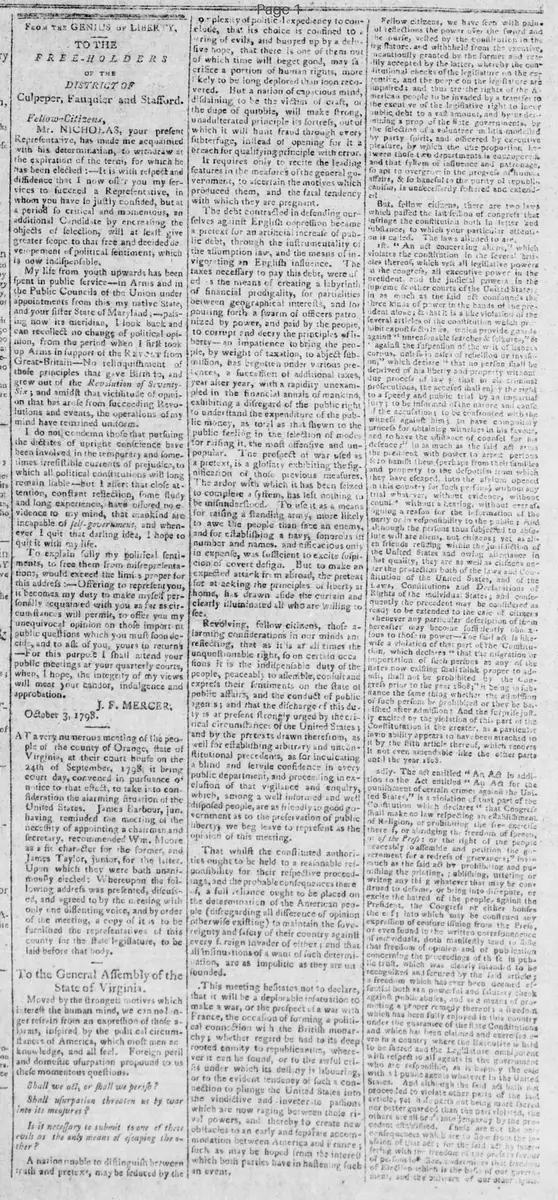
To the General Assembly of the State of Virginia.
Moved by the strongest motives which interest the human mind, we can no longer refrain from an expression of those alarms, inspired by the political circumstances of America, which most men acknowledge, and all feel. Foreign peril and domestic usurpation propound to us these momentous questions.
Shall we act, or shall we perish?
Shall usurpation frighten us by war into its measures?
Is it necessary to submit to one of these evils as the only means of escaping the other?
A nation unable to distinguish between truth and pretext, may be seduced by the perplexity of politic expediency to conclude, that its choice is confined to a ring of evils, and buoyed up by a delusive hope, that there is one of them out of which time will beget good, may sacrifice a portion of human rights, more likely to be long deplored than soon recovered. But a nation of capacious mind, disdaining to be the victim of craft, or the dupe of quibble, will make strong, unadulterated principle its fortress, out of which it will hunt fraud through every subterfuge, instead of opening for it a breach for qualifying principle with error. It requires only to recite the leading features in the measures of the general government, to ascertain the motives which produced them, and the fatal tendency with which they are pregnant.
The debt contracted in defending ourselves against English oppression became a pretext for an artificial increase of public debt, through the instrumentality of the assumption law, and the means of invigorating an English influence. The taxes necessary to pay this debt, were used as the means of creating a labyrinth of financial prodigality, for partialities between geographical interests, and for pouring forth a swarm of officers patronized by power, and paid by the people, to corrupt and decry the principles of liberty--an impatience to bring the people, by weight of taxation, to abject submission, has begotten under various pretences, a succession of additional taxes, year after year, with a rapidity unexampled in the financial annals of mankind, exhibiting a disregard of the public right to understand the expenditure of the public money, as total as that shewn to the public feeling in the selection of modes for raising it, the most offensive and unpopular. The prospect of war used as a pretext, is a glossary exhibiting the signification of those previous measures. The ardor with which it has been seized to complete a system, has left nothing to be misunderstood. To use it as a means for raising a standing army, more likely to awe the people than save an enemy, and for establishing a navy, sonorous in number and names, and efficacious only in expense, was sufficient to excite suspicion of covert design. But to make an expected attack from abroad, the pretext for attacking the principles of liberty at home, has drawn aside the curtain and clearly illuminated all who are willing to see.
Revolving, fellow citizens, those alarming considerations in our minds and respecting, that as it is at all times the unquestionable right, so on certain occasions it is the indispensable duty of the people, peaceably to assemble, consult and express their sentiments on the state of public affairs, and the conduct of public agents; and that the discharge of this duty is at present strongly urged by the critical circumstances of the United States; and by the pretexts drawn therefrom, as well for establishing arbitrary and unconstitutional precedents, as for inculcating a blind and servile confidence in every public department, and proceeding in exclusion of that vigilance and enquiry, which, among a well informed and well disposed people, are as friendly to good government as to the preservation of public liberty; we beg leave to represent as the opinion of this meeting.
That whilst the constituted authorities ought to be held to a reasonable responsibility for their respective proceedings, and the probable consequences thereof, a full reliance ought to be placed on the determination of the American people (disregarding all difference of opinion otherwise existing) to maintain the sovereignty and safety of their country against every foreign invader of either; and that all insinuations of a want of such determination, are as impolitic as they are unfounded.
This meeting hesitates not to declare, that it will be a deplorable infatuation to make a war, or the prospect of a war with France, the occasion of forming a political connection with the British monarchy; whether regard be had to its deep rooted enmity to republicanism, wherever it can be found, or to the awful crisis under which its destiny is labouring, or to the evident tendency of such a connection to plunge the United States into the vindictive and inveterate hostilities which are now raging between those rival powers, and thereby to create new obstacles to an early and separate accommodation between America and France; such as may be hoped from the interest which both parties have in hastening such an event.
Fellow citizens, we have seen with painful reflections the power over the sword and the purse, vested by the Constitution in the legislature, and withheld from the executive, cautiously granted by the former and readily accepted by the latter, whereby the constitutional checks of the legislature on the executive, and the people on the legislature are impaired: and thus are the rights of the American people to be invaded by a transfer to the executive of the legislative right to incur public debt to a vast amount, and by undermining a prop of the state governments, by the selection of a volunteer militia-modelled by party spirit, and officered by executive pleasure, by which the due proportion between those two departments is endangered and that system of influence and patronage, so apt to overgrow in the progress of human affairs, & so baneful to the purity of republicanism, is unnecessarily fostered and extended.
But, fellow citizens, there are two laws which passed the last session of congress that infringe the constitution both in letter and substance, to which your particular attention is called. The laws alluded to are.
1st. "An act concerning aliens," which violates the constitution in these several articles thereof, which vest all legislative powers in the congress, all executive power in the president, and the judicial powers in the supreme & other courts of the United States, in as much as the said act confounds the three kinds of power in the hands of the president alone: & that it is a like violation of the several articles of the constitution which prohibit ex post facto laws, which provide guard against "unreasonable searches & seizures," & against the suspension of the writ of habeas corpus, unless in cases of rebellion or invasion," which declare "that no person shall be deprived of his liberty and property without due process of law; that in all criminal prosecutions, the accused shall enjoy the right to a speedy and public trial by an impartial jury; to be informed of the nature and cause of the accusation; to be confronted with the witnesses against him; to have compulsory process for obtaining witnesses in his favour, and to have the assistance of counsel for his defence:" in as much as the said act arms the president with power to arrest persons & to banish them (perhaps from their families and property to the despotism from which they have escaped, into the asylum opened in this country for such persons) without any trial whatever, without evidence, without counsel, without a hearing, without even assuming a reason for the information of the party or in responsibility to the public; And although the persons thus subjected to absolute will are aliens, yet as alien friends residing within the jurisdiction of the United States and owing allegiance in that quality, they are as well as citizens under the protection both of the laws and Constitution of the United States, and of the Laws, Constitutions and Declarations of Rights of the individual States: and consequently the precedent may be considered as ready to be extended to the case of citizens whenever any particular description of them hereafter may become sufficiently obnoxious to those in power--The said act is likewise a violation of that part of the Constitution, which declares "that the migration or importation of such persons as any of the States now existing shall think proper to admit, shall not be prohibited by the Congress prior to the year 1808;" it being in substance the same thing whether the admission of such persons be prohibited or they be banished after admission: And the surprise justly excited by the violation of this part of the Constitution is the greater, as a particular inviolability appears to have been attached to it by the fifth article thereof, which renders it not even amendable -like the other parts until the year 1808.
2dly. The act entitled "An Act in addition to the act entitled "An Act for the punishment of certain crimes against the United States," is a violation of that part of the Constitution which declares "that Congress shall make no law respecting an establishment of Religion, or prohibiting the free exercise thereof, or abridging the freedom of speech, or of the Press; or the right of the people peaceably to assemble and petition the government for a redress of grievances;" in as much as the said act by prohibiting and punishing the printing, publishing, uttering or writing any thing whatever that may be construed to defame, or bring into disrepute, or excite the hatred of the people, against the President, the Congress or either house thereof; into which may be construed any expression of censure issuing from the Press, or even found in the written correspondence of individuals, doth manifestly tend to stifle that freedom of opinion and of publication concerning the proceedings of those in public trust, which was clearly intended to be recognized and secured by the said articles; a freedom which has ever been deemed essential both as a universal and salutary check against public abuses, and as a means of promoting a proper remedy therefor: a freedom which has been fully enjoyed in this country under the guarantee of the state Constitutions and which has been claimed and exercised even in a country where the Executive is held to be sacred and the Legislature omnipotent with respect to all agents in the government who are responsible, as is happily the case with all public agents whatever in the United States. And although the said act has not proceeded to violate other parts of the said first article, yet those parts not being more sacred nor better guarded than the part violated, the others are all or any in jeopardy by the precedent sacrificed. These are not the only consequences which are to arise from the introduction of that act: for the said act by interfering with the freedom of the press, will undermine that freedom of Election which is the basis of our government, and the bulwark of our other rights. For if the fear of personal abuse actually in public be permitted to be sufficient every day vest on their conduct and characters which cannot be formally proven in a court of Justice, whilst it is open for all the customary liberties taken against the cause are & peace testimonies of other Candidates: if the dread of public profession is too weak, the efforts of the friends of the latter, whilst the friends of the former are not subjected a like danger, there is an end of all effectual reproof. Briefly in public Agents to their principal, that is an end to that fair scope to the choice of the People, which is to decide between rival claims to their confidence: there is an end of that free and equal conduct of elections which constitutes their value and can alone preserve an attachment to them. And there is one great step taken towards the independence and self confidence in office against which the Constitution has anxiously provided! Our alarms, Fellow Citizens, are greatly heightened when we reflect that the establishment of those arbitrary precedents are in the face of a Constitution, framed from the Sovereignty of the People, and by men chosen by the People to execute that Constitution, and when too no foreign invasion excited or could be immediately apprehended, and that no rebellion or insurrection or danger thereof could be pretended; when on the contrary the laws had their full & quiet operation, the great mass of the people had everywhere given conspicuous proofs of their alacrity in supporting the constitution and enforcing the laws. These considerations we think should inspire every good citizen with deep affection and a stain on the American character and Republican cause and moreover with the be foundation alarm, attending to break down the ramparts provided for limiting the powers of the Federal Government, for defending those reserved to the individual states, and for securing the rights unalienated by the People; and finally to disorganize the whole system of order and liberty established by the Constitution.
We cannot avoid taking notice of the solicitude which marks the measures of which we complain to, shield the members of the general government against the censure of the press, and the indifference which has been shown to daily publications, endeavoring to defame the people themselves, and to bring into disrepute the Constitution of the United States by calumniating the republican principles on which it is founded, and by extravagant orations on the superior excellences of a foreign government comprehending hereditary orders.
Fellow-citizens, conceive it would be a criminal weakness, and false patriotism to be lulled into silent acquiescence under the most alarming infractions of the great palladium of public liberty, by exertions drawn from existing emergencies; it being undeniable that the Constitution has itself made ample provision for greater emergencies than have happened, or are likely to happen, and it would be an unmerited reflection on it to allege the contrary; it being well known, also that the times of danger and alarm have ever been the seasons in which precedents ensnaring to the liberties of the people have taken their rise, and consequently it is the duty of the people during such times to combine with a becoming ardor in defence of their country, a steady regard to the safety of its free constitution; and it being certain that in proportion as the people can be rendered indifferent to encroachments on their rights as individuals, they must lose the spirit and interest they ought to feel, in vindicating their rights and sovereignties as a nation. We, Fellow-Citizens, in contemplating the black catalogue of public grievances, find some consolation in a hope that the sentiments expressed by this meeting are in harmony with those entertained by their fellow-citizens in general, and that the disunion is really round the constitution with their voices united against every invasion of it, will equal that honorable zeal, which they every where evince to fly with their arms to the standard of this country the moment a foreign enemy may render it necessary. To your wisdom, Representatives of the People, we refer these observations, relying that you will take care of the Commonwealth, and pledging ourselves to support as far as we are able such remedial measures as are just and temperate, and which in your wisdom you may adopt.
WILLIAM MOORE, Chairman.
Test,
JAMES TAYLOR, Jun. Sec'ry.
What sub-type of article is it?
What keywords are associated?
What entities or persons were involved?
Editorial Details
Primary Topic
Protest Against Alien And Sedition Acts And Federal Overreach
Stance / Tone
Strong Opposition To Unconstitutional Federal Measures And Alliances
Key Figures
Key Arguments
- federal debt and taxes used to increase english influence and corruption
- prospect of war pretext for standing army and navy to control people
- opposition to political connection with britain against france
- alien act violates separation of powers, due process, and rights of aliens
- sedition act abridges freedom of speech, press, and assembly
- these acts set dangerous precedents undermining elections and republicanism
- people must vigilantly defend constitution against encroachments