Thank you for visiting SNEWPapers!
Sign up free
The Home Journal
Winchester, Franklin County, Tennessee
What is this article about?
A journalist from Winchester, attending the Tennessee Press Association in Cincinnati, praises the city's hospitality and contrasts it with Louisville's. He critiques strict Sunday laws and religious bigotry, lauds the efficient City Work House, and discusses Democratic hopes for 1872 with George H. Pendleton as a strong candidate against Ulysses S. Grant.
Clipping
OCR Quality
Full Text
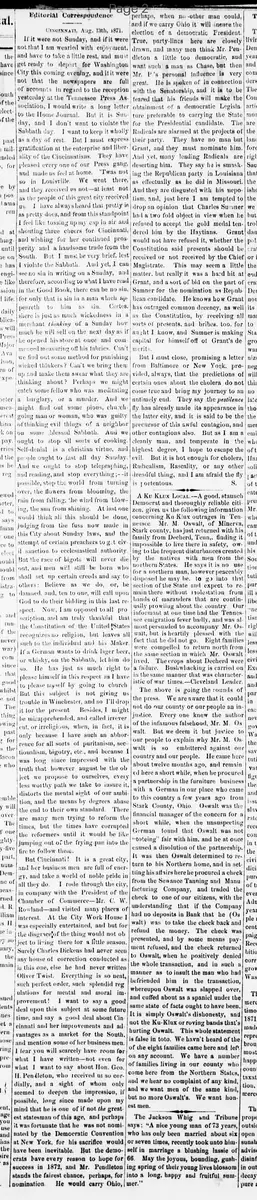
If it were not Sunday, and if it were not that I am wearied with enjoyment, and have to take a little rest, and must get ready to depart for Washington City this coming evening, and if it were not that the newspapers are full of accounts in regard to the reception yesterday at the Tennessee Press Association, I would write a long letter to the Home Journal. But it is Sunday, and I don't want to violate the Sabbath day. I want to keep it wholly as a day of rest. But I must express gratification at the enterprise and liberality of the Cincinnatians. They have pleased every one of our Press gang, and made us feel at home. 'Twas not so in Louisville. We went there, and they received us not--at least not as the people of this great city received us. I have always heard that pretty is as pretty does, and from this standpoint I feel like tossing up my cap in air and shouting three cheers for Cincinnati, and wishing for her continued prosperity and a handsome trade from the South. But I must be very brief, lest I violate the Sabbath. And yet, I can see no sin in writing on a Sunday, and therefore, according to what I have read in the Good Book, there can be no sin, for only that is sin in a man which appeareth to him as sin. Certes, there is just as much wickedness in a merchant thinking of a Sunday how much he will sell on the next day as if he opened his store at once and commenced measuring off his fabrics. Can't we find out some method for punishing wicked thinkers? Can't we bring them up and make them swear what they are thinking about? Perhaps we might catch some fellow who was meditating a burglary, or a murder. And we might find out some pious, church-going man or woman, who was guilty of thinking evil things of a neighbor on some blessed Sabbath. And we ought to stop all sorts of cooking. Self-denial is a Christian virtue, and people ought to fast all day Sunday. And we ought to stop telegraphing, and reading, and stop everything;--if possible, stop the world from turning over, the flowers from blooming, the rain from falling, the wind from blowing, the sun from shining. At last one would think all this should be done, judging from the fuss now made in this City about Sunday laws, and the attempt of certain preachers to get civil sanction to ecclesiastical authority. But the race of bigots will never die out, and men will still be born who shall set up certain creeds and say to others: Believe as we do, or, be damned, and, ten to one, will call upon God to do their bidding in this last respect. Now, I am opposed to all proscription, and am truly thankful that the Constitution of the United States recognizes no religion, but leaves all such to the individual and his Maker. If a German wants to drink lager beer, or whisky, on the Sabbath, let him do so. He has just as much right to please himself in this respect as I have to please myself by going to church. But this subject is not giving us trouble in Winchester, and so I'll drop it for the present. Besides, I might be misapprehended, and called irreverent, or irreligious, when, in fact, it is only because I have such an abhorrence for all sorts of puritanism, sectionalism, bigotry, etc., and because I was long since impressed with the truth that however august be the object we propose to ourselves, every less worthy path we take to insure it distorts the mental sight of our ambition, and the means by degrees abase the end to their own standard. There are many men trying to reform the times, but the times have corrupted the reformers until it would be like jumping out of the frying-pan into the fire to follow them.
But Cincinnati! It is a great city, and her business men are full of energy, and take a world of noble pride in all they do. I rode through the city, in company with the President of the Chamber of Commerce--Mr. C. W. Rowland--and visited many places of interest. At the City Work House I was especially entertained, and but for the disgrace of the thing would not object to living there for a little season. Surely Charles Dickens had never seen any house of correction conducted as is this one, else he had never written Oliver Twist. Everything is so neat, such perfect order, such splendid regulations for mental and moral improvement!
I want to say a good deal upon this subject at some future time, and say a good deal about Cincinnati and her improvements and advantages as a market for the South, and mention some of her business men. I fear you will scarcely have room for what I have written--not even for what I want to say about Hon. Geo. H. Pendleton, who received us so cordially, and a sight of whom only seemed to deepen the impression, if possible, long since made upon my mind that he is one of if not the greatest statesman of this age, and perhaps it was fortunate that he was not nominated by the Democratic Convention at New York, for his sacrifice would have been inevitable. But the democrats have every reason to hope for success in 1872, and Mr. Pendleton stands the fairest chance, perhaps, for nomination. He would carry Ohio, perhaps, when no other man could, and if we carry Ohio it will insure the election of a democratic President. True, party-lines here are closely drawn, and many men think Mr. Pendleton a little too democratic, and want such a man as Chase, but then Mr. P's personal influence is very great. He is spoken of in connection with the Senatorship, and it is to be feared that his friends will make the obtainment of a democratic Legislature preferable to carrying the State for the Presidential candidate. The Radicals are alarmed at the prospects of their party. They have no man but Grant, and they must nominate him. And yet, many leading Radicals are deserting him. They say he is smashing the Republican party in Louisiana as effectually as he did in Missouri. And they are disgusted with his nepotism, and, just here I am tempted to drop an opinion that Charles Sumner had a two fold object in view when he refused to accept the gold medal tendered him by the Haytians. Grant would not have refused it, whether the Constitution said presents should be received or not received by the Chief Magistrate. This may seem a little matter, but really it was a hard hit at Grant, and a sort of bid on the part of Sumner for the nomination as Republican candidate. He knows how Grant has outraged common decency, as well as the Constitution, by receiving all sorts of presents, and bribes, too, for aught I know, and Sumner is making capital for himself off of Grant's demerits.
But I must close, promising a letter from Baltimore or New York, provided, always, that the predictions of certain ones about the cholera do not come true and bring my journey to an untimely end. They say the pestilence fly has already made its appearance in the latter city, and it is said to be the precursor of this awful contagion, and other contagions also. But as I am a cleanly man, and temperate in the highest degree, I hope to escape the evil. But it is hot enough for cholera, Radicalism, Rascality, or any other dreadful thing, and I am afraid the fly is portentous.
S.
What sub-type of article is it?
What themes does it cover?
What keywords are associated?
What entities or persons were involved?
Letter to Editor Details
Author
S.
Recipient
Home Journal
Main Argument
the writer praises cincinnati's hospitality and progressive institutions while satirically critiquing religious bigotry and sunday laws, and advocates for george h. pendleton as the democratic presidential candidate in 1872 to defeat ulysses s. grant.
Notable Details