Thank you for visiting SNEWPapers!
Sign up free
Editorial
August 29, 1842
The Daily Madisonian
Washington, District Of Columbia
What is this article about?
Editorial from Journal of Commerce criticizes congressional refusal to compromise on tariff bill due to 'principle' against President Tyler's veto, calling it willful stubbornness. Argues veto is constitutional, urges settlement to end uncertainty, warns of public demand for resolution amid Whig-Locofoco tensions.
Clipping
OCR Quality
95%
Excellent
Full Text
From the Journal of Commerce.
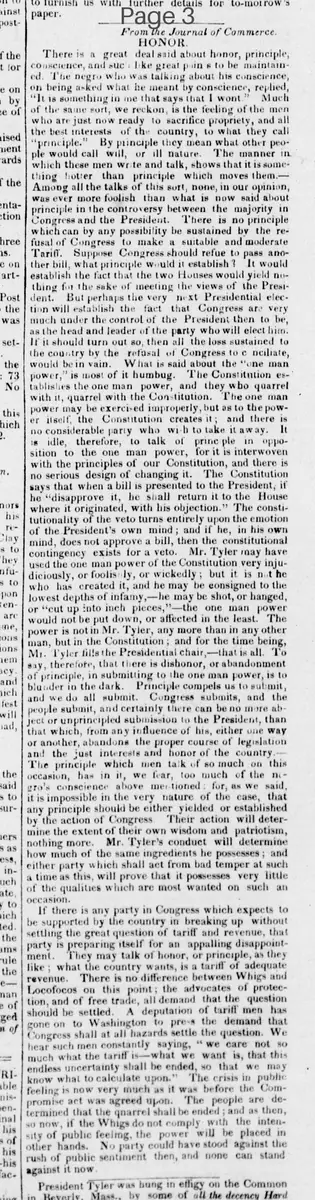
HONOR.
There is a great deal said about honor, principle conscience, and such like great points to be maintained. The negro who was talking about his conscience, on being asked what he meant by conscience, replied, "It is something in me that says that I wont" Much of the same sort, we reckon, is the feeling of the men who are just now ready to sacrifice propriety, and all the best interests of the country, to what they call "principle." By principle they mean what other people would call will, or ill nature. The manner in which these men write and talk, shows that it is something hotter than principle which moves them.—
Among all the talks of this sort, none, in our opinion, was ever more foolish than what is now said about principle in the controversy between the majority in Congress and the President. There is no principle which can by any possibility be sustained by the refusal of Congress to make a suitable and moderate Tariff. Suppose Congress should refuse to pass another bill, what principle would it establish ? It would establish the fact that the two Houses would yield nothing for the sake of meeting the views of the President. But perhaps the very next Presidential election will establish the fact that Congress are very much under the control of the President then to be, as the head and leader of the party who will elect him.
If it should turn out so, then all the loss sustained to the country by the refusal of Congress to conciliate, would be in vain. What is said about the "one man power," is most of it humbug. The Constitution establishes the one man power, and they who quarrel with it, quarrel with the Constitution. The one man power may be exercised improperly, but as to the power itself, the Constitution creates it; and there is no considerable party who wish to take it away. It is idle, therefore, to talk of principle in opposition to the one man power, for it is interwoven with the principles of our Constitution, and there is no serious design of changing it. The Constitution says that when a bill is presented to the President, if he "disapprove it, he shall return it to the House where it originated, with his objection." The constitutionality of the veto turns entirely upon the emotion of the President's own mind; and if he, in his own mind, does not approve a bill, then the constitutional contingency exists for a veto. Mr. Tyler may have used the one man power of the Constitution very injudiciously, or foolishly, or wickedly; but it is not he who has created it, and he may be consigned to the lowest depths of infamy,—he may be shot, or hanged, or "cut up into inch pieces,"—the one man power would not be put down, or affected in the least. The power is not in Mr. Tyler, any more than in any other man, but in the Constitution; and for the time being, Mr. Tyler fills the Presidential chair,—that is all. To say, therefore, that there is dishonor, or abandonment of principle, in submitting to the one man power, is to blunder in the dark. Principle compels us to submit, and we do all submit. Congress submits, and the people submit, and certainly there can be no more abject or unprincipled submission to the President, than that which, from any influence of his, either one way or another, abandons the proper course of legislation and the just interests and honor of the country.—
The principle which men talk of so much on this occasion, has in it, we fear, too much of the negro's conscience above mentioned: for, as we said, it is impossible in the very nature of the case, that any principle should be either yielded or established by the action of Congress
Their action will determine the extent of their own wisdom and patriotism, nothing more. Mr. Tyler's conduct will determine how much of the same ingredients he possesses; and either party which shall act from bad temper at such a time as this, will prove that it possesses very little of the qualities which are most wanted on such an occasion.
If there is any party in Congress which expects to be supported by the country in breaking up without settling the great question of tariff and revenue, that party is preparing itself for an appalling disappointment. They may talk of honor, or principle, as they like ; what the country wants, is a tariff of adequate revenue. There is no difference between Whigs and Locofocos on this point; the advocates of protection, and of free trade, all demand that the question should be settled. A deputation of tariff men has gone on to Washington to press the demand that Congress shall at all hazards settle the question. We hear such men constantly saying, " we care not so much what the tariff is—what we want is, that this endless uncertainty shall be ended, so that we may know what to calculate upon." The crisis in public feeling is now very much as it was before the Compromise act was agreed upon. The people are determined that the quarrel shall be ended ; and as then, so now, if the Whigs do not comply with the intensity of public feeling, the power will be placed in other hands. No party could have stood against the rush of public sentiment then, and none can stand against it now
HONOR.
There is a great deal said about honor, principle conscience, and such like great points to be maintained. The negro who was talking about his conscience, on being asked what he meant by conscience, replied, "It is something in me that says that I wont" Much of the same sort, we reckon, is the feeling of the men who are just now ready to sacrifice propriety, and all the best interests of the country, to what they call "principle." By principle they mean what other people would call will, or ill nature. The manner in which these men write and talk, shows that it is something hotter than principle which moves them.—
Among all the talks of this sort, none, in our opinion, was ever more foolish than what is now said about principle in the controversy between the majority in Congress and the President. There is no principle which can by any possibility be sustained by the refusal of Congress to make a suitable and moderate Tariff. Suppose Congress should refuse to pass another bill, what principle would it establish ? It would establish the fact that the two Houses would yield nothing for the sake of meeting the views of the President. But perhaps the very next Presidential election will establish the fact that Congress are very much under the control of the President then to be, as the head and leader of the party who will elect him.
If it should turn out so, then all the loss sustained to the country by the refusal of Congress to conciliate, would be in vain. What is said about the "one man power," is most of it humbug. The Constitution establishes the one man power, and they who quarrel with it, quarrel with the Constitution. The one man power may be exercised improperly, but as to the power itself, the Constitution creates it; and there is no considerable party who wish to take it away. It is idle, therefore, to talk of principle in opposition to the one man power, for it is interwoven with the principles of our Constitution, and there is no serious design of changing it. The Constitution says that when a bill is presented to the President, if he "disapprove it, he shall return it to the House where it originated, with his objection." The constitutionality of the veto turns entirely upon the emotion of the President's own mind; and if he, in his own mind, does not approve a bill, then the constitutional contingency exists for a veto. Mr. Tyler may have used the one man power of the Constitution very injudiciously, or foolishly, or wickedly; but it is not he who has created it, and he may be consigned to the lowest depths of infamy,—he may be shot, or hanged, or "cut up into inch pieces,"—the one man power would not be put down, or affected in the least. The power is not in Mr. Tyler, any more than in any other man, but in the Constitution; and for the time being, Mr. Tyler fills the Presidential chair,—that is all. To say, therefore, that there is dishonor, or abandonment of principle, in submitting to the one man power, is to blunder in the dark. Principle compels us to submit, and we do all submit. Congress submits, and the people submit, and certainly there can be no more abject or unprincipled submission to the President, than that which, from any influence of his, either one way or another, abandons the proper course of legislation and the just interests and honor of the country.—
The principle which men talk of so much on this occasion, has in it, we fear, too much of the negro's conscience above mentioned: for, as we said, it is impossible in the very nature of the case, that any principle should be either yielded or established by the action of Congress
Their action will determine the extent of their own wisdom and patriotism, nothing more. Mr. Tyler's conduct will determine how much of the same ingredients he possesses; and either party which shall act from bad temper at such a time as this, will prove that it possesses very little of the qualities which are most wanted on such an occasion.
If there is any party in Congress which expects to be supported by the country in breaking up without settling the great question of tariff and revenue, that party is preparing itself for an appalling disappointment. They may talk of honor, or principle, as they like ; what the country wants, is a tariff of adequate revenue. There is no difference between Whigs and Locofocos on this point; the advocates of protection, and of free trade, all demand that the question should be settled. A deputation of tariff men has gone on to Washington to press the demand that Congress shall at all hazards settle the question. We hear such men constantly saying, " we care not so much what the tariff is—what we want is, that this endless uncertainty shall be ended, so that we may know what to calculate upon." The crisis in public feeling is now very much as it was before the Compromise act was agreed upon. The people are determined that the quarrel shall be ended ; and as then, so now, if the Whigs do not comply with the intensity of public feeling, the power will be placed in other hands. No party could have stood against the rush of public sentiment then, and none can stand against it now
What sub-type of article is it?
Partisan Politics
Economic Policy
Constitutional
What keywords are associated?
Tariff Controversy
Presidential Veto
Congressional Compromise
John Tyler
Whig Locofoco Dispute
Constitutional Power
Revenue Policy
What entities or persons were involved?
Congress
President Tyler
Whigs
Locofocos
Tariff Men
Editorial Details
Primary Topic
Compromise On Tariff Bill Versus Presidential Veto Power
Stance / Tone
Critical Of Stubborn Principle, Supportive Of Constitutional Submission And Tariff Settlement
Key Figures
Congress
President Tyler
Whigs
Locofocos
Tariff Men
Key Arguments
Refusal To Compromise On Tariff Is Driven By Willfulness, Not True Principle
Presidential Veto Power Is Constitutional And Must Be Submitted To
Country Suffers From Uncertainty; Tariff Must Be Settled Regardless Of Party
Opposition To 'One Man Power' Attacks The Constitution Itself
Public Sentiment Demands Resolution, Or Parties Will Lose Power