Thank you for visiting SNEWPapers!
Sign up free
Literary
June 16, 1830
Morning Star
Limerick, York County, Maine
What is this article about?
A poetic elegy on the ruins of Persepolis, ancient Persian capital, followed by a prose description of its former splendor, architecture, and destruction by Alexander the Great after the Battle of Arbella, including plundering and burning.
Clipping
OCR Quality
95%
Excellent
Full Text
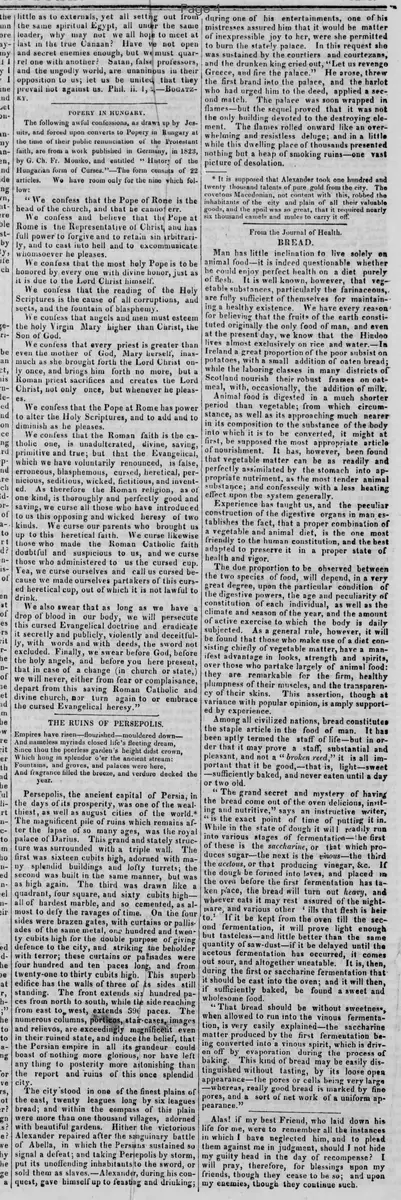
THE RUINS OF PERSEPOLIS.
Empires have risen—flourished—mouldered down—
And nameless myriads closed life's fleeting dream,
Since thou the peerless garden's height didst crown,
Which hung in splendor o'er the ancient stream:
Fountains, and groves, and palaces were here,
And fragrance filled the breeze, and verdure decked the year.
Persepolis, the ancient capital of Persia: in the days of its prosperity, was one of the wealthiest, as well as august cities of the world.*
The magnificent pile of ruins which remains after the lapse of so many ages, was the royal palace of Darius. This grand and stately structure was surrounded with a triple wall. The first was sixteen cubits high, adorned with many splendid buildings and lofty turrets; the second was built in the same manner, but was as high again. The third was drawn like a quadrant, four square, and sixty cubits high—all of hardest marble, and so cemented, as almost to defy the ravages of time. On the four sides were brazen gates, with curtains or pallisades of the same metal, one hundred and twenty cubits high for the double purpose of giving defence to the city, and striking the beholder with terror; these curtains or pallisades were four hundred and ten paces long, and from twenty-one to thirty cubits high. This superb edifice has the walls of three of its sides still standing. The front extends six hundred paces from north to south, while the side reaching from east to west, extends 300 paces. The numerous columns, porticos, stair-cases, images and relievos, are exceedingly magnificent even in their ruined state, and induce the belief, that the Persian empire in all its grandeur could boast of nothing more glorious, nor have left any thing to posterity more astonishing than the report and ruins of this once splendid city.
'The city stood in one of the finest plains of the east, twenty leagues long by six leagues broad; and within the compass of this plain were more than one thousand villages, adorned with beautiful gardens. Hither the victorious Alexander repaired after the sanguinary battle of Arbella, in which the Persians sustained so signal a defeat; and taking Persepolis by storm, put its unoffending inhabitants to the sword, or sold them as slaves.—Alexander, during his conquest, gave himself up to feasting and drinking; during one of his entertainments, one of his mistresses assured him that it would be matter of inexpressible joy to her, were she permitted to burn the stately palace. In this request she was sustained by the courtiers and courtezans, and the drunken king cried out, "Let us revenge Greece, and fire the palace." He arose, threw the first brand into the palace, and the harlot who had urged him to the deed, applied a second match. The palace was soon wrapped in flames—but the sequel proved that it was not the only building devoted to the destroying element. The flames rolled onward like an overwhelming and resistless deluge; and in a little while this dwelling place of thousands presented nothing but a heap of smoking ruins—one vast picture of desolation.
* It is supposed that Alexander took one hundred and twenty thousand talents of pure gold from the city. The covetous Macedonian, not content with this, robbed the inhabitants of the city and plain of all their valuable goods, and the spoil was so great, that it required nearly six thousand camels and mules to carry it off.
Empires have risen—flourished—mouldered down—
And nameless myriads closed life's fleeting dream,
Since thou the peerless garden's height didst crown,
Which hung in splendor o'er the ancient stream:
Fountains, and groves, and palaces were here,
And fragrance filled the breeze, and verdure decked the year.
Persepolis, the ancient capital of Persia: in the days of its prosperity, was one of the wealthiest, as well as august cities of the world.*
The magnificent pile of ruins which remains after the lapse of so many ages, was the royal palace of Darius. This grand and stately structure was surrounded with a triple wall. The first was sixteen cubits high, adorned with many splendid buildings and lofty turrets; the second was built in the same manner, but was as high again. The third was drawn like a quadrant, four square, and sixty cubits high—all of hardest marble, and so cemented, as almost to defy the ravages of time. On the four sides were brazen gates, with curtains or pallisades of the same metal, one hundred and twenty cubits high for the double purpose of giving defence to the city, and striking the beholder with terror; these curtains or pallisades were four hundred and ten paces long, and from twenty-one to thirty cubits high. This superb edifice has the walls of three of its sides still standing. The front extends six hundred paces from north to south, while the side reaching from east to west, extends 300 paces. The numerous columns, porticos, stair-cases, images and relievos, are exceedingly magnificent even in their ruined state, and induce the belief, that the Persian empire in all its grandeur could boast of nothing more glorious, nor have left any thing to posterity more astonishing than the report and ruins of this once splendid city.
'The city stood in one of the finest plains of the east, twenty leagues long by six leagues broad; and within the compass of this plain were more than one thousand villages, adorned with beautiful gardens. Hither the victorious Alexander repaired after the sanguinary battle of Arbella, in which the Persians sustained so signal a defeat; and taking Persepolis by storm, put its unoffending inhabitants to the sword, or sold them as slaves.—Alexander, during his conquest, gave himself up to feasting and drinking; during one of his entertainments, one of his mistresses assured him that it would be matter of inexpressible joy to her, were she permitted to burn the stately palace. In this request she was sustained by the courtiers and courtezans, and the drunken king cried out, "Let us revenge Greece, and fire the palace." He arose, threw the first brand into the palace, and the harlot who had urged him to the deed, applied a second match. The palace was soon wrapped in flames—but the sequel proved that it was not the only building devoted to the destroying element. The flames rolled onward like an overwhelming and resistless deluge; and in a little while this dwelling place of thousands presented nothing but a heap of smoking ruins—one vast picture of desolation.
* It is supposed that Alexander took one hundred and twenty thousand talents of pure gold from the city. The covetous Macedonian, not content with this, robbed the inhabitants of the city and plain of all their valuable goods, and the spoil was so great, that it required nearly six thousand camels and mules to carry it off.
What sub-type of article is it?
Poem
Elegy
Essay
What themes does it cover?
Death Mortality
Political
War Peace
What keywords are associated?
Persepolis
Ruins
Alexander
Persia
Darius
Palace
Conquest
Destruction
Literary Details
Title
The Ruins Of Persepolis.
Subject
Ruins And History Of Ancient Persepolis
Form / Style
Elegiac Poem Followed By Historical Prose Description
Key Lines
Empires Have Risen—Flourished—Mouldered Down—
And Nameless Myriads Closed Life's Fleeting Dream,
Since Thou The Peerless Garden's Height Didst Crown,
Which Hung In Splendor O'er The Ancient Stream:
Fountains, And Groves, And Palaces Were Here,
And Fragrance Filled The Breeze, And Verdure Decked The Year.
"Let Us Revenge Greece, And Fire The Palace."