Thank you for visiting SNEWPapers!
Sign up free
Story
June 27, 1833
Virginia Free Press
Charles Town, Jefferson County, West Virginia
What is this article about?
The U.S. Circuit Court in Alexandria orders an attachment against J.H. Pleasants, editor of the Richmond Whig, for contempt in disobeying a summons. Pleasants regrets missing the hearing and vows to resist, citing precedents by Chief Justice Marshall and Judge Barbour.
Clipping
OCR Quality
95%
Excellent
Full Text
From the Alexandria Gazette, June 19.
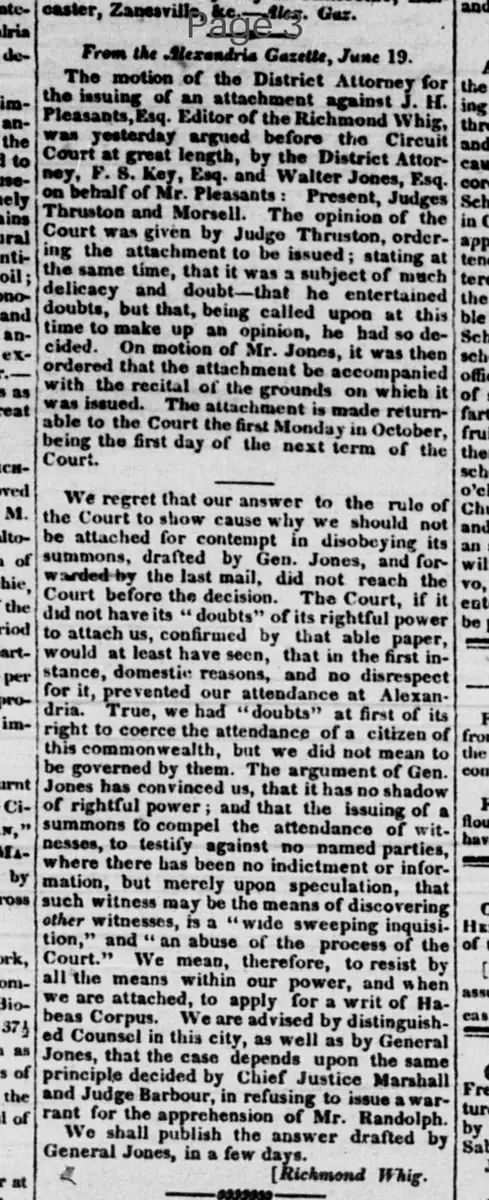
The motion of the District Attorney for the issuing of an attachment against J.H. Pleasants, Esq. Editor of the Richmond Whig, was yesterday argued before the Circuit Court at great length, by the District Attorney, F. S. Key, Esq. and Walter Jones, Esq. on behalf of Mr. Pleasants : Present, Judges Thruston and Morsell. The opinion of the Court was given by Judge Thruston, ordering the attachment to be issued; stating at the same time, that it was a subject of much delicacy and doubt—that he entertained doubts, but that, being called upon at this time to make up an opinion, he had so decided. On motion of Mr. Jones, it was then ordered that the attachment be accompanied with the recital of the grounds on which it was issued. The attachment is made returnable to the Court the first Monday in October, being the first day of the next term of the Court.
We regret that our answer to the rule of the Court to show cause why we should not be attached for contempt in disobeying its summons, drafted by Gen. Jones, and forwarded by the last mail, did not reach the Court before the decision. The Court, if it did not have its "doubts" of its rightful power to attach us, confirmed by that able paper, would at least have seen, that in the first instance, domestic reasons, and no disrespect for it, prevented our attendance at Alexandria. True, we had "doubts" at first of its right to coerce the attendance of a citizen of this commonwealth, but we did not mean to be governed by them. The argument of Gen. Jones has convinced us, that it has no shadow of rightful power; and that the issuing of a summons to compel the attendance of witnesses, to testify against no named parties, where there has been no indictment or information, but merely upon speculation, that such witness may be the means of discovering other witnesses, is a "wide sweeping inquisition," and "an abuse of the process of the Court." We mean, therefore, to resist by all the means within our power, and when we are attached, to apply for a writ of Habeas Corpus. We are advised by distinguished Counsel in this city, as well as by General Jones, that the case depends upon the same principle decided by Chief Justice Marshall and Judge Barbour, in refusing to issue a warrant for the apprehension of Mr. Randolph. We shall publish the answer drafted by General Jones, in a few days.
The motion of the District Attorney for the issuing of an attachment against J.H. Pleasants, Esq. Editor of the Richmond Whig, was yesterday argued before the Circuit Court at great length, by the District Attorney, F. S. Key, Esq. and Walter Jones, Esq. on behalf of Mr. Pleasants : Present, Judges Thruston and Morsell. The opinion of the Court was given by Judge Thruston, ordering the attachment to be issued; stating at the same time, that it was a subject of much delicacy and doubt—that he entertained doubts, but that, being called upon at this time to make up an opinion, he had so decided. On motion of Mr. Jones, it was then ordered that the attachment be accompanied with the recital of the grounds on which it was issued. The attachment is made returnable to the Court the first Monday in October, being the first day of the next term of the Court.
We regret that our answer to the rule of the Court to show cause why we should not be attached for contempt in disobeying its summons, drafted by Gen. Jones, and forwarded by the last mail, did not reach the Court before the decision. The Court, if it did not have its "doubts" of its rightful power to attach us, confirmed by that able paper, would at least have seen, that in the first instance, domestic reasons, and no disrespect for it, prevented our attendance at Alexandria. True, we had "doubts" at first of its right to coerce the attendance of a citizen of this commonwealth, but we did not mean to be governed by them. The argument of Gen. Jones has convinced us, that it has no shadow of rightful power; and that the issuing of a summons to compel the attendance of witnesses, to testify against no named parties, where there has been no indictment or information, but merely upon speculation, that such witness may be the means of discovering other witnesses, is a "wide sweeping inquisition," and "an abuse of the process of the Court." We mean, therefore, to resist by all the means within our power, and when we are attached, to apply for a writ of Habeas Corpus. We are advised by distinguished Counsel in this city, as well as by General Jones, that the case depends upon the same principle decided by Chief Justice Marshall and Judge Barbour, in refusing to issue a warrant for the apprehension of Mr. Randolph. We shall publish the answer drafted by General Jones, in a few days.
What sub-type of article is it?
Historical Event
Crime Story
What themes does it cover?
Justice
Crime Punishment
What keywords are associated?
Court Attachment
Contempt Of Court
Legal Resistance
Habeas Corpus
Witness Summons
Richmond Whig
What entities or persons were involved?
J.H. Pleasants
F. S. Key
Walter Jones
Judge Thruston
Judge Morsell
Gen. Jones
Chief Justice Marshall
Judge Barbour
Mr. Randolph
Where did it happen?
Alexandria
Story Details
Key Persons
J.H. Pleasants
F. S. Key
Walter Jones
Judge Thruston
Judge Morsell
Gen. Jones
Chief Justice Marshall
Judge Barbour
Mr. Randolph
Location
Alexandria
Event Date
June 19
Story Details
District Attorney moves for attachment against Pleasants for contempt; court grants it despite doubts. Pleasants' response delayed; he plans resistance via habeas corpus, citing precedents against coercive summons without indictment.