Thank you for visiting SNEWPapers!
Sign up free
Editorial
February 2, 1841
Rutland Herald
Rutland, Rutland County, Vermont
What is this article about?
Editorial criticizes the Sub-Treasury system proposed by Van Buren for insecurity, citing historical U.S. defalcations totaling over $8 million from 1789-1836, including cases like Theron Rudd ($116,000), John Nicholson ($100,000+), Gen. Preston ($182,000), and Jerman Baker ($33,000), questioning appointee integrity.
Clipping
OCR Quality
95%
Excellent
Full Text
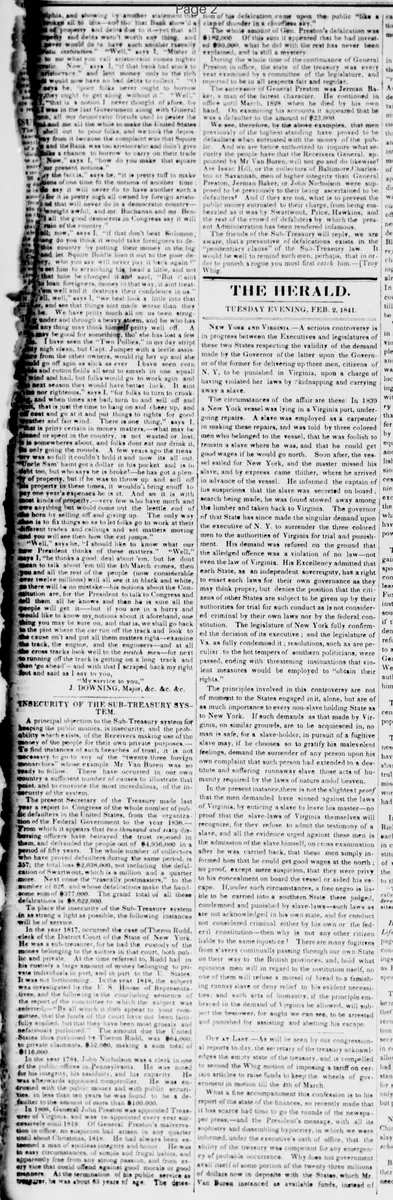
INSECURITY OF THE SUB-TREASURY SYSTEM.
A principal objection to the Sub-Treasury system for keeping the public monies, is insecurity, and the probability which exists, of the Receivers making use of the money of the people for their own private purposes.—To find instances of such breaches of trust, it is not necessary to go to any of the "twenty three foreign monarchies" whose example Mr. Van Buren was so ready to follow. There have occurred in our own country a sufficient number of cases to illustrate that point, and to convince the most incredulous, of the insecurity of the system.
The present Secretary of the Treasury made last year a report to Congress of the whole number of public defaulters in the United States, from the organization of the Federal Government to the year 1836.—From which it appears that two thousand and sixty disbursing officers have betrayed the trust reposed in them, and defrauded the people out of $4,956,000 in a period of fifty years. The whole number of collectors who have proved defaulters during the same period, is 357, the total loss $2,035,000, not including the defalcation of Swartwout, which is a million and a quarter more. Next come the "rascally postmasters," to the number of 96, and whose defalcations make the handsome sum of $377,000. The grand total of all these defalcations is $8,622,000.
To place the insecurity of the Sub-Treasury system in as strong a light as possible, the following instances will be of service.
In the year 1817, occurred the case of Theron Rudd, clerk of the District Court of the State of New York. He was a sub-treasurer, for he had the custody of the money belonging to the suitors in that court, both public and private. "At the time referred to, Rudd had in his custody a large amount of money belonging to private individuals in part, and in part to the U. States. It was not forthcoming. In the year 1818, the subject was investigated by the U. S. House of Representatives, and the following is the concluding sentence of the report of the committee to which the subject was referred,—"By all which it doth appear to your committee, that the funds of the court have not been faithfully applied, but that they have been most grossly and nefariously purloined." The amount due the United States thus purloined by Theron Rudd, was $40,000. To private claimants, $52,000, making a sum total of $116,000.
In the year 1794, John Nicholson was a clerk in one of the public offices in Pennsylvania. He was noted for his integrity, his assiduity, and his capacity. He was afterwards appointed comptroller. He was entrusted with the public money and with public securities. In less than ten years he was found to be a defaulter to the amount of more than $100,000.
In 1809, General John Preston was appointed Treasurer of Virginia, and was re-appointed every year successively until 1819. Of General Preston's malversation in office, no suspicion had arisen in any quarter until about Christmas, 1819. He had always been esteemed a man of spotless integrity and honor. He was in easy circumstances, of simple and frugal habits, and apparently free from any strong passion, and from every vice that could offend against good morals or good manners. At the termination of his public service as treasurer, he was about 68 years of age. The detection of his defalcation came upon the public "like a clap of thunder in a cloudless sky."
The whole amount of Gen. Preston's defalcation was $182,000. Of this sum it appeared that he had invested $100,000. What he did with the rest has never been explained, and is still a mystery.
During the whole time of the continuance of General Preston in office, the state of the treasury was every year examined by a committee of the legislature, and reported to be in all respects fair and regular.
The successor of General Preston was Jerman Baker, a man of the fairest character. He continued in office until March, 1826, when he died by his own hand. On examining his accounts it appeared that he was a defaulter to the amount of $33,000.
We see, therefore, by the above examples, that men previously of the highest standing have proved to be defaulters when entrusted with the money of the public. And we are hence authorized to inquire what security the people have that the Receivers General, appointed by Mr. Van Buren, will not go and do likewise? Are Isaac Hill, or the collectors of Baltimore, Charleston or Savannah, men of higher integrity than General Preston, Jerman Baker, or John Nicholson were supposed to be previously to their being ascertained to be defaulters? And if they are not, what is to prevent the public money entrusted to their charge, from being embezzled as it was by Swartwout, Price, Hawkins, and the rest of the crowd of defaulters by which the present Administration has been rendered infamous.
The friends of the Sub-Treasury will reply, we are aware, that a preventive of defalcations exists in the "penitentiary clause" of the Sub-Treasury law. It would be well to remind such men, perhaps, that in order to punish a rogue you must first catch him.—[Troy Whig.
A principal objection to the Sub-Treasury system for keeping the public monies, is insecurity, and the probability which exists, of the Receivers making use of the money of the people for their own private purposes.—To find instances of such breaches of trust, it is not necessary to go to any of the "twenty three foreign monarchies" whose example Mr. Van Buren was so ready to follow. There have occurred in our own country a sufficient number of cases to illustrate that point, and to convince the most incredulous, of the insecurity of the system.
The present Secretary of the Treasury made last year a report to Congress of the whole number of public defaulters in the United States, from the organization of the Federal Government to the year 1836.—From which it appears that two thousand and sixty disbursing officers have betrayed the trust reposed in them, and defrauded the people out of $4,956,000 in a period of fifty years. The whole number of collectors who have proved defaulters during the same period, is 357, the total loss $2,035,000, not including the defalcation of Swartwout, which is a million and a quarter more. Next come the "rascally postmasters," to the number of 96, and whose defalcations make the handsome sum of $377,000. The grand total of all these defalcations is $8,622,000.
To place the insecurity of the Sub-Treasury system in as strong a light as possible, the following instances will be of service.
In the year 1817, occurred the case of Theron Rudd, clerk of the District Court of the State of New York. He was a sub-treasurer, for he had the custody of the money belonging to the suitors in that court, both public and private. "At the time referred to, Rudd had in his custody a large amount of money belonging to private individuals in part, and in part to the U. States. It was not forthcoming. In the year 1818, the subject was investigated by the U. S. House of Representatives, and the following is the concluding sentence of the report of the committee to which the subject was referred,—"By all which it doth appear to your committee, that the funds of the court have not been faithfully applied, but that they have been most grossly and nefariously purloined." The amount due the United States thus purloined by Theron Rudd, was $40,000. To private claimants, $52,000, making a sum total of $116,000.
In the year 1794, John Nicholson was a clerk in one of the public offices in Pennsylvania. He was noted for his integrity, his assiduity, and his capacity. He was afterwards appointed comptroller. He was entrusted with the public money and with public securities. In less than ten years he was found to be a defaulter to the amount of more than $100,000.
In 1809, General John Preston was appointed Treasurer of Virginia, and was re-appointed every year successively until 1819. Of General Preston's malversation in office, no suspicion had arisen in any quarter until about Christmas, 1819. He had always been esteemed a man of spotless integrity and honor. He was in easy circumstances, of simple and frugal habits, and apparently free from any strong passion, and from every vice that could offend against good morals or good manners. At the termination of his public service as treasurer, he was about 68 years of age. The detection of his defalcation came upon the public "like a clap of thunder in a cloudless sky."
The whole amount of Gen. Preston's defalcation was $182,000. Of this sum it appeared that he had invested $100,000. What he did with the rest has never been explained, and is still a mystery.
During the whole time of the continuance of General Preston in office, the state of the treasury was every year examined by a committee of the legislature, and reported to be in all respects fair and regular.
The successor of General Preston was Jerman Baker, a man of the fairest character. He continued in office until March, 1826, when he died by his own hand. On examining his accounts it appeared that he was a defaulter to the amount of $33,000.
We see, therefore, by the above examples, that men previously of the highest standing have proved to be defaulters when entrusted with the money of the public. And we are hence authorized to inquire what security the people have that the Receivers General, appointed by Mr. Van Buren, will not go and do likewise? Are Isaac Hill, or the collectors of Baltimore, Charleston or Savannah, men of higher integrity than General Preston, Jerman Baker, or John Nicholson were supposed to be previously to their being ascertained to be defaulters? And if they are not, what is to prevent the public money entrusted to their charge, from being embezzled as it was by Swartwout, Price, Hawkins, and the rest of the crowd of defaulters by which the present Administration has been rendered infamous.
The friends of the Sub-Treasury will reply, we are aware, that a preventive of defalcations exists in the "penitentiary clause" of the Sub-Treasury law. It would be well to remind such men, perhaps, that in order to punish a rogue you must first catch him.—[Troy Whig.
What sub-type of article is it?
Economic Policy
Partisan Politics
What keywords are associated?
Sub Treasury System
Public Defalcations
Financial Insecurity
Van Buren Administration
Government Treasurers
Embezzlement Cases
Receivers General
What entities or persons were involved?
Mr. Van Buren
Secretary Of The Treasury
Theron Rudd
John Nicholson
General John Preston
Jerman Baker
Isaac Hill
Swartwout
Price
Hawkins
Editorial Details
Primary Topic
Insecurity Of The Sub Treasury System
Stance / Tone
Strongly Critical Of Sub Treasury System And Van Buren Administration
Key Figures
Mr. Van Buren
Secretary Of The Treasury
Theron Rudd
John Nicholson
General John Preston
Jerman Baker
Isaac Hill
Swartwout
Price
Hawkins
Key Arguments
Sub Treasury System Insecure Due To Risk Of Receivers Misusing Public Funds
From 1789 1836, 2,060 Disbursing Officers Defrauded $4,956,000
357 Collectors Defaulted For $2,035,000, Plus Swartwout's $1.25 Million
96 Postmasters Defaulted For $377,000, Total $8,622,000
Case Of Theron Rudd: Embezzled $116,000 In 1817
John Nicholson Defaulted Over $100,000 By 1804
General Preston Defaulted $182,000 In 1819 Despite Good Reputation
Jerman Baker Defaulted $33,000, Died By Suicide In 1826
Questions Integrity Of Van Buren Appointees Like Isaac Hill
Penitentiary Clause Ineffective Without Catching Defaulters First