Thank you for visiting SNEWPapers!
Sign up free
The National Intelligencer And Washington Advertiser
Washington, District Of Columbia
What is this article about?
Historical account of the Kentucky Spanish Association conspiracy involving figures like Gen. Wilkinson, Spanish agents, and British interests in the late 18th century, including intrigues, murders, and failed investigations. Includes 1806 testimonies from Hopkins and M'Dowell denying or clarifying charges against John Brown.
Merged-components note: Continuation of the article 'FROM THE WESTERN WORLD' on the Kentucky Spanish Association across pages 1 and 2.
Clippings
1 of 2
OCR Quality
Full Text
The Kentucky Spanish Association. Blount's Conspiracy, and General Miranda's Expedition.
(CONTINUED.)
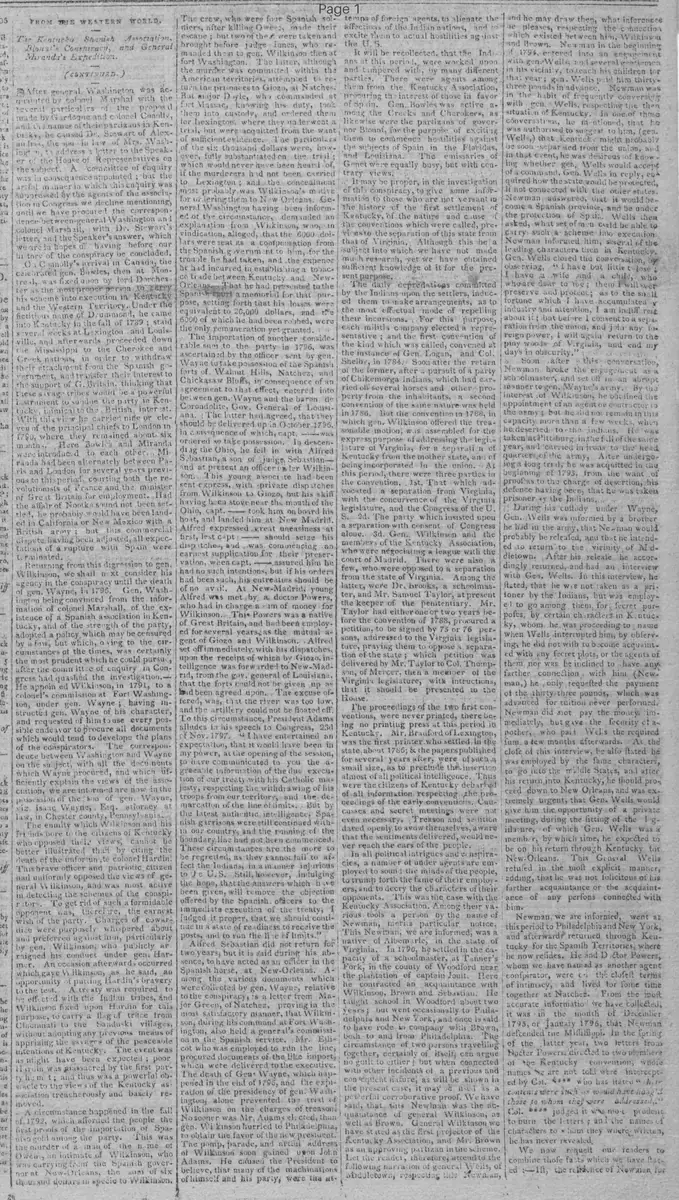
After general Washington was acquainted by colonel Marshall with the several particulars of the proposal made by Gardoqui and colonel Connolly, and the names of their partisans in Kentucky, he caused Dr. Stuart of Alexandria, the son in law of Mrs. Washington, to address a letter to the Speaker of the House of Representatives on the subject. A committee of enquiry was in consequence appointed; but the artful manner in which this enquiry was supervised by the agents of the association in Congress we decline mentioning until we have procured the correspondence between general Washington and colonel Marshall, with Dr. Stuart's letter, and the Speaker's answer, which we are in hopes of having before our history of the conspiracy be concluded.
On Connolly's arrival in Canada, the celebrated gen. Bowles, then at Montreal, was fixed upon by lord Dorchester as the most proper person to carry his scheme into execution in Kentucky and the Western Territory. Under the fictitious name of Drummond, he came into Kentucky in the fall of 1789; staid several weeks at Lexington and Louisville, and afterwards proceeded down the Mississippi to the Cherokee and Creek nations, in order to withdraw their attachment from the Spanish government, and transfer their interest to the support of G. Britain, thinking that these savage tribes would be a powerful instrument to subdue the party in Kentucky, inimical to the British interest. With this view he carried nine or eleven of the principal chiefs to London in 1790, where they remained about six months. Here Bowles and Miranda were introduced to each other. Mr. Miranda had been alternately between Paris and London for several years previous to this period, courting both the revolutionists of France and the ministers of Great Britain for employment. Had the affair of Nootka sound not been settled, he probably would have been landed in California or New Mexico with a British army; but this commercial dispute having been adjusted, all expectations of a rupture with Spain were terminated.
Returning from this digression to gen. Wilkinson, we shall next consider his agency in the conspiracy until the death of gen. Wayne, in 1796. Gen. Washington being convinced from the information of colonel Marshall, of the existence of a Spanish association in Kentucky, and of the strength of the party, adopted a policy which may be censured by a few, but which, owing to the circumstances of the times, was certainly the most prudent which he could pursue, after the committee of enquiry in Congress had quashed the investigation. He appointed Wilkinson, in 1791, to a colonel's commission at Fort Washington, under gen. Wayne; having instructed gen. Wayne of his character, and requested of him to use every possible endeavor to procure all documents which would tend to develope the plans of the conspirators. The correspondence between Washington and Wayne on the subject, with all the documents which Wayne procured, and which sufficiently explain the views of the association, we are informed are now in the possession of the son of gen. Wayne, viz. Isaac Wayne, Esq. attorney at law, in Chester county, Pennsylvania.
The enmity which Wilkinson and his friends bore to the citizens of Kentucky who opposed their views, cannot be better illustrated than by citing the death of the unfortunate colonel Hardin. This brave officer and patriotic citizen had uniformly opposed the views of general Wilkinson, and was most active in detecting the schemes of the conspirators. To get rid of such a formidable opponent was, therefore, the earnest wish of the party. Charges of cowardice were purposely whispered about and preferred against him, particularly by gen. Wilkinson, who publicly arraigned his conduct under gen. Harmar. An occasion afterwards occurred which gave Wilkinson, as he said, an opportunity of putting Hardin's bravery to the test. A treaty was required to be effected with the Indian tribes, and Wilkinson fixed upon Hardin for this purpose, to carry a flag of truce from Cincinnati to the Sandusky villages, without adopting any previous means of apprizing the savages of the peaceable intentions of Kentucky. The event was as might have been expected; poor Hardin was massacred by the first party he met: and thus was a powerful obstacle to the views of the Kentucky association treacherously and basely removed.
A circumstance happened in the fall of 1792, which afforded the people the first proofs of the importation of Spanish gold among the party. This was the murder of a man of the name of Owen, an intimate of Wilkinson, who was carrying from the Spanish governor at New-Orleans, the sum of six thousand dollars in specie to Wilkinson. The crew, who were four Spanish soldiers, after killing Owen, made their escape; but two of them were taken and brought before judge Innes, who remanded them to gen. Wilkinson then at fort Washington. The latter, although the murder was committed within the American territories, attempted to return the prisoners to Gayoso, at Natchez. But major Devereux, who commanded at fort Massac, knowing his duty, took them into custody, and ordered them for Lexington, where they underwent a trial, but were acquitted from the want of sufficient evidence. The particulars of the six thousand dollars were, however, fully substantiated on the trial; which would never have been heard of, if the murderers had not been carried to Lexington; and the concealment, most probably, was Wilkinson's motive for ordering them to New Orleans. General Washington having been informed of the circumstance, demanded an explanation from Wilkinson, who, in vindication, alleged, that the 6000 dollars were sent as a compensation from the Spanish government to him, for the trouble he had taken, and the expense he had incurred in establishing a tobacco trade between Kentucky and New-Orleans. That he had presented to the Spanish court a memorial for that purpose, setting forth that his losses were equivalent to 20,000 dollars, and the 6000 of which he had been robbed, were the only remuneration yet granted.
The importation of another considerable sum to the party in 1796, was ascertained by the officer sent by gen. Wayne to take possession of the Spanish forts of Walnut Hills, Natchez, and Chickasaw Bluffs, in consequence of an agreement to that effect, entered into between gen. Wayne and the baron de Carondelet, Gov. General of Louisiana. The latter had agreed, that they should be delivered up in October 1796, in consequence of which, capt. --- was ordered to take possession. In descending the Ohio, he fell in with Alfred Sebastian, a son of judge Sebastian—and at present an officer under Wilkinson. This young associate had been sent express, with private dispatches from Wilkinson to Gayoso, but his skiff having been stove near the mouth of the Ohio, capt. --- took him on board his boat, and landed him at New Madrid. Alfred expressed great uneasiness at first, lest capt. --- should seize his dispatches, and was commencing an earnest supplication for their preservation, when capt. --- assured him he had no such intentions, but if his orders had been such, his entreaties should be of no avail. At New-Madrid, young Alfred was met by a doctor Powers, who had in charge a sum of money for Wilkinson. This Powers was a native of Great Britain, and had been employed for several years as the mutual agent of Gayoso and Wilkinson. Alfred set off immediately, with his dispatches, upon the receipt of which by Gayoso, intelligence was forwarded to New-Madrid, from the gov. general of Louisiana, that the forts could not be given up as had been agreed upon. The excuse offered, was, that the river was too low, and the artillery could not be floated off. To this circumstance, President Adams alludes in his speech to Congress, 23d of Nov. 1797.
"I have entertained an expectation, that it would have been in my power, at the opening of the session, to have communicated to you the agreeable information of the due execution of our treaty with his Catholic majesty, respecting the withdrawing of his troops from our territory, and the demarcation of the line of limits. But by the latest authentic intelligence, Spanish garrisons were still continued within our country and the running of the boundary line had not been commenced. These circumstances are the more to be regretted, as they cannot fail to affect the Indians, in a manner injurious to the U. States. Still, however, indulging the hope, that the answers which have been given, will remove the objection offered by the Spanish officers to the immediate execution of the treaty, I judged it proper, that we should continue in a state of readiness to receive the posts, and to run the line of limits."
Alfred Sebastian did not return for two years, but it is said during his absence, to have acted as an officer in the Spanish horse, at New-Orleans. Among the various documents which were collected by gen. Wayne, relative to the conspiracy, is a letter from Major Green, of Natchez, proving in the most satisfactory manner, that Wilkinson, during his command at Fort Washington, also held a general's commission in the Spanish service. Mr. Ellicott who was employed to run the line, procured documents of the like import, which were delivered to the executive. The death of Gen. Wayne, which happened in the end of 1796, and the expiration of the presidency of gen. Washington, alone prevented the trial of Wilkinson on the charges of treason. No sooner was Mr. Adams elected, than gen. Wilkinson hurried to Philadelphia, to obtain the favor of the new president. The pomp, parade, and artful address of Wilkinson soon gained upon John Adams. He caused the President to believe, that many of the machinations of himself and his party, were the attempts of foreign agents to alienate the affections of the Indian nations, and to excite them to actual hostilities against the U. S.
It will be recollected, that the Indians at this period, were worked upon and tampred with, by many different parties. There were agents among them from the Kentucky Association, procuring the interest of those in favor of Spain. Gen. Bowles was active among the Creeks and Cherokees, as likewise were the partizans of governor Blount, for the purpose of exciting them to commence hostilities against the subjects of Spain in the Floridas, and Louisiana. The emissaries of Genet were equally busy, but with contrary views.
It may be proper, in the investigation of this conspiracy, to give some information to those who are not versant in the history of the first settlement of Kentucky, of the nature and cause of the conventions which were called, previous to the separation of this state from that of Virginia. Although this be a subject into which we have not made much research, yet we have obtained sufficient knowledge of it for the present purpose.
The daily depredations committed by the Indians upon the settlers, induced them to make arrangements, as to the most effectual mode of repelling their incursions. For this purpose, each militia company elected a representative; and the first convention of the kind which was called, convened at the instance of Gen. Logan and Col. Shelby, in 1784. Soon after the return of the former, after a pursuit of a party of Chickamauga Indians, which had carried off several horses and other property from the inhabitants, a second convention of the same nature was held in 1786. But the convention in 1788, in which gen. Wilkinson offered the treasonable motion, was assembled for the express purpose of addressing the legislature of Virginia, for a separation of Kentucky from the mother state, and of being incorporated in the union. At this period, there were three parties in the Convention. 1st. That which advocated a separation from Virginia, with the concurrence of the Virginia legislature, and the Congress of the U. S. 2d. The party which insisted upon a separation with consent of Congress alone. 3d. Gen. Wilkinson and the members of the Kentucky Association, who were negotiating a league with the court of Madrid. There were also a few, who were opposed to a separation from the state of Virginia. Among the latter, were Dr. Brooks, a schoolmaster, and Mr. Samuel Taylor, at present the keeper of the penitentiary. Mr. Taylor had either one or two years before the Convention of 1788, procured a petition, to be signed by 75 or 76 persons, addressed to the Virginia legislature, praying them to oppose a separation of the state; which petition was delivered by Mr. Taylor to Col. Thompson, of Mercer, then a member of the Virginia legislature, with instructions, that it should be presented to the House.
The proceedings of the two first conventions, were never printed, there being no printing press at this period in Kentucky. Mr. Bradford of Lexington, was the first printer, who settled in the state, about 1786; & the papers published for several years after, were of such a small size, as to preclude the insertion almost of all political intelligence. Thus were the citizens of Kentucky debarred of all information respecting the proceedings of the early conventions. Caucusses and secret meetings were not even necessary. Treason and sedition dared openly to avow themselves, aware that the sentiments delivered, would never reach the ears of the people.
In all political intrigues and conspiracies, a number of under agents are employed to sound the minds of the people, to trump forth the fame of their employers, and to decry the characters of their opponents. This was the case with the Kentucky Association. Among their various tools a person by the name of Newman, merits particular notice. This Newman, we are informed, was a native of Albemarle, in the state of Virginia. In 1790, he settled in the capacity of a schoolmaster, at Tanner's Fork, in the county of Woodford near the plantation of captain Jouett. Here he contracted an acquaintance with Wilkinson, Brown and Sebastian. He taught school in Woodford about two years; but went occasionally to Philadelphia and New York, and once is said to have rode in company with Brown, both to and from Philadelphia. The circumstance of two persons travelling together, certainly of itself, can argue no guilt to either; but when connected with other incidents of a previous and consequent nature, as will be shown in the present case, it may be used as a powerful corroborative proof. We have said, that this Newman was the acquaintance of general Wilkinson, as well as Brown. General Wilkinson we have stated as the first projector of the Kentucky Association, and Mr. Brown as an approving partizan in the scheme. Let the reader, therefore, attend to the following narration of general Wells, of Middletown, respecting this Newman, and he may draw from them, what inferences he pleases, respecting the connection which existed between him, Wilkinson and Brown.
Newman in the beginning of 1794, entered into an engagement with gen. Wells, and several gentlemen in his vicinity, to teach his children for that year: gen. Wells paid him thirty-three pounds in advance. Newman was in the habit of frequently conversing with gen. Wells, respecting the then situation of Kentucky. In one of those conversations, he mentioned, that he was authorised to suggest to him, (gen. Wells) that Kentucky might probably be soon separated from the union, and in that event, he was desirous of knowing whether gen. Wells would accept of a command. Gen. Wells in reply, enquired how the state would be protected, if not connected with the other states. Newman answered, that it would become a Spanish province, and be under the protection of Spain. Wells then asked, what set of men could be able to carry such a scheme into execution. Newman informed him, several of the leading characters then in Kentucky. Gen. Wells closed the conversation, by observing, "I have but little to lose: I have a wife and a child, who are dear to me; them I will ever preserve and protect; as to the small fortune which I have accumulated by industry and attention, I am indifferent about it; but before I consent to a separation from the union, and join any foreign power, I will again return to the pine woods of Virginia, and end my days in obscurity."
Soon after this conversation, Newman broke the engagement as a schoolmaster, and set off in an abrupt manner to gen. Wayne's army. By the interest of Wilkinson, he obtained the appointment of an agent or contractor to the army; but he did not remain in this capacity more than a few weeks, when he deserted to the Indians. He was taken at Pittsburgh, in the fall of the same year, and carried in irons to the head quarters of the army. After undergoing a long trial, he was acquitted in the beginning of 1795, from the want of proof as to the charge of desertion, his defence having been, that he was taken prisoner by the Indians.
During his custody under Wayne, Gen. Wells was informed by a brother he had in the army, that Newman would probably be released, and that he intended to return to the vicinity of Middletown. After his release he accordingly returned, and had an interview with Gen. Wells. In this interview, he stated, that he was not taken as a prisoner by the Indians, but was employed to go among them, or secret purposes, by certain characters in Kentucky, whom he was proceeding to name when Wells interrupted him, by observing, he did not wish to become acquainted with any secret plots, or the agents of them nor was he inclined to have any farther connection with him (Newman,) he only requested the payment of the thirty-three pounds, which was advanced for tuition never performed. Newman did not pay the money immediately, but gave the security of another, who paid Wells the required sum, a few months afterwards. At the close of this interview, he also stated he was employed by the same characters, to go into the middle States, and after his return into Kentucky, he should proceed down to New Orleans, and was extremely urgent, that Gen. Wells would give him the opportunity of a private meeting, during the sitting of the Legislature, of which Gen. Wells was a member, by which time, he expected to be on his return through Kentucky for New-Orleans. This General Wells refused in the most explicit manner, adding, that he was not solicitous of his farther acquaintance or the acquaintance of any persons connected with him.
Newman, we are informed, went at this period to Philadelphia and New York, and afterwards returned through Kentucky for the Spanish Territories, where he now resides. He and Doctor Powers, whom we have named as another agent conspirator, were on the closest terms of intimacy, and lived for some time together at Natchez. From the most accurate information we have collected it was in the month of December 1795, or January 1796, that Newman descended the Mississippi. In the spring of the latter year, two letters from Doctor Powers, directed to two members of the Kentucky convention, whose names we are not told were intercepted by Col. --- who has stated "their contents were such as would have hang'd those to whom they were addressed." Col. --- judged it was not prudent to burn the letters; and the names characters to whom they were written, he has never revealed.
We now request our readers to combine those facts which we have stated:--1st, the residence of Newman for several years previous to the formation of the association, in the immediate neighborhood of Wilkinson, Innes, Brown, Sebastian, &c. 2d. His sudden departure from Kentucky, immediately after the conversation with gen. Wells, and his obtaining, through the interest of Wilkinson, an appointment in Wayne's army. 3d. His pretended desertion to the Indians, and subsequent acquittal. 4th. His return to Kentucky, and the confession to gen. Wells, that he was employed by certain characters in Kentucky, to go among the Indians on secret purposes. 5th. His urgent request to have a private meeting with gen. Wells, during the sitting of the legislature, on his return from the middle states through Kentucky to New Orleans. 6th. His intimacy with doctor Powers, the mutual agent of Gayoso and Wilkinson. 7th. The intercepted letters from Powers to two members of the convention of 1788. And 8th. His final residence in the Spanish territories.
Some years in the county of Woodford and his acquaintance with Wilkinson, Brown and Sebastian—2d. The proposition which he made to General Wells before he joined Wayne's army, and the narration he gave to General Wells after his release. 3d. His descending the Mississippi in the end of 1795 or the beginning of 1796, and his intimacy with Doctor Powers. 4th. The interception of treasonable letters from Doctor Powers to two members of the Kentucky Convention in the Spring of 1797 by colonel ****. 5th. The meeting of Captain—with Alfred Sebastian carrying dispatches from Wilkinson to Gizot in the fall of 1796. 6th. The reception of Sebastian by Doctor Powers at New-Madrid. 7th. The refusal of the Spanish Forts to be delivered up when these dispatches were received. When these are combined and on reflection, we have no hesitation in saying, that we believe but one opinion can be formed of the intention of the persons concerned.
FROM THE WESTERN WORLD.
One of the Editors being informed by Mr. Brown, that gov. Greenup has written a letter denying in part his conversation, with respect to him, we beg leave to lay before the public the following communication from Mr. Hopkins, who was requested to favor us with his sentiments on the subject, having been present during the whole of the conversation between gov. Greenup & J. W. Leaving our subscribers to decide on the preference which ought to be given to the weight of testimony, we shall conclude it at present, and continue the investigation of the conspiracy next paper.
FRANKFORT, 9th July, 1806.
Gentlemen,
Agreeable to your request, I feel no hesitation in communicating my impressions arising from the conversation between gov. Greenup and Mr. Wood, relative to the "Kentucky Spanish Association," during the whole of which I was present.
I have a clear recollection that the statement contained in the first number of the Western World, is in substance correct; and from the willingness with which the governor seemed to impart the information, I am much astonished at a denial of any part of it. With regard to the passage to which you particularly called my attention, I well remember that gov. Greenup stated that he conversed with Mr. Brown on the subject of the propositions of the Spanish minister, and that Mr. Brown "seemed in a guarded manner to approve of them;" but on the governor's expressing his abhorrence at the scheme all communication afterwards between him and any of the party was entirely broken off.
I deprecate the circumstance that has imposed the necessity of this application, and the more especially because I had thought it would never exist; but unappalled at the idea of incurring the displeasure of the great, if you deem this letter important to your cause, you are hereby privileged to make use of it.
I am, Gentlemen,
With great respect,
Your humble Servant,
S. G. HOPKINS.
To the Editors of the Western World.
FROM THE (K.) PALLADIUM.
Mr. Hunter,
The annexed statement given by the hon. Samuel M'Dowell, refers to the following paragraphs, contained in the first part of the "Kentucky Spanish Association," &c. published by the Editors of the Western World, in the first number of that paper, viz.
5.
First—With regard to the Spanish negotiation, Gardoqui commenced his operations by sounding Mr. John Brown, member of Congress for Kentucky, then in Philadelphia, on the subject.—Having discovered in Mr. Brown an accommodating disposition towards the Spanish government; he directly made proposals for a separation of the state of Kentucky from the U. S. in favor of Spain, on the following conditions, with an assurance to Mr. Brown, if they were carried into effect, he himself should be raised to the dignity of a Spanish Grandee, with a suitable pension for life—
1st. That the citizens would be allowed the privilege of their laws, and no restraint placed on them in respect to religious matters.
2d. That the navigation of the Mississippi would be equally free to the Kentuckians, as to the other subjects of Spain.
3d. That in all other matters the Kentuckians would remain on the same footing with the Louisianians
Whether the terms were complied with on the part of Mr. Brown, we know not; but they are narrated in a letter written at that period to the hon. Saml. M'Dowell, of Jessamine county, one of the circuit judges of the state. Mr. Brown was then said to be on the point of marriage with Mr. M'Dowell's daughter; and it is very natural to suppose he should embrace this opportunity of informing his intended father-in-law of the honors which were to be conferred on him at the Spanish court.
From an attentive perusal of Col. M'Dowell's statement, it is manifest that the above paragraphs contain absolute falsehoods. Every unprejudiced reader will therefore be cautious in believing the numerous and improbable charges which are exhibited in the "Western World." until they are supported by satisfactory proof—as yet none has been adduced,
DETECTOR.
[CERTIFICATE.]
Having observed in the Western World a publication in which Mr. John Brown is charged with having been engaged in a treasonable Conspiracy, to transfer and subject this country to the dominion of Spain, and having seen with surprise that a letter written to me in 1788, by Mr. Brown, is referred to as containing the evidence of his guilt, I do in justice to Mr: Brown, hereby declare that I never received from him any communication either written or verbal, which could authorise or justify the statement contained in that publication.
In the year 1788, when the application of the people of Kentucky to be admitted into the union as an independent state, was depending before Congress, Mr. Brown was a member of that body; and was, as I have reason to believe, very anxious that Kentucky should be received into the Union as a state, and used his best exertions to effect that object.
After that application had been laid over for the consideration of the new government, Mr. Brown wrote me a letter informing me of the fate of the application, and stating the reasons in his opinion of the failure. In that letter was enclosed a paper containing a statement in the hand writing of Mr. Brown, of which the following is the substance, and to the best of my recollection, the very words made use of, viz.
"In a conversation I had with M. Gardoqui, the Spanish minister, relative to the navigation of the Mississippi, he stated that if the people of Kentucky would form themselves into an independent state, and appoint a proper person to negotiate with him, that he had authority for that purpose, and would enter into an arrangement with them for the exportation of their produce to New Orleans on terms of mutual advantage."
That paper contained the above statement of Gardoqui's remarks only, for Mr. Brown subjoined no observations expressive either of his approbation or disapprobation, which induced me to conclude that it had been forwarded merely for information. Mr. Brown never intimated to me, either at that time or any other, that Mr. Gardoqui had ever on any pretence, made him any propositions tending to his personal aggrandisement, as has been erroneously suggested in the Western World. And as to the alleged project of subjecting Kentucky to the government of Spain, and of raising an army to maintain a revolt against the U. S.—I do declare that nothing of the kind was ever suggested to me by Mr. Brown, nor to the best of my recollection did I ever hear that such ideas were at any time advanced or advocated by him or any other person in the western country, until I saw the charges published in the Western World.
I regret very much that it is not in my power at present, to find the letter and paper aforementioned, I fear they are lost or destroyed. About ten years ago I removed to Jessamine, from Mercer county, and left my son Joseph in possession of my house in which I left a large bundle of old letters and papers. Three or four years after my removal, my son informed me that all the old letters and papers I had left behind were destroyed; and as I cannot find the letter and paper referred to among the papers now in my possession, I suspect they were among those left in Mercer county.
SAMUEL M'DOWELL,
August 4, 1806.
What sub-type of article is it?
What themes does it cover?
What keywords are associated?
What entities or persons were involved?
Where did it happen?
Story Details
Key Persons
Location
Kentucky, Western Territory, Mississippi River, New Orleans, Natchez
Event Date
1784 1797, With Testimonies In 1806
Story Details
Detailed account of the Kentucky Spanish Association's conspiracy to separate Kentucky from the U.S. and ally with Spain, involving Gen. Wilkinson's intrigues, Spanish gold imports, agent Newman, Indian manipulations, and failed investigations; includes 1806 letters from Hopkins confirming Brown's guarded approval of Spanish proposals and from M'Dowell denying treason charges against Brown.