Thank you for visiting SNEWPapers!
Sign up free
Literary
August 5, 1914
The Evening Herald
Albuquerque, Bernalillo County, New Mexico
What is this article about?
Anne Ives, anxious about financier Leopold Magniff's threats, travels to Paris with fiancé Charles d'Yves to open a safe holding valuable bonds. They formalize their betrothal per the Code Napoleon. At the bank, Magniff and officials prepare the unlocking procedure.
Merged-components note: Merged serial literary story with its illustration image due to spatial adjacency and overlap.
Clipping
OCR Quality
85%
Good
Full Text
ANNE IVES
Mascot
By H. M. EGBERT
Illustrations by O. IRWIN MYERS
(Copyright 1913 by W. G. Chapman)
(Continued from Saturday.)
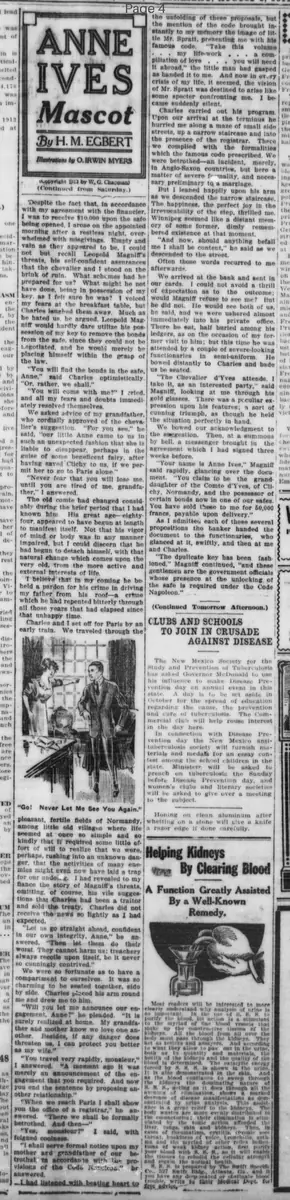
Despite the fact that, in accordance with my agreement with the financier, I was to receive $10,000 upon the safe being opened, I arose on the appointed morning after a restless night, overwhelmed with misgivings. Empty and vain as they appeared to be, I could not but recall Leopold Magniff's threats, his self-confident assurances that the chevalier and I stood on the brink of ruin. What schemes had he prepared for us? What might he not have done, being in possession of my key, as I felt sure he was? I voiced my fears at the breakfast table, but Charles laughed them away. Much as he hated us, he argued, Leopold Magniff would hardly dare utilize his possession of my key to remove the bonds from the safe, since they could not be negotiated, and he would merely be placing himself within the grasp of the law.
"You will find the bonds in the safe, Anne," said Charles optimistically. "Or, rather, we shall."
"You will come with me?" I cried, and all my fears and doubts immediately resolved themselves.
We asked advice of my grandfather, who cordially approved of the chevalier's suggestion. "For you see," he said, "our little Anne came to us in such an unexpected fashion that she is liable to disappear, perhaps in the guise of some beneficent fairy, after having saved Clichy to us, if we permit her to go to Paris alone."
"Never fear that you will lose me, until you are tired of me, grandfather," I answered.
The old comte had changed considerably during the brief period that I had known him. His great age—eighty-four, appeared to have begun at length to manifest itself. Not that his vigor of mind or body was in any manner impaired, but I could discern that he had begun to detach himself, with that natural change which comes upon the very old, from the more active and external interests of life.
I believe that in my coming he beheld a pardon for his crime in driving my father from his roof—a crime which he had repented bitterly through all those years that had elapsed since that unhappy time.
Charles and I set off for Paris by an early train. We traveled through the pleasant, fertile fields of Normandy, among little old villages where life seemed at once so simple and so kindly that it required some little effort of will to realize that we were, perhaps, rushing into an unknown danger, that the activities of many enemies might even now have laid a trap for our undoing. I had revealed to my fiance the story of Magniff's threats, omitting, of course, his vile suggestions that Charles had been a traitor and sold the treaty.
Charles did not receive the news so lightly as I had expected.
"Let us go straight ahead, confident in our own integrity, Anne," he answered. "Then let them do their worst. They cannot harm us: treachery always recoils upon itself, be it never so cunningly contrived."
We were so fortunate as to have a compartment to ourselves. It was so charming to be seated together, side by side. Charles placed his arm round me and drew me to him.
"Will you let me announce our engagement, Anne?" he pleaded. "It is surely realized at home. My grandfather and mother know we love one another. Besides, if any danger does threaten us, I can protect you better as my wife."
"You travel very rapidly, monsieur," I answered. "A moment ago it was merely an announcement of the engagement that you required. And now you end the sentence by proposing another relationship."
"When we reach Paris I shall show you the office of a registrar," he answered. "There we shall be formally betrothed. And then—"
"Yes, monsieur?" I said, with feigned coolness.
"I shall serve formal notice upon my mother and grandfather of our betrothal in accordance with the provisions of the Code Napoleon," he answered.
I had listened with beating heart to the unfolding of these proposals, but the mention of the code brought instantly to my memory the image of little Mr. Spratt, presenting me with his famous code. "Take this volume . . . my life-work . . . a compilation of love . . . you will need it abroad," the little man had gasped as he handed it to me. And now in every crisis of my life, it seemed, the vision of Mr. Spratt was destined to arise like some specter confronting me. I became suddenly silent.
Charles carried out his program. Upon our arrival at the terminus he hurried me along a maze of small side streets, up a narrow staircase and into the presence of the registrar. There we complied with the formalities which the famous code prescribed. We were betrothed—an incident, merely, in Anglo-Saxon countries, but here a matter of severe formality, and necessary preliminary to a marriage.
But I leaned happily upon his arm as we descended the narrow staircase. The happiness, the perfect joy in the irrevocability of the step, thrilled me. Winnipeg seemed like a distant memory of some former, dimly remembered existence at that moment.
"And now, should anything befall me I shall be content," he said as we descended to the street. Often those words recurred to me afterwards.
We arrived at the bank and sent in our cards. I could not avoid a thrill of expectation as to the outcome: would Magniff refuse to see me? But he did not. He would see both of us, he said, and we were ushered almost immediately into his private office.
There he sat, half buried among his ledgers, as on the occasion of my former visit to him; but this time he was attended by a couple of severe-looking functionaries in semi-uniform. He bowed distantly to Charles and bade us be seated.
"The Chevalier d'Yves attends, I take it, as an interested party," said Magniff, looking at me through his gold glasses. There was a peculiar expression upon his features; a sort of cunning triumph, as though he held the situation perfectly in hand.
We bowed our acknowledgment to the suggestion. Then, at a summons by bell, a messenger brought in the agreement which I had signed three weeks before.
"Your name is Anne Ives," Magniff said rapidly, glancing over the document. "You claim to be the granddaughter of the Comte d'Yves, of Clichy, Normandy, and the possessor of certain bonds now in one of our safes. You have sold these to me for 50,000 francs, payable upon delivery."
As I admitted each of these several propositions the banker handed the document to the functionaries, who glanced at it, swiftly, and then at me and Charles.
"The duplicate key has been fashioned," Magniff continued, "and these gentlemen are the government officials whose presence at the unlocking of the safe is required under the Code Napoleon."
(Continued Tomorrow Afternoon.)
Mascot
By H. M. EGBERT
Illustrations by O. IRWIN MYERS
(Copyright 1913 by W. G. Chapman)
(Continued from Saturday.)
Despite the fact that, in accordance with my agreement with the financier, I was to receive $10,000 upon the safe being opened, I arose on the appointed morning after a restless night, overwhelmed with misgivings. Empty and vain as they appeared to be, I could not but recall Leopold Magniff's threats, his self-confident assurances that the chevalier and I stood on the brink of ruin. What schemes had he prepared for us? What might he not have done, being in possession of my key, as I felt sure he was? I voiced my fears at the breakfast table, but Charles laughed them away. Much as he hated us, he argued, Leopold Magniff would hardly dare utilize his possession of my key to remove the bonds from the safe, since they could not be negotiated, and he would merely be placing himself within the grasp of the law.
"You will find the bonds in the safe, Anne," said Charles optimistically. "Or, rather, we shall."
"You will come with me?" I cried, and all my fears and doubts immediately resolved themselves.
We asked advice of my grandfather, who cordially approved of the chevalier's suggestion. "For you see," he said, "our little Anne came to us in such an unexpected fashion that she is liable to disappear, perhaps in the guise of some beneficent fairy, after having saved Clichy to us, if we permit her to go to Paris alone."
"Never fear that you will lose me, until you are tired of me, grandfather," I answered.
The old comte had changed considerably during the brief period that I had known him. His great age—eighty-four, appeared to have begun at length to manifest itself. Not that his vigor of mind or body was in any manner impaired, but I could discern that he had begun to detach himself, with that natural change which comes upon the very old, from the more active and external interests of life.
I believe that in my coming he beheld a pardon for his crime in driving my father from his roof—a crime which he had repented bitterly through all those years that had elapsed since that unhappy time.
Charles and I set off for Paris by an early train. We traveled through the pleasant, fertile fields of Normandy, among little old villages where life seemed at once so simple and so kindly that it required some little effort of will to realize that we were, perhaps, rushing into an unknown danger, that the activities of many enemies might even now have laid a trap for our undoing. I had revealed to my fiance the story of Magniff's threats, omitting, of course, his vile suggestions that Charles had been a traitor and sold the treaty.
Charles did not receive the news so lightly as I had expected.
"Let us go straight ahead, confident in our own integrity, Anne," he answered. "Then let them do their worst. They cannot harm us: treachery always recoils upon itself, be it never so cunningly contrived."
We were so fortunate as to have a compartment to ourselves. It was so charming to be seated together, side by side. Charles placed his arm round me and drew me to him.
"Will you let me announce our engagement, Anne?" he pleaded. "It is surely realized at home. My grandfather and mother know we love one another. Besides, if any danger does threaten us, I can protect you better as my wife."
"You travel very rapidly, monsieur," I answered. "A moment ago it was merely an announcement of the engagement that you required. And now you end the sentence by proposing another relationship."
"When we reach Paris I shall show you the office of a registrar," he answered. "There we shall be formally betrothed. And then—"
"Yes, monsieur?" I said, with feigned coolness.
"I shall serve formal notice upon my mother and grandfather of our betrothal in accordance with the provisions of the Code Napoleon," he answered.
I had listened with beating heart to the unfolding of these proposals, but the mention of the code brought instantly to my memory the image of little Mr. Spratt, presenting me with his famous code. "Take this volume . . . my life-work . . . a compilation of love . . . you will need it abroad," the little man had gasped as he handed it to me. And now in every crisis of my life, it seemed, the vision of Mr. Spratt was destined to arise like some specter confronting me. I became suddenly silent.
Charles carried out his program. Upon our arrival at the terminus he hurried me along a maze of small side streets, up a narrow staircase and into the presence of the registrar. There we complied with the formalities which the famous code prescribed. We were betrothed—an incident, merely, in Anglo-Saxon countries, but here a matter of severe formality, and necessary preliminary to a marriage.
But I leaned happily upon his arm as we descended the narrow staircase. The happiness, the perfect joy in the irrevocability of the step, thrilled me. Winnipeg seemed like a distant memory of some former, dimly remembered existence at that moment.
"And now, should anything befall me I shall be content," he said as we descended to the street. Often those words recurred to me afterwards.
We arrived at the bank and sent in our cards. I could not avoid a thrill of expectation as to the outcome: would Magniff refuse to see me? But he did not. He would see both of us, he said, and we were ushered almost immediately into his private office.
There he sat, half buried among his ledgers, as on the occasion of my former visit to him; but this time he was attended by a couple of severe-looking functionaries in semi-uniform. He bowed distantly to Charles and bade us be seated.
"The Chevalier d'Yves attends, I take it, as an interested party," said Magniff, looking at me through his gold glasses. There was a peculiar expression upon his features; a sort of cunning triumph, as though he held the situation perfectly in hand.
We bowed our acknowledgment to the suggestion. Then, at a summons by bell, a messenger brought in the agreement which I had signed three weeks before.
"Your name is Anne Ives," Magniff said rapidly, glancing over the document. "You claim to be the granddaughter of the Comte d'Yves, of Clichy, Normandy, and the possessor of certain bonds now in one of our safes. You have sold these to me for 50,000 francs, payable upon delivery."
As I admitted each of these several propositions the banker handed the document to the functionaries, who glanced at it, swiftly, and then at me and Charles.
"The duplicate key has been fashioned," Magniff continued, "and these gentlemen are the government officials whose presence at the unlocking of the safe is required under the Code Napoleon."
(Continued Tomorrow Afternoon.)
What sub-type of article is it?
Prose Fiction
What themes does it cover?
Love Romance
Political
Moral Virtue
What keywords are associated?
Serial Fiction
Romance
Intrigue
Betrothal
Bank Safe
Normandy
Paris
Code Napoleon
What entities or persons were involved?
By H. M. Egbert
Literary Details
Title
Mascot
Author
By H. M. Egbert
Key Lines
"Let Us Go Straight Ahead, Confident In Our Own Integrity, Anne," He Answered. "Then Let Them Do Their Worst. They Cannot Harm Us: Treachery Always Recoils Upon Itself, Be It Never So Cunningly Contrived."
"And Now, Should Anything Befall Me I Shall Be Content," He Said As We Descended To The Street. Often Those Words Recurred To Me Afterwards.
"Your Name Is Anne Ives," Magniff Said Rapidly, Glancing Over The Document. "You Claim To Be The Granddaughter Of The Comte D'yves, Of Clichy, Normandy, And The Possessor Of Certain Bonds Now In One Of Our Safes. You Have Sold These To Me For 50,000 Francs, Payable Upon Delivery."