Thank you for visiting SNEWPapers!
Sign up free
Nashville Union And American
Nashville, Davidson County, Tennessee
What is this article about?
In a New York court case involving the India Rubber suit, lawyer Charles O'Conor disputes Judge Betts' ruling allowing parol evidence against a sealed instrument, claiming it belongs in equity. Offended by Betts' reference to Johnson's Reports, O'Conor wagers $1,000 that no such precedent exists.
Clipping
OCR Quality
Full Text
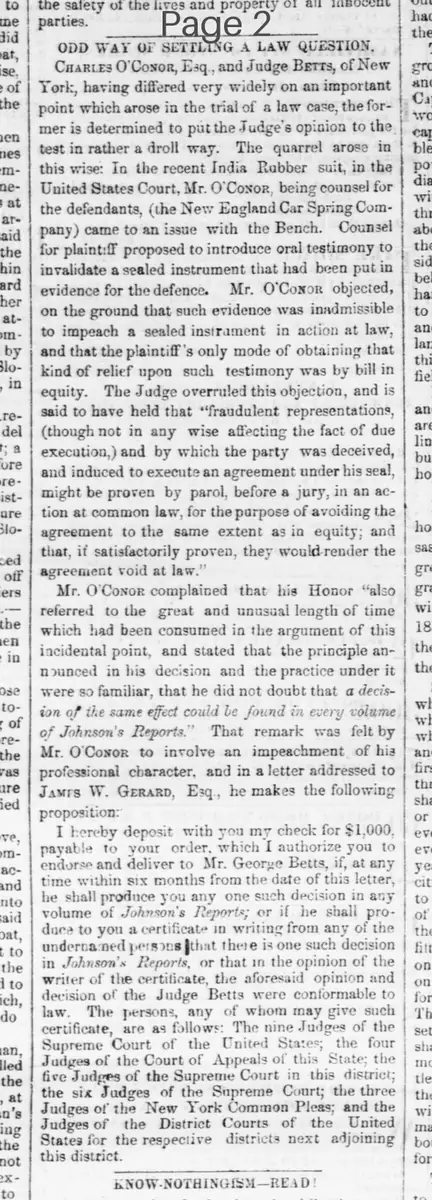
Charles O'Conor, Esq., and Judge Betts, of New York, having differed very widely on an important point which arose in the trial of a law case, the former is determined to put the Judge's opinion to the test in rather a droll way. The quarrel arose in this wise: In the recent India Rubber suit, in the United States Court, Mr. O'Conor, being counsel for the defendants, (the New England Car Spring Company) came to an issue with the Bench. Counsel for plaintiff proposed to introduce oral testimony to invalidate a sealed instrument that had been put in evidence for the defence. Mr. O'Conor objected, on the ground that such evidence was inadmissible to impeach a sealed instrument in action at law, and that the plaintiff's only mode of obtaining that kind of relief upon such testimony was by bill in equity. The Judge overruled this objection, and is said to have held that "fraudulent representations, (though not in any wise affecting the fact of due execution,) and by which the party was deceived, and induced to execute an agreement under his seal, might be proven by parol, before a jury, in an action at common law, for the purpose of avoiding the agreement to the same extent as in equity; and that, if satisfactorily proven, they would render the agreement void at law."
Mr. O'Conor complained that his Honor "also referred to the great and unusual length of time which had been consumed in the argument of this incidental point, and stated that the principle announced in his decision and the practice under it were so familiar, that he did not doubt that a decision of the same effect could be found in every volume of Johnson's Reports." That remark was felt by Mr. O'Conor to involve an impeachment of his professional character, and in a letter addressed to James W. Gerard, Esq, he makes the following proposition:
I hereby deposit with you my check for $1,000, endorse and deliver to Mr. George Betts, if, at any time within six months from the date of this letter, he shall produce you any one such decision in any volume of Johnson's Reports; or if he shall produce to you a certificate in writing from any of the undersigned judges that there is one such decision in Johnson's Reports, or that in the opinion of the Judges of the District Courts of the United States for the respective districts next adjoining this district.
What sub-type of article is it?
What themes does it cover?
What keywords are associated?
What entities or persons were involved?
Where did it happen?
Story Details
Key Persons
Location
New York
Event Date
Recent
Story Details
Charles O'Conor objects to Judge Betts allowing oral testimony to invalidate a sealed instrument in the India Rubber suit, arguing it requires equity. Betts overrules, citing Johnson's Reports. O'Conor challenges this by depositing $1,000 with Gerard, to be paid if Betts produces such a decision or judge's certificate within six months.