Thank you for visiting SNEWPapers!
Sign up free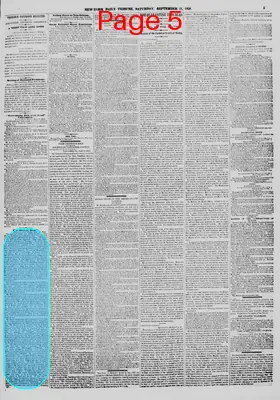
Story
September 11, 1858
New York Daily Tribune
New York, New York County, New York
What is this article about?
On September 10, 1858, in Philadelphia, Parson Brownlow and Mr. Abram Pryne debated slavery, with Brownlow defending its biblical and constitutional basis, while Pryne argued against it using founders' writings and moral grounds, amid audience interruptions.
Clipping
OCR Quality
95%
Excellent
Full Text
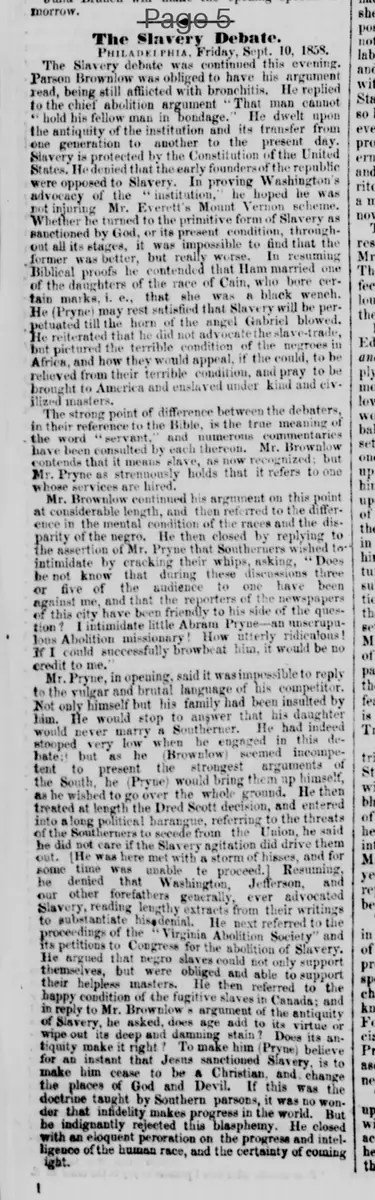
The Slavery Debate.
PHILADELPHIA, Friday, Sept. 10, 1858.
The Slavery debate was continued this evening.
Parson Brownlow was obliged to have his argument read, being still afflicted with bronchitis. He replied to the chief abolition argument "That man cannot hold his fellow man in bondage." He dwelt upon the antiquity of the institution and its transfer from one generation to another to the present day.
Slavery is protected by the Constitution of the United States. He denied that the early founders of the republic were opposed to Slavery. In proving Washington's advocacy of the "institution," he hoped he was not injuring Mr. Everett's Mount Vernon scheme.
Whether he turned to the primitive form of Slavery as sanctioned by God, or its present condition, throughout all its stages, it was impossible to find that the former was better, but really worse. In resuming Biblical proofs he contended that Ham married one of the daughters of the race of Cain, who bore certain marks, i. e., that she was a black wench.
He (Pryne) may rest satisfied that Slavery will be perpetuated till the horn of the angel Gabriel blowed.
He reiterated that he did not advocate the slave-trade, but pictured the terrible condition of the negroes in Africa, and how they would appeal, if they could, to be relieved from their terrible condition, and pray to be brought to America and enslaved under kind and civilized masters.
The strong point of difference between the debaters, in their reference to the Bible, is the true meaning of the word "servant," and numerous commentaries have been consulted by each thereon. Mr. Brownlow contends that it means slave, as now recognized: but Mr. Pryne as strenuously holds that it refers to one whose services are hired.
Mr. Brownlow continued his argument on this point at considerable length, and then referred to the difference in the mental condition of the races and the disparity of the negro. He then closed by replying to the assertion of Mr. Pryne that Southerners wished to intimidate by cracking their whips, asking, "Does he not know that during these discussions three or five of the audience to one have been against me, and that the reporters of the newspapers of this city have been friendly to his side of the question? I intimidate little Abram Pryne—an unscrupulous Abolition missionary! How utterly ridiculous! If I could successfully browbeat him, it would be no credit to me."
Mr. Pryne, in opening, said it was impossible to reply to the vulgar and brutal language of his competitor. Not only himself but his family had been insulted by him. He would stop to answer that his daughter would never marry a Southerner. He had indeed stooped very low when he engaged in this debate; but as he (Brownlow) seemed incompetent to present the strongest arguments of the South, he (Pryne) would bring them up himself, and treated at length the Dred Scott decision, and entered into a long political harangue, referring to the threats of the Southerners to secede from the Union, he said he did not care if the Slavery agitation did drive them out. [He was here met with a storm of hisses, and for some time was unable to proceed.] Resuming, he denied that Washington, Jefferson, and our other forefathers generally, ever advocated Slavery, reading lengthy extracts from their writings to substantiate his denial. He next referred to the proceedings of the "Virginia Abolition Society" and its petitions to Congress for the abolition of Slavery.
He argued that negro slaves could not only support themselves, but were obliged and able to support their helpless masters. He then referred to the happy condition of the fugitive slaves in Canada; and in reply to Mr. Brownlow's argument of the antiquity of Slavery he asked does age wipe out its deep and damning stain? Does its antiquity make it right? To make him (Pryne) believe for an instant that Jesus sanctioned Slavery, is to make him cease to be a Christian, and change the places of God and Devil. If this was the doctrine taught by Southern parsons, it was no wonder that infidelity makes progress in the world. But he indignantly rejected this blasphemy. He closed with an eloquent peroration on the progress and intelligence of the human race, and the certainty of coming right.
PHILADELPHIA, Friday, Sept. 10, 1858.
The Slavery debate was continued this evening.
Parson Brownlow was obliged to have his argument read, being still afflicted with bronchitis. He replied to the chief abolition argument "That man cannot hold his fellow man in bondage." He dwelt upon the antiquity of the institution and its transfer from one generation to another to the present day.
Slavery is protected by the Constitution of the United States. He denied that the early founders of the republic were opposed to Slavery. In proving Washington's advocacy of the "institution," he hoped he was not injuring Mr. Everett's Mount Vernon scheme.
Whether he turned to the primitive form of Slavery as sanctioned by God, or its present condition, throughout all its stages, it was impossible to find that the former was better, but really worse. In resuming Biblical proofs he contended that Ham married one of the daughters of the race of Cain, who bore certain marks, i. e., that she was a black wench.
He (Pryne) may rest satisfied that Slavery will be perpetuated till the horn of the angel Gabriel blowed.
He reiterated that he did not advocate the slave-trade, but pictured the terrible condition of the negroes in Africa, and how they would appeal, if they could, to be relieved from their terrible condition, and pray to be brought to America and enslaved under kind and civilized masters.
The strong point of difference between the debaters, in their reference to the Bible, is the true meaning of the word "servant," and numerous commentaries have been consulted by each thereon. Mr. Brownlow contends that it means slave, as now recognized: but Mr. Pryne as strenuously holds that it refers to one whose services are hired.
Mr. Brownlow continued his argument on this point at considerable length, and then referred to the difference in the mental condition of the races and the disparity of the negro. He then closed by replying to the assertion of Mr. Pryne that Southerners wished to intimidate by cracking their whips, asking, "Does he not know that during these discussions three or five of the audience to one have been against me, and that the reporters of the newspapers of this city have been friendly to his side of the question? I intimidate little Abram Pryne—an unscrupulous Abolition missionary! How utterly ridiculous! If I could successfully browbeat him, it would be no credit to me."
Mr. Pryne, in opening, said it was impossible to reply to the vulgar and brutal language of his competitor. Not only himself but his family had been insulted by him. He would stop to answer that his daughter would never marry a Southerner. He had indeed stooped very low when he engaged in this debate; but as he (Brownlow) seemed incompetent to present the strongest arguments of the South, he (Pryne) would bring them up himself, and treated at length the Dred Scott decision, and entered into a long political harangue, referring to the threats of the Southerners to secede from the Union, he said he did not care if the Slavery agitation did drive them out. [He was here met with a storm of hisses, and for some time was unable to proceed.] Resuming, he denied that Washington, Jefferson, and our other forefathers generally, ever advocated Slavery, reading lengthy extracts from their writings to substantiate his denial. He next referred to the proceedings of the "Virginia Abolition Society" and its petitions to Congress for the abolition of Slavery.
He argued that negro slaves could not only support themselves, but were obliged and able to support their helpless masters. He then referred to the happy condition of the fugitive slaves in Canada; and in reply to Mr. Brownlow's argument of the antiquity of Slavery he asked does age wipe out its deep and damning stain? Does its antiquity make it right? To make him (Pryne) believe for an instant that Jesus sanctioned Slavery, is to make him cease to be a Christian, and change the places of God and Devil. If this was the doctrine taught by Southern parsons, it was no wonder that infidelity makes progress in the world. But he indignantly rejected this blasphemy. He closed with an eloquent peroration on the progress and intelligence of the human race, and the certainty of coming right.
What sub-type of article is it?
Historical Event
What themes does it cover?
Moral Virtue
Justice
What keywords are associated?
Slavery Debate
Abolition
Biblical Arguments
Dred Scott
Founding Fathers
What entities or persons were involved?
Parson Brownlow
Mr. Pryne
Abram Pryne
Where did it happen?
Philadelphia
Story Details
Key Persons
Parson Brownlow
Mr. Pryne
Abram Pryne
Location
Philadelphia
Event Date
Sept. 10, 1858
Story Details
Parson Brownlow defends slavery using biblical arguments, constitutional protection, and historical founders' support, while criticizing abolitionists. Mr. Pryne counters with founders' anti-slavery views, Dred Scott decision critique, and moral condemnation of slavery as un-Christian, facing audience hisses.