Thank you for visiting SNEWPapers!
Sign up free
Portland Gazette, And Maine Advertiser
Portland, Cumberland County, Maine
What is this article about?
A letter from Springfield, Massachusetts, dated October 2, 1813, warns a friend in Boston against indirectly supporting the unjust War of 1812 through purchasing war loan stocks and celebrating naval victories, arguing these actions bolster the administration's popularity and prolong a conflict harmful to New England's commerce.
Clipping
OCR Quality
Full Text
From the Columbian Centinel.
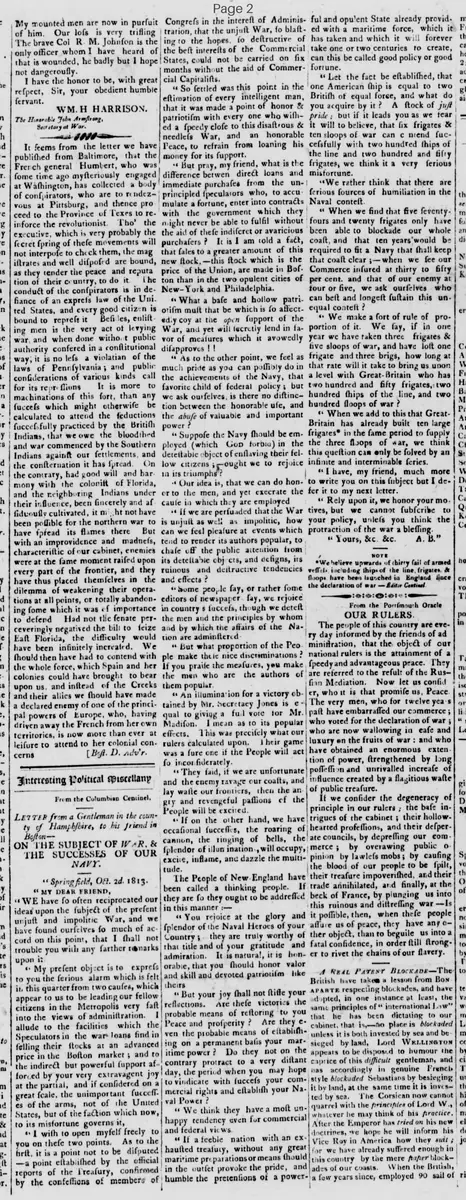
LETTER from a Gentleman in the county of Hampshire, to his friend in Boston—
ON THE SUBJECT OF WAR. &
THE SUCCESSES OF OUR
NAVY.
Springfield, Oct. 2d. 1813
MY DEAR FRIEND,
WE have so often reciprocated our ideas upon the subject of the present unjust and impolitic War, and we have found ourselves so much of accord on this point, that I shall not trouble you with any further remarks upon it.
My present object is to express to you the serious alarm which is felt in this quarter from two causes, which appear to us to be leading our fellow citizens in the Metropolis very fast into the views of administration. I allude to the facilities which the Speculators in the war loans find in selling their stocks at an advanced price in the Boston market; and to the indirect but powerful support afforded by your very extravagant joy at the partial, and if considered on a great scale, the unimportant successes of the arms, not of the United States, but of the faction which now, to its misfortune governs it.
I wish to open myself freely to you on these two points. As to the first, it is a point not to be disputed—a point established by the official reports of the Treasury, confirmed by the confessions of members of Congress in the interest of Administration, that the unjust War, so blasting to the hopes, so destructive of the best interests of the Commercial States, could not be carried on six months without the aid of Commercial Capitalists.
So settled was this point in the estimation of every intelligent man, that it was made a point of honor & patriotism with every one who wished a speedy close to this disastrous & needless War, and an honorable Peace, to refrain from loaning his money for its support.
But pray, my friend, what is the difference between direct loans and immediate purchases from the unprincipled speculators who, to accumulate a fortune, enter into contracts with the government which they might never be able to fulfil without the aid of these indiscreet or avaricious purchasers? It is I am told a fact. that sales to a greater amount of this new stock,—this stock which is the price of the Union, are made in Boston than in the two opulent cities of New-York and Philadelphia.
What a base and hollow patriotism must that be which is so affectedly coy at the open support of the War, and yet will secretly lend in favor of measures which it avowedly disapproves!!
As to the other point, we feel as much pride as you can possibly do in the achievements of the Navy, that favorite child of federal policy; but we ask ourselves, is there no distinction between the honorable use, and the abuse of valuable and important power?
Suppose the Navy should be employed (which God forbid) in the detestable object of enslaving their fellow citizens—ought we to rejoice in its triumphs?
Our idea is, that we can do honor to the men, and yet execrate the cause in which they are employed. If we are persuaded that the War is unjust as well as impolitic, how can we feel pleasure at events which tend to render its authors popular, to chase off the public attention from its detestable objects, and designs, its ruinous and destructive tendencies and effects?
Some people say, or rather some editors of newspapers say, we rejoice in country's success, though we detest the men and the principles by whom and by which the affairs of the Nation are administered.
But what proportion of the People make these nice discriminations? If you praise the measures, you make the men who are the authors of them popular.
An illumination for a victory obtained by Mr. Secretary Jones is equal to giving a full vote for Mr. Madison. I mean as to its popular effects. This was precisely what our rulers calculated upon. Their game was a sure one if the People will act so inconsiderately.
They said, if we are unfortunate and the enemy ravage our coasts, and lay waste our frontiers, then the angry and revengeful passions of the People will be excited.
If on the other hand, we have occasional successes, the roaring of cannon, the ringing of bells, the splendor of illumination, will occupy, excite, inflame, and dazzle the multitude.
The People of New-England have been called a thinking people. If they are so they ought to be addressed in this manner:
You rejoice at the glory and splendor of the Naval Heroes of your Country; they are truly worthy of that title and of your gratitude and admiration. It is natural, it is honorable, that you should honor valor and skill and devoted patriotism like theirs.
But your joy shall not stifle your reflections. Are these victories the probable means of restoring to you Peace and prosperity? Are they even the probable means of establishing on a permanent basis your maritime power? Do they not on the contrary protract to a very distant day, the period when you may hope to vindicate with success your commercial rights and establish your Naval Power?
We think they have a most unhappy tendency even for commercial and federal views.
If a feeble nation with an exhausted treasury, without any great maritime preparations or means should in the outset provoke the pride, and humble the pretensions of a powerful and opulent State already provided with a maritime force, which it has taken and which it will forever take one or two centuries to create, can this be called good policy or good fortune.
Let the fact be established, that one American ship is equal to two British of equal force, and what do you acquire by it? A stock of just pride; but if it leads you as we fear it will to believe, that six frigates & ten sloops of war can contend successfully with two hundred ships of the line and two hundred and fifty frigates, we think it a very serious misfortune.
We rather think that there are serious sources of humiliation in the Naval contest.
When we find that five seventy-fours and twenty frigates only have been able to blockade our whole coast, and that ten years would be required to fit a Navy that shall keep that coast clear;—when we see our Commerce insured at thirty to fifty per cent. and that of our enemy at four or five, we ask ourselves who can best and longest sustain this unequal contest?
We make a sort of rule of proportion of it. We say, if in one year we have taken three frigates & five sloops of war, and have lost one frigate and three brigs, how long at that rate will it take to bring us upon a level with Great-Britain who has two hundred and fifty frigates, two hundred ships of the line, and two hundred sloops of war?
When we add to this that Great-Britain has already built ten large frigates* in the same period to supply the three sloops of war, we think this question can only be solved by an infinite and interminable series.
I have, my friend, much more to write you on this subject but I defer it to my next letter.
Rely upon it, we honor your motives, but we cannot subscribe to your policy, unless you think the protraction of the war a blessing.
Yours, &c. &c.
A. B.
NOTE
*We believe upwards of thirty sail of armed vessels, including ships of the line, frigates. & sloops have been launched in England since the declaration of war—Editor Centinel.
What sub-type of article is it?
What themes does it cover?
What keywords are associated?
What entities or persons were involved?
Letter to Editor Details
Author
A. B.
Recipient
His Friend In Boston
Main Argument
bostonians are unwittingly supporting the unjust and impolitic war of 1812 by buying war loan stocks from speculators and excessively celebrating naval successes, which boosts the administration's popularity and prolongs a conflict destructive to new england's commercial interests.
Notable Details