Thank you for visiting SNEWPapers!
Sign up free
Story
April 11, 1924
The Midland Journal
Rising Sun, Cecil County, Maryland
What is this article about?
Historical account of how telephones revolutionized journalism starting in 1878 in New Haven, Conn., enabling remote reporting and aiding news, advertising, and business departments, replacing the need for reporters to physically rush facts to the office.
Clipping
OCR Quality
98%
Excellent
Full Text
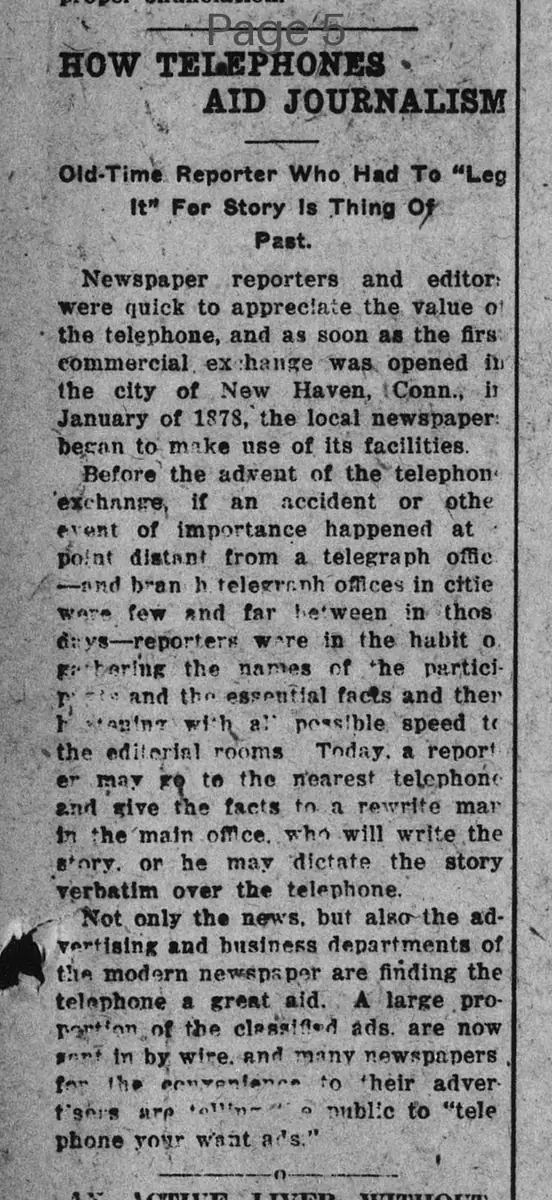
HOW TELEPHONES
AID JOURNALISM
Old-Time Reporter Who Had To "Leg It" For Story Is Thing Of Past.
Newspaper reporters and editors were quick to appreciate the value of the telephone, and as soon as the first commercial exchange was opened in the city of New Haven, Conn., in January of 1878, the local newspapers began to make use of its facilities.
Before the advent of the telephone exchange, if an accident or other event of importance happened at a point distant from a telegraph office -- and branch telegraph offices in cities were few and far between in those days -- reporters were in the habit of gathering the names of the participants and the essential facts and then rushing with all possible speed to the editorial rooms. Today, a reporter may go to the nearest telephone and give the facts to a rewrite man in the main office, who will write the story, or he may dictate the story verbatim over the telephone.
Not only the news, but also the advertising and business departments of the modern newspaper are finding the telephone a great aid. A large portion of the classified ads are now in by wire, and many newspapers for the convenience of their advertisers are printing to the public to "telephone your want ads."
AID JOURNALISM
Old-Time Reporter Who Had To "Leg It" For Story Is Thing Of Past.
Newspaper reporters and editors were quick to appreciate the value of the telephone, and as soon as the first commercial exchange was opened in the city of New Haven, Conn., in January of 1878, the local newspapers began to make use of its facilities.
Before the advent of the telephone exchange, if an accident or other event of importance happened at a point distant from a telegraph office -- and branch telegraph offices in cities were few and far between in those days -- reporters were in the habit of gathering the names of the participants and the essential facts and then rushing with all possible speed to the editorial rooms. Today, a reporter may go to the nearest telephone and give the facts to a rewrite man in the main office, who will write the story, or he may dictate the story verbatim over the telephone.
Not only the news, but also the advertising and business departments of the modern newspaper are finding the telephone a great aid. A large portion of the classified ads are now in by wire, and many newspapers for the convenience of their advertisers are printing to the public to "telephone your want ads."
What sub-type of article is it?
Historical Event
What themes does it cover?
Triumph
What keywords are associated?
Telephone Journalism
Newspaper Reporters
Commercial Exchange
New Haven
Classified Ads
Where did it happen?
New Haven, Conn.
Story Details
Location
New Haven, Conn.
Event Date
January Of 1878
Story Details
Newspaper reporters and editors quickly adopted the telephone after the first commercial exchange opened in New Haven, Conn., in January 1878, allowing them to report facts remotely instead of rushing to the office, transforming journalism from the era of old-time reporters who had to leg it for stories.