Thank you for visiting SNEWPapers!
Sign up free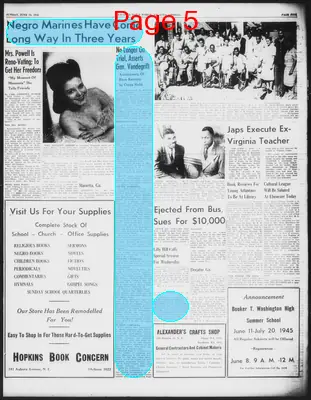
Story
June 10, 1945
Atlanta Daily World
Atlanta, Fulton County, Georgia
What is this article about?
Article marks three years of African American Marines in the USMC, from 1942 enlistment and training at Montford Point to combat valor in WWII Pacific campaigns, earning praise from Commandant Vandegrift and paving way for officers.
Clipping
OCR Quality
88%
Good
Full Text
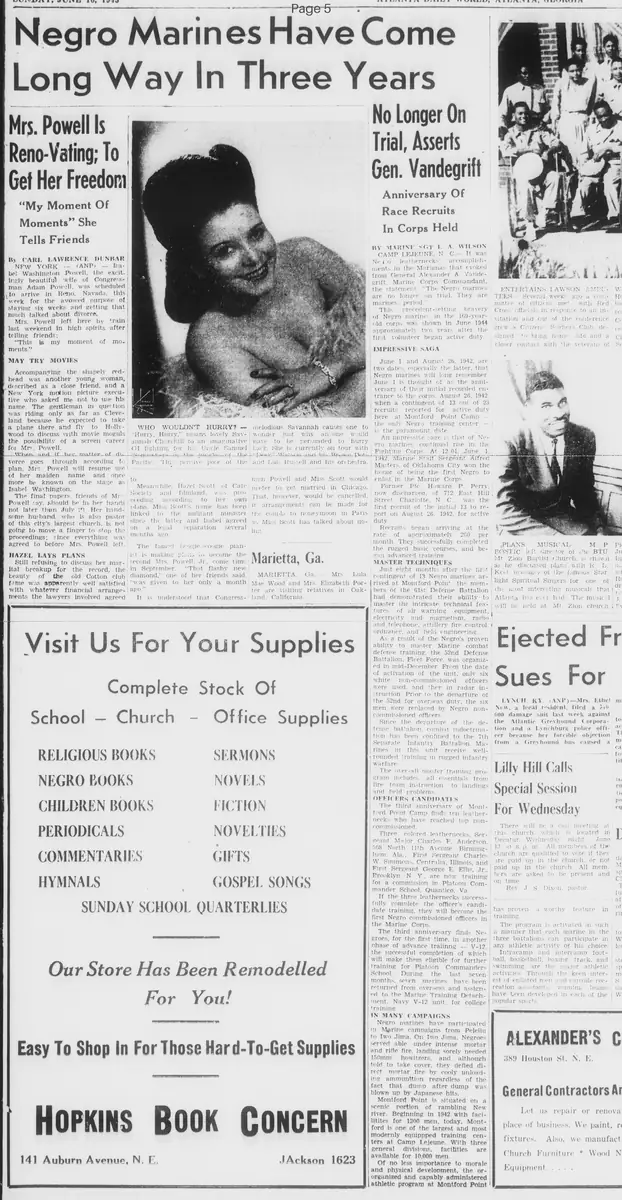
Negro Marines Have Come a Long Way In Three Years
No Longer On Trial, Asserts Gen. Vandegrift
Anniversary Of Race Recruits In Corps Held
BY MARINE SGT L A. WILSON
CAMP LEJEUNE, N C.- It was now four years that leathernecks' accomplishments in the Marianas evoked from General Alexander A. Vandegrift, Marine Corps Commandant, the statement "The Negro marines are no longer on trial. They are marines, period."
This precedent-setting bravery of Negro marines in the 169-year-old corps was shown in June 1944, approximately two years after the first volunteer began active duty.
IMPRESSIVE SAGA
June 1 and August 26, 1942, are two dates, especially the latter, that Negro marines will long remember. June 1 is thought of as the anniversary of their initial recorded entrance to the corps. August 26, 1942, when a contingent of 13 out of 200 recruits reported for active duty here at Montford Point Camp - the only Negro training center - is the paramount date.
An impressive saga is that of Negro marines' continual rise in the Fighting Corps. At 12:01, June 1, 1942, Marine Staff Sergeant Alfred Masters, of Oklahoma City won the honor of being the first Negro to enlist in the Marine Corps.
Former Pfc. Howard P. Perry, now discharged, of 712 East Hill Street, Charlotte, N. C. was the first recruit of the initial 13 to report on August 26, 1942, for active duty.
Recruits began arriving at the rate of approximately 200 per month. They successfully completed the rugged basic courses, and began advanced training.
MASTER TECHNIQUES
Just eight months after the first contingent of 13 Negro marines arrived at Montford Point, the members of the 51st Defense Battalion had demonstrated their ability to master the intricate technical features of air warning equipment, electricity and magnetism, radio and telephone, artillery fire control, ordnance, and field engineering.
As a result of the Negro's proven ability to master Marine combat defense training, the 52nd Defense Battalion, Fleet Force, was organized in mid-December. From the date of activation of the unit, only six white non-commissioned officers were used, and they in radar instruction. Prior to the departure of the 52nd for overseas duty, the six men were replaced by Negro non-commissioned officers.
Since the departure of the defense battalion, combat doctrination has been confined to the 51st Separate Infantry Battalion. Marines in this unit receive well-rounded training in rugged infantry warfare.
The over-all master training program includes all essentials from fire team instruction to landings and field problems.
OFFICERS CANDIDATES
The third anniversary of Montford Point Camp finds ten leathernecks who have reached top non-commissioned.
Three colored leathernecks, Sergeant Major Charles F. Anderson, 508 North 11th Avenue, Birmingham, Ala.; First Sergeant Charles W. Simmons, Centralia, Illinois, and First Sergeant George E. Ellis, Jr., Brooklyn, N. Y. are now training for a commission in Platoon Commander School, Quantico, Va.
If the three leathernecks successfully complete the officer's candidate training, they will become the first Negro commissioned officers in the Marine Corps.
The third anniversary finds Negroes, for the first time, in another phase of advance training - V-12, the successful completion of which will make them eligible for further training for Platoon Commanders School. During the last seven months, seven marines have been returned from overseas and assigned to the Marine Training Detachment, Navy V-12 unit, for college training.
IN MANY CAMPAIGNS
Negro marines have participated in Marine campaigns from Peleliu to Iwo Jima. On Iwo Jima, Negroes served ably under intense mortar and rifle fire, landing sorely needed 150mm howitzers, and although told to take cover, they defied direct mortar fire by cooly unloading ammunition regardless of the fact that dump after dump was blown up by Japanese hits.
Montford Point is situated on a scenic portion of rambling New River. Beginning in 1942 with facilities for 1200 men, today, Montford is one of the largest and most modernly equipped training centers at Camp Lejeune. With three general divisions, facilities are available for 10,000 men.
Of no less importance to morale and physical development, the organized and capably administered athletic program at Montford Point has proven worthy feature in training.
The program is activated in such a manner that each marine in the three battalions can participate in any athletic activity of his choice.
Intracamp and intercamp football, basketball, boxing, track, and swimming are the major athletic activities. Through the keen interest of enlisted men and capable recreation assistant winning teams have been developed in each of the popular sports.
No Longer On Trial, Asserts Gen. Vandegrift
Anniversary Of Race Recruits In Corps Held
BY MARINE SGT L A. WILSON
CAMP LEJEUNE, N C.- It was now four years that leathernecks' accomplishments in the Marianas evoked from General Alexander A. Vandegrift, Marine Corps Commandant, the statement "The Negro marines are no longer on trial. They are marines, period."
This precedent-setting bravery of Negro marines in the 169-year-old corps was shown in June 1944, approximately two years after the first volunteer began active duty.
IMPRESSIVE SAGA
June 1 and August 26, 1942, are two dates, especially the latter, that Negro marines will long remember. June 1 is thought of as the anniversary of their initial recorded entrance to the corps. August 26, 1942, when a contingent of 13 out of 200 recruits reported for active duty here at Montford Point Camp - the only Negro training center - is the paramount date.
An impressive saga is that of Negro marines' continual rise in the Fighting Corps. At 12:01, June 1, 1942, Marine Staff Sergeant Alfred Masters, of Oklahoma City won the honor of being the first Negro to enlist in the Marine Corps.
Former Pfc. Howard P. Perry, now discharged, of 712 East Hill Street, Charlotte, N. C. was the first recruit of the initial 13 to report on August 26, 1942, for active duty.
Recruits began arriving at the rate of approximately 200 per month. They successfully completed the rugged basic courses, and began advanced training.
MASTER TECHNIQUES
Just eight months after the first contingent of 13 Negro marines arrived at Montford Point, the members of the 51st Defense Battalion had demonstrated their ability to master the intricate technical features of air warning equipment, electricity and magnetism, radio and telephone, artillery fire control, ordnance, and field engineering.
As a result of the Negro's proven ability to master Marine combat defense training, the 52nd Defense Battalion, Fleet Force, was organized in mid-December. From the date of activation of the unit, only six white non-commissioned officers were used, and they in radar instruction. Prior to the departure of the 52nd for overseas duty, the six men were replaced by Negro non-commissioned officers.
Since the departure of the defense battalion, combat doctrination has been confined to the 51st Separate Infantry Battalion. Marines in this unit receive well-rounded training in rugged infantry warfare.
The over-all master training program includes all essentials from fire team instruction to landings and field problems.
OFFICERS CANDIDATES
The third anniversary of Montford Point Camp finds ten leathernecks who have reached top non-commissioned.
Three colored leathernecks, Sergeant Major Charles F. Anderson, 508 North 11th Avenue, Birmingham, Ala.; First Sergeant Charles W. Simmons, Centralia, Illinois, and First Sergeant George E. Ellis, Jr., Brooklyn, N. Y. are now training for a commission in Platoon Commander School, Quantico, Va.
If the three leathernecks successfully complete the officer's candidate training, they will become the first Negro commissioned officers in the Marine Corps.
The third anniversary finds Negroes, for the first time, in another phase of advance training - V-12, the successful completion of which will make them eligible for further training for Platoon Commanders School. During the last seven months, seven marines have been returned from overseas and assigned to the Marine Training Detachment, Navy V-12 unit, for college training.
IN MANY CAMPAIGNS
Negro marines have participated in Marine campaigns from Peleliu to Iwo Jima. On Iwo Jima, Negroes served ably under intense mortar and rifle fire, landing sorely needed 150mm howitzers, and although told to take cover, they defied direct mortar fire by cooly unloading ammunition regardless of the fact that dump after dump was blown up by Japanese hits.
Montford Point is situated on a scenic portion of rambling New River. Beginning in 1942 with facilities for 1200 men, today, Montford is one of the largest and most modernly equipped training centers at Camp Lejeune. With three general divisions, facilities are available for 10,000 men.
Of no less importance to morale and physical development, the organized and capably administered athletic program at Montford Point has proven worthy feature in training.
The program is activated in such a manner that each marine in the three battalions can participate in any athletic activity of his choice.
Intracamp and intercamp football, basketball, boxing, track, and swimming are the major athletic activities. Through the keen interest of enlisted men and capable recreation assistant winning teams have been developed in each of the popular sports.
What sub-type of article is it?
Historical Event
Biography
Personal Triumph
What themes does it cover?
Bravery Heroism
Triumph
Social Manners
What keywords are associated?
Negro Marines
Usmc Integration
Montford Point
Wwii Combat
Defense Battalion
Officer Training
Racial Progress
What entities or persons were involved?
Alexander A. Vandegrift
Alfred Masters
Howard P. Perry
Charles F. Anderson
Charles W. Simmons
George E. Ellis, Jr.
L A. Wilson
Where did it happen?
Montford Point Camp, Camp Lejeune, N.C.
Story Details
Key Persons
Alexander A. Vandegrift
Alfred Masters
Howard P. Perry
Charles F. Anderson
Charles W. Simmons
George E. Ellis, Jr.
L A. Wilson
Location
Montford Point Camp, Camp Lejeune, N.C.
Event Date
June 1, 1942 To 1945
Story Details
African American Marines enlisted starting June 1, 1942, trained at Montford Point, formed defense battalions, fought in Pacific WWII campaigns like Marianas, Peleliu, and Iwo Jima, earning Vandegrift's praise; three pursue commissioning as first Black officers.