Thank you for visiting SNEWPapers!
Sign up free
Literary
November 12, 1841
Carroll Free Press
Carrollton, Carroll County, Ohio
What is this article about?
A young man from the woods falls for a delicate visitor, steals a kiss, later marries her at 20. As a novice lawyer in Kentucky, he defends a counterfeit money suspect in court, overcomes nerves to win, earning fees that secure his and his wife's future amid poverty.
Clipping
OCR Quality
98%
Excellent
Full Text
From the N. York Knickerbocker.
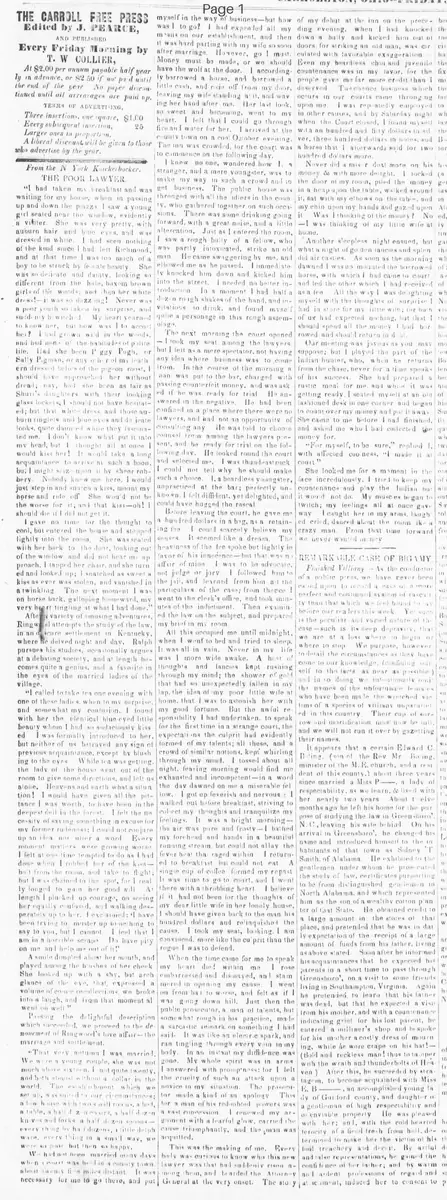
THE POOR LAWYER.
"I had taken my breakfast and was waiting for my horse, when in passing up and down the piazza I saw a young girl seated near the window, evidently a visitor. She was very pretty, with auburn hair and blue eyes, and was dressed in white. I had seen nothing of the kind since I had left Richmond, and at that time I was too much of a boy to be struck by female beauty. She was so delicate and dainty, looking so different from the hale, buxom brown girls of the woods, and her white dress!—it was so dazzling! Never was a poor youth so taken by surprise, and suddenly with my heart yearning to know her, but how was I to accost her? I had grown wild in the woods, and had none of the blandishments of polite life. Had she been Peggy Pugh, or Sally Pigman, or any other of my hearth friends dressed in the pigeon roost, I should have approached her without dread, nay, had she been as fair as Shurt's daughters with their looking glass lockets, I should not have hesitated; but that white dress and those auburn ringlets and blue eyes and delicate looks, quite daunted me when they fascinated me. I don't know what put it into my head, but I thought all at once I would kiss her! It would take a long acquaintance to arrive at such a boon, but I might seize upon it by sheer robbery. Nobody knew me here. I would just step in and snatch a kiss, mount my horse and ride off. She would not be the worse for it, and that kiss—oh! I should die if I did not get it.
I gave no time for the thought to cool, but entered the house and stepped lightly into the room. She was seated with her back to the door, looking out of the window and did not hear me approach. I tapped her chair, and she turned and looked up; I snatched as sweet a kiss as ever was stolen, and vanished in a twinkling. The next moment I was on horseback, galloping homeward, my very heart tingling at what I had done."
After a variety of amusing adventures, Ringwood attempts the study of the law, in an obscure settlement in Kentucky, where he delved night and day. Ralph pursues his studies, occasionally argues at a debating society, and at length becomes quite a genius, and a favorite in the eyes of the married ladies of the village.
"I called to take tea one evening with one of these ladies, when to my surprise, and somewhat my confusion, I found with her the beautiful blue-eyed little beauty whom I had so audaciously kissed. I was formally introduced to her, but neither of us betrayed any sign of previous acquaintance, except by blushing to the eyes. While tea was getting, the lady of the house went out of the room to give some directions, and left us alone. Heavens and earth! what a situation! I would have given all the pittance I was worth, to have been in the deepest dell in the forest. I felt the necessity of saying something in excuse for my former rudeness: I could not conjure up an idea nor utter a word. Every moment matters were growing worse. I felt at one time tempted to do as I had done when I robbed her of the kiss—bolt from the room, and take to flight, but I was chained to the spot, for I really longed to gain her good will. At length I plucked up courage, on seeing her equally confused, and walking desperately up to her, exclaimed: 'I have been trying to muster up something to say to you, but I cannot. I feel that I am in a horrible scrape. Do have pity on me and help me out of it.'
A smile dimpled above her mouth, and played among the bushes of her cheek. She looked up with a shy, but arch glance of the eye, that expressed a volume of coy recollections. We broke into a laugh, and from that moment all went on well."
Passing the delightful description which follows, we proceed to the denouement of Ringwood's love affair—the marriage and settlement.
"That very autumn I was married. We were a young couple, she was not much above sixteen, I not quite twenty, and both almost without a dollar in the world. The establishment which we set up was suited to our circumstances—all household with small rooms—a table, a half dozen chairs, a half dozen knives and forks, a half dozen spoons—everything by half dozens, silverplate ware, everything in a small way, we were so proud but then so happy.
We had not been married many days when court was holding in a county town about twenty miles distant. It was necessary for me to go there, and put myself in the way of business—but how was I to go? I had expended all my means on our establishment, and then it was hard parting with my wife so soon after marriage. However, go I must. Money must be made, or we should have the wolf at the door. I accordingly borrowed a horse, and borrowed a little cash, and rode off from my door, leaving my wife standing at it, and waving her hand after me. Her last look, so sweet and becoming, went to my heart. I felt that I could go through fire and water for her. I arrived at the county town on a cool October evening. The inn was crowded, for the court was to commence on the following day. I knew no one, wondered how I, a stranger, and a mere youngster, was to make my way in such a crowd and to get business. The public house was thronged with all the idlers in the county, who gathered together on such occasions. There was some drinking going forward, with a great noise, and a little altercation. Just as I entered the room, I saw a rough bully of a fellow, who was partly intoxicated, strike an old man. He came swaggering by me, and elbowed me as he passed. Immediately I knocked him down and kicked him into the street. I needed no better introduction. In a moment I had half a dozen rough shakes of the hand, and invitations to drink, and found myself quite a personage in this rough assembly.
The next morning the court opened—I took my seat among the lawyers, but I felt as a mere spectator, not having any idea where business was to come from. In the course of the morning a man was put to the bar, charged with passing counterfeit money, and was asked if he was ready for trial. He answered in the negative. He had been confined in a place where there were no lawyers, and had not an opportunity of consulting any. He was told to choose counsel from among the lawyers present, and be ready for trial on the following day. He looked round the court and selected me. I was thunderstruck. I could not tell why he should make such a choice. I, a beardless youngster, unpracticed at the bar; perfectly unknown. I felt diffident, yet delighted, and could have hugged the rascal.
Before leaving the court, he gave me a hundred dollars in a bag, as a retaining fee. I could scarcely believe my senses. It seemed like a dream. The heaviness of the fee spoke but lightly in favor of his innocence—but that was not an affair of mine. I was to be advocate, not judge or jury. I followed him to the jail, and learned from him the particulars of the case; from thence I went to the clerk's office, and took minutes of the indictment. Then examined the law on the subject, and prepared my brief in my room. All this occupied me until midnight, when I went to bed and tried to sleep. It was all in vain. Never in my life was I more wide awake. A host of thoughts and fancies kept rushing through my mind: the shower of gold that had so unexpectedly fallen in my lap, the idea of my poor little wife at home, that I was to astonish her with my good fortune. But the awful responsibility I had undertaken, to speak for the first time in a strange court, the expectations the culprit had evidently formed of my talents; all these, and a crowd of similar notions, kept whirling through my mind. I tossed about all night, fearing morning would find me exhausted and incompetent—in a word, the day dawned on me a miserable fellow. I got up feverish and nervous. I walked out before breakfast, striving to collect my thoughts and tranquilize my feelings. It was a bright morning—the air was pure and frosty—I bathed my forehead and hands in a beautiful running stream but could not allay the fever heat that raged within. I returned to breakfast but could not eat. A single cup of coffee formed my repast. It was time to go to court, and I went there with a throbbing heart. I believe if it had not been for the thoughts of my dear little wife in her lonely house, I should have given back to the man his hundred dollars and relinquished the cause. I took my seat, looking, I am convinced, more like the culprit than the rogue I was to defend.
When the time came for me to speak my heart died within me. I rose embarrassed and dismayed, and stammered in opening my cause. I went on from bad to worse, and felt as if I was going down hill. Just then the public prosecutor, a man of talents, but somewhat rough in his practice, made a sarcastic remark on something I had said. It was like an electric spark, and ran tingling through every vein in my body. In an instant my diffidence was gone. My whole spirit was in arms. I answered with promptness: for I felt the cruelty of such an attack upon a novice in my situation. The prosecutor made a kind of an apology. This for a man of his redoubted powers was a vast concession. I renewed my argument with a fearful glow, carried the cause triumphantly, and the man was acquitted.
This was the making of me. Everybody was curious to know who this new lawyer was that had suddenly risen among them, and startled the Attorney General at the very onset. The story of my debut at the inn on the preceding evening, when I had knocked down a bully and kicked him out of doors for striking an old man, was circulated with favorable exaggeration. Even my beardless chin and juvenile countenance was in my favor, for the people gave me far more credit than I deserved. The chance business which occurs in our courts came thronging upon me. I was repeatedly employed in other causes, and by Saturday night when the Court closed, I found myself with a hundred and fifty dollars in silver, three hundred dollars in notes, and a horse that I afterwards sold for two hundred dollars more.
Never did a miser dote more on his money with more delight. I locked the door of my room, piled the money in a heap upon the table, walked around it, sat with my elbows on the table, and my chin upon my hands and gazed upon it. Was I thinking of the money? No—I was thinking of my little wife at home.
Another sleepless night ensued, but what a night of golden fancies and splendid air castles. As soon as the morning dawned I was up, mounted the borrowed horse, with which I had come to court, and led the other which I had received as a fee. All the way I was delighting myself with the thoughts of surprise I had in store for my little wife; for both of us had expected nothing, but that I should spend all the money I had borrowed and should return in debt. Our meeting was joyous as you may suppose: but I played the part of the Indian hunter, who, when he returns from the chase, never for a time speaks of his success. She had prepared a rustic meal for me and while it was getting ready, I seated myself at an old fashioned desk in one corner and began to count over my money and put it away. She came to me before I had finished, and asked me who I had collected the money for.
"For myself, to be sure," replied I, with affected coolness, "I made it at court."
She looked me for a moment in the face incredulously. I tried to keep my countenance and play the Indian but it would not do. My muscles began to twitch; my feelings all at once gave way. I caught her in my arms, laughed cried, danced about the room like a crazy man. From that time forward we never waned in joy.
THE POOR LAWYER.
"I had taken my breakfast and was waiting for my horse, when in passing up and down the piazza I saw a young girl seated near the window, evidently a visitor. She was very pretty, with auburn hair and blue eyes, and was dressed in white. I had seen nothing of the kind since I had left Richmond, and at that time I was too much of a boy to be struck by female beauty. She was so delicate and dainty, looking so different from the hale, buxom brown girls of the woods, and her white dress!—it was so dazzling! Never was a poor youth so taken by surprise, and suddenly with my heart yearning to know her, but how was I to accost her? I had grown wild in the woods, and had none of the blandishments of polite life. Had she been Peggy Pugh, or Sally Pigman, or any other of my hearth friends dressed in the pigeon roost, I should have approached her without dread, nay, had she been as fair as Shurt's daughters with their looking glass lockets, I should not have hesitated; but that white dress and those auburn ringlets and blue eyes and delicate looks, quite daunted me when they fascinated me. I don't know what put it into my head, but I thought all at once I would kiss her! It would take a long acquaintance to arrive at such a boon, but I might seize upon it by sheer robbery. Nobody knew me here. I would just step in and snatch a kiss, mount my horse and ride off. She would not be the worse for it, and that kiss—oh! I should die if I did not get it.
I gave no time for the thought to cool, but entered the house and stepped lightly into the room. She was seated with her back to the door, looking out of the window and did not hear me approach. I tapped her chair, and she turned and looked up; I snatched as sweet a kiss as ever was stolen, and vanished in a twinkling. The next moment I was on horseback, galloping homeward, my very heart tingling at what I had done."
After a variety of amusing adventures, Ringwood attempts the study of the law, in an obscure settlement in Kentucky, where he delved night and day. Ralph pursues his studies, occasionally argues at a debating society, and at length becomes quite a genius, and a favorite in the eyes of the married ladies of the village.
"I called to take tea one evening with one of these ladies, when to my surprise, and somewhat my confusion, I found with her the beautiful blue-eyed little beauty whom I had so audaciously kissed. I was formally introduced to her, but neither of us betrayed any sign of previous acquaintance, except by blushing to the eyes. While tea was getting, the lady of the house went out of the room to give some directions, and left us alone. Heavens and earth! what a situation! I would have given all the pittance I was worth, to have been in the deepest dell in the forest. I felt the necessity of saying something in excuse for my former rudeness: I could not conjure up an idea nor utter a word. Every moment matters were growing worse. I felt at one time tempted to do as I had done when I robbed her of the kiss—bolt from the room, and take to flight, but I was chained to the spot, for I really longed to gain her good will. At length I plucked up courage, on seeing her equally confused, and walking desperately up to her, exclaimed: 'I have been trying to muster up something to say to you, but I cannot. I feel that I am in a horrible scrape. Do have pity on me and help me out of it.'
A smile dimpled above her mouth, and played among the bushes of her cheek. She looked up with a shy, but arch glance of the eye, that expressed a volume of coy recollections. We broke into a laugh, and from that moment all went on well."
Passing the delightful description which follows, we proceed to the denouement of Ringwood's love affair—the marriage and settlement.
"That very autumn I was married. We were a young couple, she was not much above sixteen, I not quite twenty, and both almost without a dollar in the world. The establishment which we set up was suited to our circumstances—all household with small rooms—a table, a half dozen chairs, a half dozen knives and forks, a half dozen spoons—everything by half dozens, silverplate ware, everything in a small way, we were so proud but then so happy.
We had not been married many days when court was holding in a county town about twenty miles distant. It was necessary for me to go there, and put myself in the way of business—but how was I to go? I had expended all my means on our establishment, and then it was hard parting with my wife so soon after marriage. However, go I must. Money must be made, or we should have the wolf at the door. I accordingly borrowed a horse, and borrowed a little cash, and rode off from my door, leaving my wife standing at it, and waving her hand after me. Her last look, so sweet and becoming, went to my heart. I felt that I could go through fire and water for her. I arrived at the county town on a cool October evening. The inn was crowded, for the court was to commence on the following day. I knew no one, wondered how I, a stranger, and a mere youngster, was to make my way in such a crowd and to get business. The public house was thronged with all the idlers in the county, who gathered together on such occasions. There was some drinking going forward, with a great noise, and a little altercation. Just as I entered the room, I saw a rough bully of a fellow, who was partly intoxicated, strike an old man. He came swaggering by me, and elbowed me as he passed. Immediately I knocked him down and kicked him into the street. I needed no better introduction. In a moment I had half a dozen rough shakes of the hand, and invitations to drink, and found myself quite a personage in this rough assembly.
The next morning the court opened—I took my seat among the lawyers, but I felt as a mere spectator, not having any idea where business was to come from. In the course of the morning a man was put to the bar, charged with passing counterfeit money, and was asked if he was ready for trial. He answered in the negative. He had been confined in a place where there were no lawyers, and had not an opportunity of consulting any. He was told to choose counsel from among the lawyers present, and be ready for trial on the following day. He looked round the court and selected me. I was thunderstruck. I could not tell why he should make such a choice. I, a beardless youngster, unpracticed at the bar; perfectly unknown. I felt diffident, yet delighted, and could have hugged the rascal.
Before leaving the court, he gave me a hundred dollars in a bag, as a retaining fee. I could scarcely believe my senses. It seemed like a dream. The heaviness of the fee spoke but lightly in favor of his innocence—but that was not an affair of mine. I was to be advocate, not judge or jury. I followed him to the jail, and learned from him the particulars of the case; from thence I went to the clerk's office, and took minutes of the indictment. Then examined the law on the subject, and prepared my brief in my room. All this occupied me until midnight, when I went to bed and tried to sleep. It was all in vain. Never in my life was I more wide awake. A host of thoughts and fancies kept rushing through my mind: the shower of gold that had so unexpectedly fallen in my lap, the idea of my poor little wife at home, that I was to astonish her with my good fortune. But the awful responsibility I had undertaken, to speak for the first time in a strange court, the expectations the culprit had evidently formed of my talents; all these, and a crowd of similar notions, kept whirling through my mind. I tossed about all night, fearing morning would find me exhausted and incompetent—in a word, the day dawned on me a miserable fellow. I got up feverish and nervous. I walked out before breakfast, striving to collect my thoughts and tranquilize my feelings. It was a bright morning—the air was pure and frosty—I bathed my forehead and hands in a beautiful running stream but could not allay the fever heat that raged within. I returned to breakfast but could not eat. A single cup of coffee formed my repast. It was time to go to court, and I went there with a throbbing heart. I believe if it had not been for the thoughts of my dear little wife in her lonely house, I should have given back to the man his hundred dollars and relinquished the cause. I took my seat, looking, I am convinced, more like the culprit than the rogue I was to defend.
When the time came for me to speak my heart died within me. I rose embarrassed and dismayed, and stammered in opening my cause. I went on from bad to worse, and felt as if I was going down hill. Just then the public prosecutor, a man of talents, but somewhat rough in his practice, made a sarcastic remark on something I had said. It was like an electric spark, and ran tingling through every vein in my body. In an instant my diffidence was gone. My whole spirit was in arms. I answered with promptness: for I felt the cruelty of such an attack upon a novice in my situation. The prosecutor made a kind of an apology. This for a man of his redoubted powers was a vast concession. I renewed my argument with a fearful glow, carried the cause triumphantly, and the man was acquitted.
This was the making of me. Everybody was curious to know who this new lawyer was that had suddenly risen among them, and startled the Attorney General at the very onset. The story of my debut at the inn on the preceding evening, when I had knocked down a bully and kicked him out of doors for striking an old man, was circulated with favorable exaggeration. Even my beardless chin and juvenile countenance was in my favor, for the people gave me far more credit than I deserved. The chance business which occurs in our courts came thronging upon me. I was repeatedly employed in other causes, and by Saturday night when the Court closed, I found myself with a hundred and fifty dollars in silver, three hundred dollars in notes, and a horse that I afterwards sold for two hundred dollars more.
Never did a miser dote more on his money with more delight. I locked the door of my room, piled the money in a heap upon the table, walked around it, sat with my elbows on the table, and my chin upon my hands and gazed upon it. Was I thinking of the money? No—I was thinking of my little wife at home.
Another sleepless night ensued, but what a night of golden fancies and splendid air castles. As soon as the morning dawned I was up, mounted the borrowed horse, with which I had come to court, and led the other which I had received as a fee. All the way I was delighting myself with the thoughts of surprise I had in store for my little wife; for both of us had expected nothing, but that I should spend all the money I had borrowed and should return in debt. Our meeting was joyous as you may suppose: but I played the part of the Indian hunter, who, when he returns from the chase, never for a time speaks of his success. She had prepared a rustic meal for me and while it was getting ready, I seated myself at an old fashioned desk in one corner and began to count over my money and put it away. She came to me before I had finished, and asked me who I had collected the money for.
"For myself, to be sure," replied I, with affected coolness, "I made it at court."
She looked me for a moment in the face incredulously. I tried to keep my countenance and play the Indian but it would not do. My muscles began to twitch; my feelings all at once gave way. I caught her in my arms, laughed cried, danced about the room like a crazy man. From that time forward we never waned in joy.
What sub-type of article is it?
Prose Fiction
What themes does it cover?
Love Romance
Moral Virtue
What keywords are associated?
Poor Lawyer
Stolen Kiss
Young Marriage
Court Debut
Kentucky Law
Romantic Success
What entities or persons were involved?
From The N. York Knickerbocker
Literary Details
Title
The Poor Lawyer.
Author
From The N. York Knickerbocker
Key Lines
I Snatched As Sweet A Kiss As Ever Was Stolen, And Vanished In A Twinkling.
I Felt The Necessity Of Saying Something In Excuse For My Former Rudeness: I Could Not Conjure Up An Idea Nor Utter A Word.
I Renewed My Argument With A Fearful Glow, Carried The Cause Triumphantly, And The Man Was Acquitted.
Was I Thinking Of The Money? No—I Was Thinking Of My Little Wife At Home.
From That Time Forward We Never Waned In Joy.