Thank you for visiting SNEWPapers!
Sign up free
Literary
September 19, 1884
Daily Republican
Wilmington, New Castle County, Delaware
What is this article about?
Nell Page, a working girl, visits her wealthy, eccentric Aunt Martha after receiving an invitation. She cares for her aunt after a stroke triggered by seeing Walter Spencer's photo, learns of their past quarrel. Aunt dies intending to share inheritance equally, but will invalid; Nell and Walter, who love each other, become co-heirs and marry.
Clipping
OCR Quality
95%
Excellent
Full Text
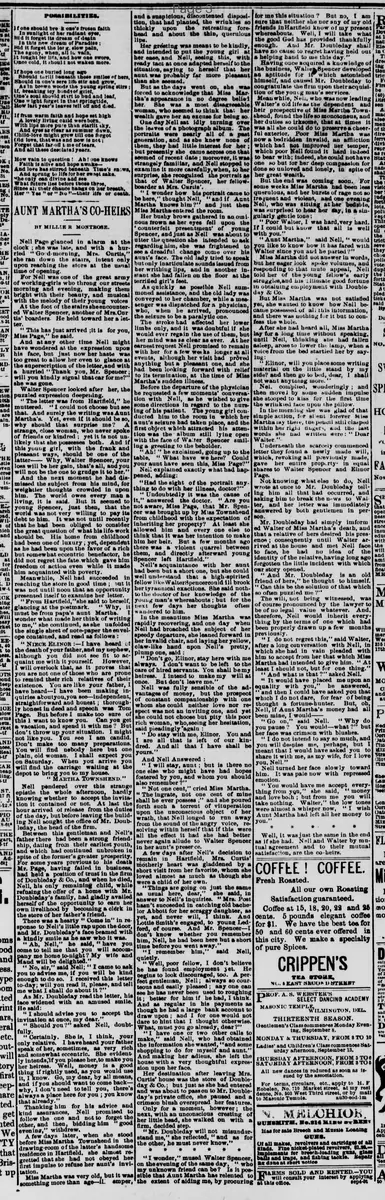
AUNT MARTHA'S CO-HEIRS
BY MILLIE R. MONTROSE.
Nell Page glanced in alarm at the clock; she was late, and with a hurried "Good-morning, Mrs. Curtis."
she ran down the stairs, intent only upon reaching the store at the usual time of opening.
For Nell was one of the great army of working-girls who throng our streets morning and evening, making them bright with their beauty, and musical with the melody of their young voices. At the foot of the stairs she encountered Walter Spencer, another of Mrs. Curtis' boarders. He held toward her a letter.
"This has just arrived; it is for you, Miss Page," he said.
And at any other time Nell might have wondered at the expression upon his face, but just now her haste was too great to allow her even to glance at the superscription of the letter, and with a hurried "Thank you, Mr. Spencer, will you kindly signal that car for me?" she was gone.
Walter Spencer looked after her, the puzzled expression deepening.
"The letter was from Hartfield," he muttered. "I could not choose but see that. And surely the writing was Aunt Martha's. Yet, even if it should be so why should that surprise me? A strange, close woman, who never spoke of friends or kindred; yet it is not unlikely that she possesses both. And if this young girl, with the frank and pleasant ways, should be one of the latter—Why, Walter Spencer, your loss will be her gain, that's all, and you will not be the one to grudge it to her."
And the next moment he had dismissed the subject from his mind, for weightier thoughts crowded in upon him. The world owes every man a living, it is said. But it seemed to young Spencer, just then, that the world was not very willing to pay its debt to him. It was not until recently that he had been obliged to consider the great question of what his life work should be. His home from childhood had been one of luxury; yet, dependent as he had been upon the favor of a rich but somewhat eccentric benefactor, he did not regret the fate which gave him freedom of action even while it made him acquainted with poverty.
Meanwhile, Nell had succeeded in reaching the store in good time; but it was not until noon that an opportunity presented itself to examine her letter.
"From Hartfield," she said to herself glancing at the postmark. "Why, it must be from papa's aunt Martha. I wonder what made her think of writing to me," she continued, as she unfolded the single sheet of note-paper the envelope contained, and read as follows:
"NIECE ELLINOR:—I have heard of the death of your father, and my nephew although you did not see fit to acquaint me with it yourself. However, I will overlook that, as it proves that you are not one of those who are prone to remind their rich relatives of their existence. You are like your father, I have heard—I have been making inquiries about you, you see—independent, straightforward and honest; thoroughly honest in deed and speech was Tom Page. But before I make too sure of this I want to know you. Can you get vacation, and spend it with me? But don't throw up your situation. I might not like you. You see I am candid. Don't make too many preparations. You will find nobody here but one plain, old woman. I shall expect you on Saturday. When you arrive you will find the carriage waiting at the depot to bring you to my house.
MARTHA TOWNSHEND."
Nell pondered over this strange epistle the whole afternoon, hardly knowing whether to accept the invitation it contained or not. At last the hour arrived of release from the duties of the day, but before leaving the building Nell sought the office of Mr. Doubleday, the head of the firm.
Between this gentleman and Nell's father there had been a strong friendship, dating from their earliest youth, and which had continued unbroken in spite of the former's greater prosperity. For some years previous to his death Mr. Page, having failed in business, had held a position of trust in the firm of Doubleday & Co., and when he died Nell, his only remaining child, while refusing the offer of a home with Mr. Doubleday's family, had gladly availed herself of the opportunity to earn her own livelihood by becoming a clerk in the store of her father's friend.
There was a hearty "Come in" in response to Nell's little rap upon the door, and Mr. Doubleday's face beamed with a kindly smile as he saw who it was.
"Ah, Nell," he said, "have you come to tell me that you will accompany me home to-night? My wife and Maud will be delighted."
"No, sir," said Nell; "I came to ask you to advise me, if you will be kind enough to do so. I received this letter to-day; will you read it, please, and tell me what I shall do about it?"
As Mr. Doubleday read the letter, his face widened with an amused smile. He said:
"I should advise you to accept the invitation at once, my dear."
"Should you?" asked Nell, doubtfully.
"Certainly. She is, I think, your only relative. I have heard your father speak of her, sometimes, as very rich and somewhat eccentric. She evidently intends, if you please her, to make you her heiress. Well, money is a good thing if rightly used, as you would use it, I know. Go, my dear, by all means, and if you should want to come back—why, I don't need to tell you, there's always a place here for you; you know that already."
Thanking him for his advice and kind assurances, Nell promised to follow the one and not to forget the other, and then, bidding him "good evening,"
withdrew.
A few days later, when she stood before Miss Martha Townshend in the drawing-room of the latter's handsome residence in Hartfield, she almost regretted that she had not obeyed her first impulse to refuse her aunt's invitation.
Miss Martha was very old, but it was something more than age—a temper and a suspicious, discontented disposition, that had planted the wrinkles so thickly upon the retreating forehead and about the thin, querulous lips.
Her greeting was meant to be kindly, and intended to put the young girl at her ease, and Nell, seeing this, with ready tact at once adapted herself to the situation, saying to herself that her aunt was probably far more pleasant than she seemed.
But as the days went on, she was forced to acknowledge that Miss Martha's appearance in no degree belied her. She was a most disagreeable woman, who seemed to think that her wealth gave her an excuse for being so.
One day Nell sat idly turning over the leaves of a photograph album. The portraits were nearly all of a past generation, and as she knew none of them, they had little interest for her; but presently she came across one that seemed of recent date; moreover, it was strangely familiar, and Nell stopped to examine it more carefully, when, to her surprise, she recognized the portrait as that of Walter Spencer, her fellow-boarder at Mrs. Curtis'.
"I wonder how his portrait came to be here," thought Nell. "and if Aunt Martha knows him?" and just then Miss Martha entered the room.
Her bushy brows gathered in an ominous frown as her eyes fell upon the 'counterfeit presentment' of young Spencer, and just as Nell was about to utter the question she intended to ask regarding him, she was frightened to see a dreadful change come over his aunt's face. The old lady tried to speak but only inarticulate sounds issued from her writhing lips, and in another instant she had fallen on the floor at the terrified girl's feet.
As quickly as possible Nell summoned assistance, and the old lady was conveyed to her chamber, while a messenger was dispatched for a physician, who, when he arrived, pronounced the seizure to be a paralytic one.
The stroke had affected her lower limbs only, and it was doubtful if she would ever regain the use of them, but her mind was as clear as ever. At her earnest request Nell promised to remain with her for a few weeks longer at all events, although her visit had proved anything but a pleasant one, and she had been looking forward with relief to its termination, at the time of Miss Martha's sudden illness.
Before the departure of the physician he requested a few moments' conversation with Nell, as he wished to give some directions in regard to the nursing of his patient. The young girl conducted him to the room in which her aunt's seizure had taken place, and the first object which attracted his attention was the album still lying open with the face of Walter Spencer smiling a greeting to the beholder.
"Ah!" he exclaimed, going up to the table, "What have we here? Could your aunt have seen this, Miss Page?"
Nell explained exactly what had happened, adding:
"Had the sight of the portrait anything to do with her illness, doctor?"
"Undoubtedly it was the cause of it," answered the doctor. "Are you not aware, Miss Page, that Mr. Spencer was brought up by Miss Townshend from childhood with the expectation of inheriting her property? At least she allowed him and every one else to think that it was her intention to make him her heir. But a few months ago there was a violent quarrel between them, and directly afterward young Spencer left Hartfield."
Nell's acquaintance with her aunt had been but a short one, but she could well understand that a high-spirited fellow like Walter Spencer could ill brook her tyrannical exactions. She said nothing to the doctor of her knowledge of the young man's whereabouts; but for the next few days her thoughts often wandered to him.
In the meantime Miss Martha was rapidly recovering, and one day when Nell had broached the subject of her speedy departure, she leaned forward in her invalid chair, and laying her yellow, claw-like hand upon Nell's pretty, plump one, said:
"Don't go, Elinor, stay here with me always. I don't want to be left to the care of hired servants. You shall be my heiress. I intend to make my will at once. But don't leave me."
Nell was fully sensible of the advantages of money, but the prospect of constant companionship with one whom she could neither love nor respect was not an inviting one, and yet she could not choose but pity this poor rich woman, who, seeing her hesitation, said pleadingly again:
"Do stay with me, Elinor. You and I are all that is left of our kindred. And all that I have shall be yours."
And Nell answered:
"I will stay, aunt; but is there no one else who might have had hopes fostered by you, and whom you should also remember?"
"Not one cent," cried Miss Martha. "The ingrate, not one cent of mine shall he ever possess;" and she poured forth such a torrent of vituperation upon the unconscious object of her wrath, that Nell longed to run away from the sound of the angry voice, resolving within herself that if this were all the effect it had she had better never again allude to Walter Spencer in her aunt's presence.
A few days after Nell's decision to remain in Hartfield, Mrs. Curtis' motherly heart was gladdened by a short visit from her favorite, whom she loved almost as much as though she were a child of her own.
"Things are going on just the same as usual here, dear," she said, in answer to Nell's inquiries. "Mrs. Post hasn't succeeded in catching old bachelor Abbott for her scraggy daughter, as yet, and never will, I think. And Lottie Smith's engaged, to young Ledford, of course. And Mr. Spencer—I don't know whether you remember him, Nell, he had been here but a short time before you went away."
"I remember him," said Nell, quietly.
"Well, poor fellow, I don't believe he has found employment yet. He begins to look discouraged, too. A perfect gentleman, Nell; always so courteous and easily pleased; any one can see he has never been used to roughing it: better for him if he had, I think. And as regular in his payments as though he had a large bank account to draw upon; and I for one would not dare to hint that I thought otherwise. What, must you go already, dear?"
"I have one or two other calls to make," said Nell, who had obtained the information she wanted, "and some shopping to do for myself and aunt."
And making her adieus, she left the house with a very thoughtful expression upon her face.
Her destination after leaving Mrs. Curtis' house was the store of Doubleday & Co.; but just as she had entered and was about to pass on to Mr. Doubleday's private office, she paused and a crimson blush overspread her features. Only for a moment, however; the next, with an unconscious cresting of her little head, she walked on with a firm, decided step.
"Mr. Doubleday will not misunderstand me," she reflected, "and as for the other, he must never know."
"I wonder," mused Walter Spencer, on the evening of the same day, "who my unknown friend can be? Is it possible that Aunt Martha has relented to the extent of aiding me, by procuring for me this situation? But no, I am sure that neither she nor any of my old friends in Hartfield know of my present whereabouts. Well, I will take what the good God has provided thankfully enough. And Mr. Doubleday shall have no cause to regret having held out a helping hand to me this day."
Having once acquired a knowledge of the business, Walter Spencer developed an aptitude for it which astonished himself, and caused Mr. Doubleday to congratulate the firm upon their acquisition of the young man's services.
Meanwhile, Nell, who was now leading Walter's old life as the dependent and heir prospective of Miss Martha Townshend, found the life so monotonous, and her duties so irksome, that at times it was all she could do to preserve a cheerful exterior. Poor Miss Martha was now a bedridden invalid, an affliction which had not improved her temper, which poor Nell found it hard indeed to bear with; indeed, she could not have done so but for her deep compassion for one so unloved and lonely, in spite of her great wealth.
But the end was coming soon. For some weeks Miss Martha had been less querulous, and her bursts of rage not so frequent and violent, and one evening Nell, who was sitting at her bedside, was surprised to hear her say, in a singularly gentle tone:
"Poor Walter, I was hard, very hard. If I could but know that all is well with you."
"Aunt Martha," said Nell, "would you like to know how it has fared with Walter since you and he parted?"
Miss Martha did not answer in words, but her eager look spoke volumes, and responding to that mute appeal, Nell told her of the young fellow's early struggles, and his ultimate good fortune in obtaining employment with Doubleday & Co.
But Miss Martha was not satisfied yet, she wanted to know how Nell became possessed of all this information, and there was nothing for it but to confess the whole.
After she had heard all, Miss Martha lay for a long time without speaking, until Nell, thinking she had fallen asleep, arose to lower the lamp, when a voice from the bed startled her by saying:
"Elinor, will you place some writing material on the little stand by my side? and then go to bed, dear, I shall not want anything more."
Nell complied, wonderingly; and then moved by some sudden impulse she stooped to kiss for the first time the wrinkled face upon the pillow.
In the morning she was glad of that simple action, for silent forever Miss Martha lay there, the pencil still clasped within her rigid fingers, and the last words she had written were: "Dear Walter."
Underneath the scarcely commenced letter they found a newly made will, which, revoking all previously made gave her entire property in equal shares to Walter Spencer and Elinor Page.
Not knowing what else to do, Nell wrote at once to Mr. Doubleday telling him all that had occurred, and asking him to break the news to Walter, and her letter was immediately answered by both gentlemen in person.
Mr. Doubleday had simply informed Walter of Miss Martha's death, and that a relative of hers desired his presence: consequently until Walter arrived at the house and met Nell face to face, he had no idea of the identity of the relative, having long ago forgotten the little incident with which our story opened.
"And Mr. Doubleday is an old friend of hers," he thought to himself. "Can this be the solution of that which so often puzzled me?"
The will, not being witnessed, was of course pronounced by the lawyer to be of no legal value whatever. And, therefore, Nell would inherit everything by the terms of one which had been properly drawn up a few months previously.
"I do not regret this," said Walter after a long conversation with Nell, in which she had in vain pleaded with him to accept from her that which Miss Martha had intended to give him. "At least I should not, but for one thing."
"And what is that?" asked Nell.
"It would have placed me upon an equality with you," he answered, "and then I could have asked you that which I do not dare, for fear of being thought a fortune-hunter. But, oh, Nell, if Aunt Martha's money had all been mine, I would"
"Go on," said Nell. "Why do you pause? You would—what?" but her face was crimson with blushes.
"I do not intend to say so much, and you will despise me, perhaps, but I meant that I would have asked you to share it with me, as my wife, for I love you, Nell."
Nell turned her face slowly toward him. It was pale now with repressed emotion.
"You would have me accept everything from you," she said, "money and love both; but from me you will take nothing. Walter," the low tones were almost a whisper now, "I wish Aunt Martha had left all her money to you."
Well, it was just the same in the end as if she had. Nell and Walter by mutual agreement and to their mutual satisfaction, are the co-heirs.
BY MILLIE R. MONTROSE.
Nell Page glanced in alarm at the clock; she was late, and with a hurried "Good-morning, Mrs. Curtis."
she ran down the stairs, intent only upon reaching the store at the usual time of opening.
For Nell was one of the great army of working-girls who throng our streets morning and evening, making them bright with their beauty, and musical with the melody of their young voices. At the foot of the stairs she encountered Walter Spencer, another of Mrs. Curtis' boarders. He held toward her a letter.
"This has just arrived; it is for you, Miss Page," he said.
And at any other time Nell might have wondered at the expression upon his face, but just now her haste was too great to allow her even to glance at the superscription of the letter, and with a hurried "Thank you, Mr. Spencer, will you kindly signal that car for me?" she was gone.
Walter Spencer looked after her, the puzzled expression deepening.
"The letter was from Hartfield," he muttered. "I could not choose but see that. And surely the writing was Aunt Martha's. Yet, even if it should be so why should that surprise me? A strange, close woman, who never spoke of friends or kindred; yet it is not unlikely that she possesses both. And if this young girl, with the frank and pleasant ways, should be one of the latter—Why, Walter Spencer, your loss will be her gain, that's all, and you will not be the one to grudge it to her."
And the next moment he had dismissed the subject from his mind, for weightier thoughts crowded in upon him. The world owes every man a living, it is said. But it seemed to young Spencer, just then, that the world was not very willing to pay its debt to him. It was not until recently that he had been obliged to consider the great question of what his life work should be. His home from childhood had been one of luxury; yet, dependent as he had been upon the favor of a rich but somewhat eccentric benefactor, he did not regret the fate which gave him freedom of action even while it made him acquainted with poverty.
Meanwhile, Nell had succeeded in reaching the store in good time; but it was not until noon that an opportunity presented itself to examine her letter.
"From Hartfield," she said to herself glancing at the postmark. "Why, it must be from papa's aunt Martha. I wonder what made her think of writing to me," she continued, as she unfolded the single sheet of note-paper the envelope contained, and read as follows:
"NIECE ELLINOR:—I have heard of the death of your father, and my nephew although you did not see fit to acquaint me with it yourself. However, I will overlook that, as it proves that you are not one of those who are prone to remind their rich relatives of their existence. You are like your father, I have heard—I have been making inquiries about you, you see—independent, straightforward and honest; thoroughly honest in deed and speech was Tom Page. But before I make too sure of this I want to know you. Can you get vacation, and spend it with me? But don't throw up your situation. I might not like you. You see I am candid. Don't make too many preparations. You will find nobody here but one plain, old woman. I shall expect you on Saturday. When you arrive you will find the carriage waiting at the depot to bring you to my house.
MARTHA TOWNSHEND."
Nell pondered over this strange epistle the whole afternoon, hardly knowing whether to accept the invitation it contained or not. At last the hour arrived of release from the duties of the day, but before leaving the building Nell sought the office of Mr. Doubleday, the head of the firm.
Between this gentleman and Nell's father there had been a strong friendship, dating from their earliest youth, and which had continued unbroken in spite of the former's greater prosperity. For some years previous to his death Mr. Page, having failed in business, had held a position of trust in the firm of Doubleday & Co., and when he died Nell, his only remaining child, while refusing the offer of a home with Mr. Doubleday's family, had gladly availed herself of the opportunity to earn her own livelihood by becoming a clerk in the store of her father's friend.
There was a hearty "Come in" in response to Nell's little rap upon the door, and Mr. Doubleday's face beamed with a kindly smile as he saw who it was.
"Ah, Nell," he said, "have you come to tell me that you will accompany me home to-night? My wife and Maud will be delighted."
"No, sir," said Nell; "I came to ask you to advise me, if you will be kind enough to do so. I received this letter to-day; will you read it, please, and tell me what I shall do about it?"
As Mr. Doubleday read the letter, his face widened with an amused smile. He said:
"I should advise you to accept the invitation at once, my dear."
"Should you?" asked Nell, doubtfully.
"Certainly. She is, I think, your only relative. I have heard your father speak of her, sometimes, as very rich and somewhat eccentric. She evidently intends, if you please her, to make you her heiress. Well, money is a good thing if rightly used, as you would use it, I know. Go, my dear, by all means, and if you should want to come back—why, I don't need to tell you, there's always a place here for you; you know that already."
Thanking him for his advice and kind assurances, Nell promised to follow the one and not to forget the other, and then, bidding him "good evening,"
withdrew.
A few days later, when she stood before Miss Martha Townshend in the drawing-room of the latter's handsome residence in Hartfield, she almost regretted that she had not obeyed her first impulse to refuse her aunt's invitation.
Miss Martha was very old, but it was something more than age—a temper and a suspicious, discontented disposition, that had planted the wrinkles so thickly upon the retreating forehead and about the thin, querulous lips.
Her greeting was meant to be kindly, and intended to put the young girl at her ease, and Nell, seeing this, with ready tact at once adapted herself to the situation, saying to herself that her aunt was probably far more pleasant than she seemed.
But as the days went on, she was forced to acknowledge that Miss Martha's appearance in no degree belied her. She was a most disagreeable woman, who seemed to think that her wealth gave her an excuse for being so.
One day Nell sat idly turning over the leaves of a photograph album. The portraits were nearly all of a past generation, and as she knew none of them, they had little interest for her; but presently she came across one that seemed of recent date; moreover, it was strangely familiar, and Nell stopped to examine it more carefully, when, to her surprise, she recognized the portrait as that of Walter Spencer, her fellow-boarder at Mrs. Curtis'.
"I wonder how his portrait came to be here," thought Nell. "and if Aunt Martha knows him?" and just then Miss Martha entered the room.
Her bushy brows gathered in an ominous frown as her eyes fell upon the 'counterfeit presentment' of young Spencer, and just as Nell was about to utter the question she intended to ask regarding him, she was frightened to see a dreadful change come over his aunt's face. The old lady tried to speak but only inarticulate sounds issued from her writhing lips, and in another instant she had fallen on the floor at the terrified girl's feet.
As quickly as possible Nell summoned assistance, and the old lady was conveyed to her chamber, while a messenger was dispatched for a physician, who, when he arrived, pronounced the seizure to be a paralytic one.
The stroke had affected her lower limbs only, and it was doubtful if she would ever regain the use of them, but her mind was as clear as ever. At her earnest request Nell promised to remain with her for a few weeks longer at all events, although her visit had proved anything but a pleasant one, and she had been looking forward with relief to its termination, at the time of Miss Martha's sudden illness.
Before the departure of the physician he requested a few moments' conversation with Nell, as he wished to give some directions in regard to the nursing of his patient. The young girl conducted him to the room in which her aunt's seizure had taken place, and the first object which attracted his attention was the album still lying open with the face of Walter Spencer smiling a greeting to the beholder.
"Ah!" he exclaimed, going up to the table, "What have we here? Could your aunt have seen this, Miss Page?"
Nell explained exactly what had happened, adding:
"Had the sight of the portrait anything to do with her illness, doctor?"
"Undoubtedly it was the cause of it," answered the doctor. "Are you not aware, Miss Page, that Mr. Spencer was brought up by Miss Townshend from childhood with the expectation of inheriting her property? At least she allowed him and every one else to think that it was her intention to make him her heir. But a few months ago there was a violent quarrel between them, and directly afterward young Spencer left Hartfield."
Nell's acquaintance with her aunt had been but a short one, but she could well understand that a high-spirited fellow like Walter Spencer could ill brook her tyrannical exactions. She said nothing to the doctor of her knowledge of the young man's whereabouts; but for the next few days her thoughts often wandered to him.
In the meantime Miss Martha was rapidly recovering, and one day when Nell had broached the subject of her speedy departure, she leaned forward in her invalid chair, and laying her yellow, claw-like hand upon Nell's pretty, plump one, said:
"Don't go, Elinor, stay here with me always. I don't want to be left to the care of hired servants. You shall be my heiress. I intend to make my will at once. But don't leave me."
Nell was fully sensible of the advantages of money, but the prospect of constant companionship with one whom she could neither love nor respect was not an inviting one, and yet she could not choose but pity this poor rich woman, who, seeing her hesitation, said pleadingly again:
"Do stay with me, Elinor. You and I are all that is left of our kindred. And all that I have shall be yours."
And Nell answered:
"I will stay, aunt; but is there no one else who might have had hopes fostered by you, and whom you should also remember?"
"Not one cent," cried Miss Martha. "The ingrate, not one cent of mine shall he ever possess;" and she poured forth such a torrent of vituperation upon the unconscious object of her wrath, that Nell longed to run away from the sound of the angry voice, resolving within herself that if this were all the effect it had she had better never again allude to Walter Spencer in her aunt's presence.
A few days after Nell's decision to remain in Hartfield, Mrs. Curtis' motherly heart was gladdened by a short visit from her favorite, whom she loved almost as much as though she were a child of her own.
"Things are going on just the same as usual here, dear," she said, in answer to Nell's inquiries. "Mrs. Post hasn't succeeded in catching old bachelor Abbott for her scraggy daughter, as yet, and never will, I think. And Lottie Smith's engaged, to young Ledford, of course. And Mr. Spencer—I don't know whether you remember him, Nell, he had been here but a short time before you went away."
"I remember him," said Nell, quietly.
"Well, poor fellow, I don't believe he has found employment yet. He begins to look discouraged, too. A perfect gentleman, Nell; always so courteous and easily pleased; any one can see he has never been used to roughing it: better for him if he had, I think. And as regular in his payments as though he had a large bank account to draw upon; and I for one would not dare to hint that I thought otherwise. What, must you go already, dear?"
"I have one or two other calls to make," said Nell, who had obtained the information she wanted, "and some shopping to do for myself and aunt."
And making her adieus, she left the house with a very thoughtful expression upon her face.
Her destination after leaving Mrs. Curtis' house was the store of Doubleday & Co.; but just as she had entered and was about to pass on to Mr. Doubleday's private office, she paused and a crimson blush overspread her features. Only for a moment, however; the next, with an unconscious cresting of her little head, she walked on with a firm, decided step.
"Mr. Doubleday will not misunderstand me," she reflected, "and as for the other, he must never know."
"I wonder," mused Walter Spencer, on the evening of the same day, "who my unknown friend can be? Is it possible that Aunt Martha has relented to the extent of aiding me, by procuring for me this situation? But no, I am sure that neither she nor any of my old friends in Hartfield know of my present whereabouts. Well, I will take what the good God has provided thankfully enough. And Mr. Doubleday shall have no cause to regret having held out a helping hand to me this day."
Having once acquired a knowledge of the business, Walter Spencer developed an aptitude for it which astonished himself, and caused Mr. Doubleday to congratulate the firm upon their acquisition of the young man's services.
Meanwhile, Nell, who was now leading Walter's old life as the dependent and heir prospective of Miss Martha Townshend, found the life so monotonous, and her duties so irksome, that at times it was all she could do to preserve a cheerful exterior. Poor Miss Martha was now a bedridden invalid, an affliction which had not improved her temper, which poor Nell found it hard indeed to bear with; indeed, she could not have done so but for her deep compassion for one so unloved and lonely, in spite of her great wealth.
But the end was coming soon. For some weeks Miss Martha had been less querulous, and her bursts of rage not so frequent and violent, and one evening Nell, who was sitting at her bedside, was surprised to hear her say, in a singularly gentle tone:
"Poor Walter, I was hard, very hard. If I could but know that all is well with you."
"Aunt Martha," said Nell, "would you like to know how it has fared with Walter since you and he parted?"
Miss Martha did not answer in words, but her eager look spoke volumes, and responding to that mute appeal, Nell told her of the young fellow's early struggles, and his ultimate good fortune in obtaining employment with Doubleday & Co.
But Miss Martha was not satisfied yet, she wanted to know how Nell became possessed of all this information, and there was nothing for it but to confess the whole.
After she had heard all, Miss Martha lay for a long time without speaking, until Nell, thinking she had fallen asleep, arose to lower the lamp, when a voice from the bed startled her by saying:
"Elinor, will you place some writing material on the little stand by my side? and then go to bed, dear, I shall not want anything more."
Nell complied, wonderingly; and then moved by some sudden impulse she stooped to kiss for the first time the wrinkled face upon the pillow.
In the morning she was glad of that simple action, for silent forever Miss Martha lay there, the pencil still clasped within her rigid fingers, and the last words she had written were: "Dear Walter."
Underneath the scarcely commenced letter they found a newly made will, which, revoking all previously made gave her entire property in equal shares to Walter Spencer and Elinor Page.
Not knowing what else to do, Nell wrote at once to Mr. Doubleday telling him all that had occurred, and asking him to break the news to Walter, and her letter was immediately answered by both gentlemen in person.
Mr. Doubleday had simply informed Walter of Miss Martha's death, and that a relative of hers desired his presence: consequently until Walter arrived at the house and met Nell face to face, he had no idea of the identity of the relative, having long ago forgotten the little incident with which our story opened.
"And Mr. Doubleday is an old friend of hers," he thought to himself. "Can this be the solution of that which so often puzzled me?"
The will, not being witnessed, was of course pronounced by the lawyer to be of no legal value whatever. And, therefore, Nell would inherit everything by the terms of one which had been properly drawn up a few months previously.
"I do not regret this," said Walter after a long conversation with Nell, in which she had in vain pleaded with him to accept from her that which Miss Martha had intended to give him. "At least I should not, but for one thing."
"And what is that?" asked Nell.
"It would have placed me upon an equality with you," he answered, "and then I could have asked you that which I do not dare, for fear of being thought a fortune-hunter. But, oh, Nell, if Aunt Martha's money had all been mine, I would"
"Go on," said Nell. "Why do you pause? You would—what?" but her face was crimson with blushes.
"I do not intend to say so much, and you will despise me, perhaps, but I meant that I would have asked you to share it with me, as my wife, for I love you, Nell."
Nell turned her face slowly toward him. It was pale now with repressed emotion.
"You would have me accept everything from you," she said, "money and love both; but from me you will take nothing. Walter," the low tones were almost a whisper now, "I wish Aunt Martha had left all her money to you."
Well, it was just the same in the end as if she had. Nell and Walter by mutual agreement and to their mutual satisfaction, are the co-heirs.
What sub-type of article is it?
Prose Fiction
What themes does it cover?
Love Romance
Moral Virtue
Commerce Trade
What keywords are associated?
Inheritance
Heiress
Working Girl
Aunt Martha
Walter Spencer
Romance
Family Reconciliation
What entities or persons were involved?
By Millie R. Montrose.
Literary Details
Title
Aunt Martha's Co Heirs
Author
By Millie R. Montrose.
Key Lines
"Niece Ellinor:—I Have Heard Of The Death Of Your Father, And My Nephew Although You Did Not See Fit To Acquaint Me With It Yourself. However, I Will Overlook That, As It Proves That You Are Not One Of Those Who Are Prone To Remind Their Rich Relatives Of Their Existence."
"Don't Go, Elinor, Stay Here With Me Always. I Don't Want To Be Left To The Care Of Hired Servants. You Shall Be My Heiress. I Intend To Make My Will At Once. But Don't Leave Me."
"Poor Walter, I Was Hard, Very Hard. If I Could But Know That All Is Well With You."