Thank you for visiting SNEWPapers!
Sign up free
Editorial
July 8, 1857
New York Daily Tribune
New York, New York County, New York
What is this article about?
This editorial from THE TRIBUNE provides guidelines for public submissions, urging legibility, proper grammar and spelling (per Webster's), conciseness, and respectful tone, distinguishing hasty news reports from deliberate opinion pieces.
Clipping
OCR Quality
98%
Excellent
Full Text
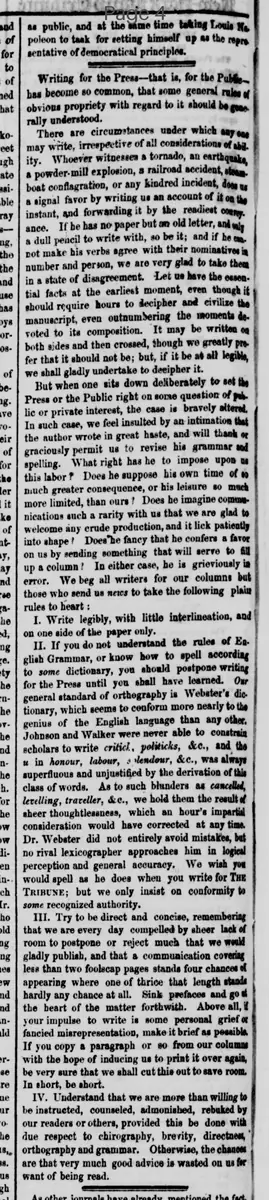
Writing for the Press-that is, for the Public-has become so common, that some general rules of obvious propriety with regard to it should be generally understood.
There are circumstances under which anyone may write, irrespective of all considerations of ability. Whoever witnesses a tornado, an earthquake, a powder-mill explosion, a railroad accident, steamboat conflagration, or any kindred incident, does us a signal favor by writing us an account of it on the instant, and forwarding it by the readiest conveyance. If he has no paper but an old letter, and only a dull pencil to write with, so be it; and if he cannot make his verbs agree with their nominatives in number and person, we are very glad to take them in a state of disagreement. Let us have the essential facts at the earliest moment, even though it should require hours to decipher and civilize the manuscript, even outnumbering the moments devoted to its composition. It may be written on both sides and then crossed, though we greatly prefer that it should not be; but, if it be at all legible we shall gladly undertake to decipher it.
But when one sits down deliberately to set the Press or the Public right on some question of public or private interest, the case is bravely altered. In such case, we feel insulted by an intimation that the author wrote in great haste, and will thank or graciously permit us to revise his grammar and spelling. What right has he to impose upon us this labor? Does he suppose his own time of so much greater consequence, or his leisure so much more limited, than ours? Does he imagine communications such a rarity with us that we are glad to welcome any crude production, and lick patiently into shape? Does he fancy that he confers a favor on us by sending something that will serve to fill up a column? In either case, he is grievously in error. We beg all writers for our columns but those who send us news to take the following plain rules to heart:
I. Write legibly, with little interlineation, and on one side of the paper only.
II. If you do not understand the rules of English Grammar, or know how to spell according to some dictionary, you should postpone writing for the Press until you shall have learned. Our general standard of orthography is Webster's dictionary, which seems to conform more nearly to the genius of the English language than any other. Johnson and Walker were never able to constrain scholars to write critick, politicks, &c., and the u in honour, labour, splendour, &c., was always superfluous and unjustified by the derivation of this class of words. As to such blunders as cancelled, levelling, traveller, &c., we hold them the result of sheer thoughtlessness, which an hour's impartial consideration would have corrected at any time. Dr. Webster did not entirely avoid mistakes, but no rival lexicographer approaches him in logical perception and general accuracy. We wish you would spell as he does when you write for THE TRIBUNE; but we only insist on conformity to some recognized authority.
III. Try to be direct and concise, remembering that we are every day compelled by sheer lack of room to postpone or reject much that we would gladly publish, and that a communication covering less than two foolscap pages stands four chances of appearing where one of thrice that length stands hardly any chance at all. Sink prefaces and go at the heart of the matter forthwith. Above all, if your impulse to write is some personal grief or fancied misrepresentation, make it brief as possible. If you copy a paragraph or so from our columns with the hope of inducing us to print it over again be very sure that we shall cut this out to save room. In short, be short.
IV. Understand that we are more than willing to be instructed, counseled, admonished, rebuked by our readers or others, provided this be done with due respect to chirography, brevity, directness, orthography and grammar. Otherwise, the chances are that very much good advice is wasted on us for want of being read.
There are circumstances under which anyone may write, irrespective of all considerations of ability. Whoever witnesses a tornado, an earthquake, a powder-mill explosion, a railroad accident, steamboat conflagration, or any kindred incident, does us a signal favor by writing us an account of it on the instant, and forwarding it by the readiest conveyance. If he has no paper but an old letter, and only a dull pencil to write with, so be it; and if he cannot make his verbs agree with their nominatives in number and person, we are very glad to take them in a state of disagreement. Let us have the essential facts at the earliest moment, even though it should require hours to decipher and civilize the manuscript, even outnumbering the moments devoted to its composition. It may be written on both sides and then crossed, though we greatly prefer that it should not be; but, if it be at all legible we shall gladly undertake to decipher it.
But when one sits down deliberately to set the Press or the Public right on some question of public or private interest, the case is bravely altered. In such case, we feel insulted by an intimation that the author wrote in great haste, and will thank or graciously permit us to revise his grammar and spelling. What right has he to impose upon us this labor? Does he suppose his own time of so much greater consequence, or his leisure so much more limited, than ours? Does he imagine communications such a rarity with us that we are glad to welcome any crude production, and lick patiently into shape? Does he fancy that he confers a favor on us by sending something that will serve to fill up a column? In either case, he is grievously in error. We beg all writers for our columns but those who send us news to take the following plain rules to heart:
I. Write legibly, with little interlineation, and on one side of the paper only.
II. If you do not understand the rules of English Grammar, or know how to spell according to some dictionary, you should postpone writing for the Press until you shall have learned. Our general standard of orthography is Webster's dictionary, which seems to conform more nearly to the genius of the English language than any other. Johnson and Walker were never able to constrain scholars to write critick, politicks, &c., and the u in honour, labour, splendour, &c., was always superfluous and unjustified by the derivation of this class of words. As to such blunders as cancelled, levelling, traveller, &c., we hold them the result of sheer thoughtlessness, which an hour's impartial consideration would have corrected at any time. Dr. Webster did not entirely avoid mistakes, but no rival lexicographer approaches him in logical perception and general accuracy. We wish you would spell as he does when you write for THE TRIBUNE; but we only insist on conformity to some recognized authority.
III. Try to be direct and concise, remembering that we are every day compelled by sheer lack of room to postpone or reject much that we would gladly publish, and that a communication covering less than two foolscap pages stands four chances of appearing where one of thrice that length stands hardly any chance at all. Sink prefaces and go at the heart of the matter forthwith. Above all, if your impulse to write is some personal grief or fancied misrepresentation, make it brief as possible. If you copy a paragraph or so from our columns with the hope of inducing us to print it over again be very sure that we shall cut this out to save room. In short, be short.
IV. Understand that we are more than willing to be instructed, counseled, admonished, rebuked by our readers or others, provided this be done with due respect to chirography, brevity, directness, orthography and grammar. Otherwise, the chances are that very much good advice is wasted on us for want of being read.
What sub-type of article is it?
Press Freedom
What keywords are associated?
Press Writing
Grammar Rules
Spelling Standards
Brevity
Contributor Guidelines
What entities or persons were involved?
The Tribune
Webster's Dictionary
Johnson
Walker
Editorial Details
Primary Topic
Rules For Writing Submissions To The Press
Stance / Tone
Instructive And Insistent On Standards
Key Figures
The Tribune
Webster's Dictionary
Johnson
Walker
Key Arguments
Write Legibly On One Side Of Paper With Minimal Interlineations
Learn English Grammar And Spell According To A Recognized Dictionary Like Webster's
Be Direct And Concise To Increase Chances Of Publication
Provide Instruction Or Criticism Respectfully With Proper Writing Standards