Thank you for visiting SNEWPapers!
Sign up free
Editorial
November 22, 1802
Jenks' Portland Gazette. Maine Advertiser
Portland, Cumberland County, Maine
What is this article about?
The General Conference of the Methodist Episcopal Church issues an address lamenting Negro slavery as repugnant to civil liberty and Christianity, urging annual conferences to petition state legislatures for gradual emancipation laws and mobilizing members to gather signatures and support the cause.
Clipping
OCR Quality
95%
Excellent
Full Text
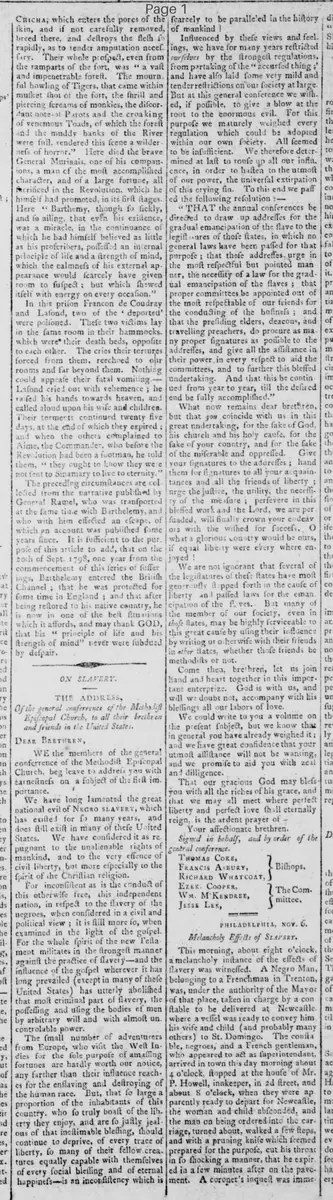
ON SLAVERY.
THE ADDRESS,
Of the general conference of the Methodist Episcopal Church, to all their brethren and friends in the United States.
Dear Brethren,
WE the members of the general conference of the Methodist Episcopal Church, beg leave to address you with earnestness on a subject of the first importance.
We have long lamented the great national evil of NEGRO SLAVERY, which has existed for so many years, and does still exist in many of these United States. We have considered it as repugnant to the unalienable rights of mankind, and to the very essence of civil liberty, but more especially to the spirit of the Christian religion.
For inconsistent as is the conduct of this otherwise free, this independent nation, in respect to the slavery of the negroes, when considered in a civil and political view; it is still more so, when examined in the light of the gospel.
For the whole spirit of the new Testament militates in the strongest manner against the practice of slavery—and the influence of the gospel wherever it has long prevailed (except in many of these United States) has utterly abolished that most criminal part of slavery, the possessing and using the bodies of men by arbitrary will and with almost uncontrollable power.
The small number of adventurers from Europe, who visit the West Indies for the sole purpose of amassing fortunes are hardly worth our notice, any farther than their influence reaches for the enslaving and destroying of the human race. But, that so large a proportion of the inhabitants of this country, who so truly boast of the liberty they enjoy, and are so justly jealous of that inestimable blessing, should continue to deprive, of every trace of liberty, so many of their fellow-creatures equally capable with themselves of every social blessing and of eternal happiness—is an inconsistency which is scarcely to be paralleled in the history of mankind!
Influenced by these views and feelings, we have for many years restricted ourselves by the strongest regulations, from partaking of the "accursed thing;" and have also laid some very mild and tender restrictions on our society at large.
But at this general conference we wished, if possible, to give a blow at the root to the enormous evil. For this purpose we maturely weighed every regulation which could be adopted within our own society. All seemed to be insufficient. We therefore determined at last to rouse up all our influence, in order to hasten to the utmost of our power, the universal extirpation of this crying sin. To this end we passed the following resolution:--
"THAT the annual conferences be directed to draw up addresses for the gradual emancipation of the slaves to the legislatures of those states, in which no general laws have been passed for that purpose; that these addresses, urge in the most respectful but pointed manner, the necessity of a law for the gradual emancipation of the slaves: that proper committees be appointed out of the most respectable of our friends for the conducting of the business: and that the presiding elders, deacons, and travelling preachers, do procure as many proper signatures as possible to the addresses, and give all the assistance in their power in every respect to aid the committees, and to further this blessed undertaking. And that this be continued from year to year, till the desired end be fully accomplished."
What now remains dear brethren, but that you coincide with us in this great undertaking, for the sake of God, his church and his holy cause, for the sake of your country, and for the sake of the miserable and oppressed. Give your signatures to the addresses: hand them for signatures to all your acquaintances and all the friends of liberty: urge the justice, the utility, the necessity of the measure; persevere in this blessed work and the Lord, we are persuaded, will finally crown your endeavors with the wished for success. O what a glorious country would be ours, if equal liberty were every where enjoyed!
We are not ignorant that several of the legislatures of these states have most generously stepped forth in the cause of liberty and passed laws for the emancipation of the slaves. But many of the members of our society, even in those states, may be highly serviceable to this great cause by using their influence by writing or otherwise with their friends in other states, whether those friends be methodists or not.
Come then, brethren, let us join hand and heart together in this important enterprize. God is with us, and will we doubt not, accompany with his blessings all our labors of love.
We could write to you a volume on the present subject, but we know that in general you have already weighed it; and we have great confidence that your utmost assistance will not be wanting, and we promise to aid you with zeal and diligence.
That our gracious God may bless you with all the riches of his grace, and that we may all meet where perfect liberty and perfect love shall eternally reign, is the ardent prayer of-
Your affectionate brethren.
Signed in behalf and by order of the general conference.
Thomas Coke,
Francis Asbury,
Bishops.
Richard Whatcoat,
Ezek. Cooper,
The Committee.
Wm. M'Kendree,
Jesse Lee,
THE ADDRESS,
Of the general conference of the Methodist Episcopal Church, to all their brethren and friends in the United States.
Dear Brethren,
WE the members of the general conference of the Methodist Episcopal Church, beg leave to address you with earnestness on a subject of the first importance.
We have long lamented the great national evil of NEGRO SLAVERY, which has existed for so many years, and does still exist in many of these United States. We have considered it as repugnant to the unalienable rights of mankind, and to the very essence of civil liberty, but more especially to the spirit of the Christian religion.
For inconsistent as is the conduct of this otherwise free, this independent nation, in respect to the slavery of the negroes, when considered in a civil and political view; it is still more so, when examined in the light of the gospel.
For the whole spirit of the new Testament militates in the strongest manner against the practice of slavery—and the influence of the gospel wherever it has long prevailed (except in many of these United States) has utterly abolished that most criminal part of slavery, the possessing and using the bodies of men by arbitrary will and with almost uncontrollable power.
The small number of adventurers from Europe, who visit the West Indies for the sole purpose of amassing fortunes are hardly worth our notice, any farther than their influence reaches for the enslaving and destroying of the human race. But, that so large a proportion of the inhabitants of this country, who so truly boast of the liberty they enjoy, and are so justly jealous of that inestimable blessing, should continue to deprive, of every trace of liberty, so many of their fellow-creatures equally capable with themselves of every social blessing and of eternal happiness—is an inconsistency which is scarcely to be paralleled in the history of mankind!
Influenced by these views and feelings, we have for many years restricted ourselves by the strongest regulations, from partaking of the "accursed thing;" and have also laid some very mild and tender restrictions on our society at large.
But at this general conference we wished, if possible, to give a blow at the root to the enormous evil. For this purpose we maturely weighed every regulation which could be adopted within our own society. All seemed to be insufficient. We therefore determined at last to rouse up all our influence, in order to hasten to the utmost of our power, the universal extirpation of this crying sin. To this end we passed the following resolution:--
"THAT the annual conferences be directed to draw up addresses for the gradual emancipation of the slaves to the legislatures of those states, in which no general laws have been passed for that purpose; that these addresses, urge in the most respectful but pointed manner, the necessity of a law for the gradual emancipation of the slaves: that proper committees be appointed out of the most respectable of our friends for the conducting of the business: and that the presiding elders, deacons, and travelling preachers, do procure as many proper signatures as possible to the addresses, and give all the assistance in their power in every respect to aid the committees, and to further this blessed undertaking. And that this be continued from year to year, till the desired end be fully accomplished."
What now remains dear brethren, but that you coincide with us in this great undertaking, for the sake of God, his church and his holy cause, for the sake of your country, and for the sake of the miserable and oppressed. Give your signatures to the addresses: hand them for signatures to all your acquaintances and all the friends of liberty: urge the justice, the utility, the necessity of the measure; persevere in this blessed work and the Lord, we are persuaded, will finally crown your endeavors with the wished for success. O what a glorious country would be ours, if equal liberty were every where enjoyed!
We are not ignorant that several of the legislatures of these states have most generously stepped forth in the cause of liberty and passed laws for the emancipation of the slaves. But many of the members of our society, even in those states, may be highly serviceable to this great cause by using their influence by writing or otherwise with their friends in other states, whether those friends be methodists or not.
Come then, brethren, let us join hand and heart together in this important enterprize. God is with us, and will we doubt not, accompany with his blessings all our labors of love.
We could write to you a volume on the present subject, but we know that in general you have already weighed it; and we have great confidence that your utmost assistance will not be wanting, and we promise to aid you with zeal and diligence.
That our gracious God may bless you with all the riches of his grace, and that we may all meet where perfect liberty and perfect love shall eternally reign, is the ardent prayer of-
Your affectionate brethren.
Signed in behalf and by order of the general conference.
Thomas Coke,
Francis Asbury,
Bishops.
Richard Whatcoat,
Ezek. Cooper,
The Committee.
Wm. M'Kendree,
Jesse Lee,
What sub-type of article is it?
Slavery Abolition
Moral Or Religious
Social Reform
What keywords are associated?
Negro Slavery
Emancipation
Methodist Conference
Gradual Abolition
Christian Opposition
State Legislatures
What entities or persons were involved?
Methodist Episcopal Church
General Conference
Thomas Coke
Francis Asbury
State Legislatures
Editorial Details
Primary Topic
Call For Gradual Emancipation Of Slaves
Stance / Tone
Strong Advocacy Against Slavery And For Abolition
Key Figures
Methodist Episcopal Church
General Conference
Thomas Coke
Francis Asbury
State Legislatures
Key Arguments
Negro Slavery Is A Great National Evil Repugnant To Unalienable Rights, Civil Liberty, And Christian Religion
New Testament Spirit Opposes Slavery
Gospel Has Abolished Slavery Elsewhere Except In Many Us States
Inconsistency Of A Free Nation Enslaving Fellow Humans
Church Has Restricted Involvement In Slavery
Resolution To Petition Legislatures For Gradual Emancipation Laws
Urge Members To Sign And Promote Addresses For Emancipation