Thank you for visiting SNEWPapers!
Sign up free
Domestic News
May 19, 1895
The Anaconda Standard
Anaconda, Deer Lodge County, Montana
What is this article about?
The Presbyterian general assembly in Pittsburg debated control over theological seminaries, with speakers like Hon. E. E. White and Thomas MacDougal arguing against and for the proposal, highlighting legal and practical issues.
Clipping
OCR Quality
98%
Excellent
Full Text
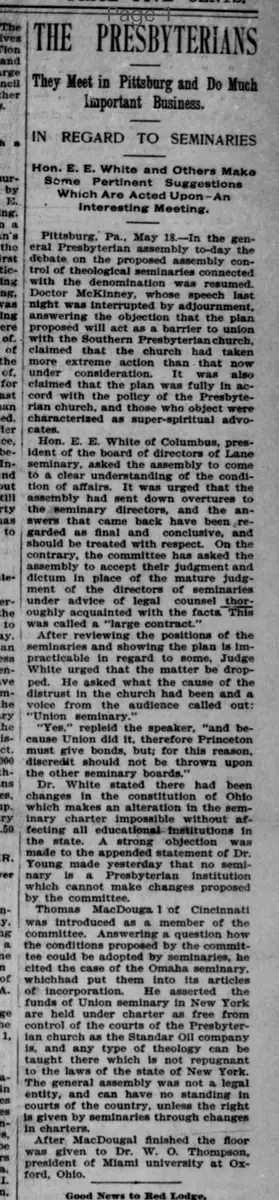
THE PRESBYTERIANS
They Meet in Pittsburg and Do Much Important Business.
IN REGARD TO SEMINARIES
Hon. E. E. White and Others Make Some Pertinent Suggestions Which Are Acted Upon—An Interesting Meeting.
Pittsburg, Pa., May 18.—In the general Presbyterian assembly to-day the debate on the proposed assembly control of theological seminaries connected with the denomination was resumed. Doctor McKinney, whose speech last night was interrupted by adjournment, answering the objection that the plan proposed will act as a barrier to union with the Southern Presbyterian church, claimed that the church had taken more extreme action than that now under consideration. It was also claimed that the plan was fully in accord with the policy of the Presbyterian church, and those who object were characterized as super-spiritual advocates. Hon. E. E. White of Columbus, president of the board of directors of Lane seminary, asked the assembly to come to a clear understanding of the condition of affairs. It was urged that the assembly had sent down overtures to the seminary directors, and the answers that came back have been regarded as final and conclusive, and should be treated with respect. On the contrary, the committee has asked the assembly to accept their judgment and dictum in place of the mature judgment of the directors of seminaries under advice of legal counsel thoroughly acquainted with the facts. This was called a "large contract." After reviewing the positions of the seminaries and showing the plan is impracticable in regard to some, Judge White urged that the matter be dropped. He asked what the cause of the distrust in the church had been and a voice from the audience called out: "Union seminary." "Yes," replied the speaker, "and because Union did it, therefore Princeton must give bonds, but for this reason, discredit should not be thrown upon the other seminary boards." Dr. White stated there had been changes in the constitution of Ohio which makes an alteration in the seminary charter impossible without affecting all educational institutions in the state. A strong objection was made to the appended statement of Dr. Young made yesterday that no seminary is a Presbyterian institution which cannot make changes proposed by the committee. Thomas MacDougal of Cincinnati was introduced as a member of the committee. Answering a question how the conditions proposed by the committee could be adopted by seminaries, he cited the case of the Omaha seminary, which had put them into its articles of incorporation. He asserted the funds of Union seminary in New York are held under charter as free from control of the courts of the Presbyterian church as the Standard Oil company is, and any type of theology can be taught there which is not repugnant to the laws of the state of New York. The general assembly was not a legal entity, and can have no standing in courts of the country, unless the right is given by seminaries through changes in charters. After MacDougal finished the floor was given to Dr. W. O. Thompson, president of Miami university at Oxford, Ohio.
They Meet in Pittsburg and Do Much Important Business.
IN REGARD TO SEMINARIES
Hon. E. E. White and Others Make Some Pertinent Suggestions Which Are Acted Upon—An Interesting Meeting.
Pittsburg, Pa., May 18.—In the general Presbyterian assembly to-day the debate on the proposed assembly control of theological seminaries connected with the denomination was resumed. Doctor McKinney, whose speech last night was interrupted by adjournment, answering the objection that the plan proposed will act as a barrier to union with the Southern Presbyterian church, claimed that the church had taken more extreme action than that now under consideration. It was also claimed that the plan was fully in accord with the policy of the Presbyterian church, and those who object were characterized as super-spiritual advocates. Hon. E. E. White of Columbus, president of the board of directors of Lane seminary, asked the assembly to come to a clear understanding of the condition of affairs. It was urged that the assembly had sent down overtures to the seminary directors, and the answers that came back have been regarded as final and conclusive, and should be treated with respect. On the contrary, the committee has asked the assembly to accept their judgment and dictum in place of the mature judgment of the directors of seminaries under advice of legal counsel thoroughly acquainted with the facts. This was called a "large contract." After reviewing the positions of the seminaries and showing the plan is impracticable in regard to some, Judge White urged that the matter be dropped. He asked what the cause of the distrust in the church had been and a voice from the audience called out: "Union seminary." "Yes," replied the speaker, "and because Union did it, therefore Princeton must give bonds, but for this reason, discredit should not be thrown upon the other seminary boards." Dr. White stated there had been changes in the constitution of Ohio which makes an alteration in the seminary charter impossible without affecting all educational institutions in the state. A strong objection was made to the appended statement of Dr. Young made yesterday that no seminary is a Presbyterian institution which cannot make changes proposed by the committee. Thomas MacDougal of Cincinnati was introduced as a member of the committee. Answering a question how the conditions proposed by the committee could be adopted by seminaries, he cited the case of the Omaha seminary, which had put them into its articles of incorporation. He asserted the funds of Union seminary in New York are held under charter as free from control of the courts of the Presbyterian church as the Standard Oil company is, and any type of theology can be taught there which is not repugnant to the laws of the state of New York. The general assembly was not a legal entity, and can have no standing in courts of the country, unless the right is given by seminaries through changes in charters. After MacDougal finished the floor was given to Dr. W. O. Thompson, president of Miami university at Oxford, Ohio.
What sub-type of article is it?
Religious Event
Politics
Education
What keywords are associated?
Presbyterian Assembly
Theological Seminaries
Church Control
Pittsburg Meeting
Seminary Debate
What entities or persons were involved?
Doctor Mckinney
Hon. E. E. White
Dr. Young
Thomas Macdougal
Dr. W. O. Thompson
Where did it happen?
Pittsburg, Pa.
Domestic News Details
Primary Location
Pittsburg, Pa.
Event Date
May 18.
Key Persons
Doctor Mckinney
Hon. E. E. White
Dr. Young
Thomas Macdougal
Dr. W. O. Thompson
Event Details
In the general Presbyterian assembly, debate resumed on proposed assembly control of theological seminaries. Doctor McKinney defended the plan against union objections. Hon. E. E. White urged dropping the matter due to impracticability and legal issues. Thomas MacDougal explained adoption possibilities. The floor was given to Dr. W. O. Thompson.