Thank you for visiting SNEWPapers!
Sign up free
Editorial
August 17, 1953
Trainman News
Indianapolis, Marion County, Indiana
What is this article about?
Editorial warns of economic depression signals amid record U.S. prosperity, citing declining farm incomes, rising consumer debt, and inventory buildup. Criticizes proposals for national sales tax, reduced income taxes, and higher debt limits, urging Congress to address inequitable distribution and defense cutbacks.
Clipping
OCR Quality
98%
Excellent
Full Text
Depression Signals
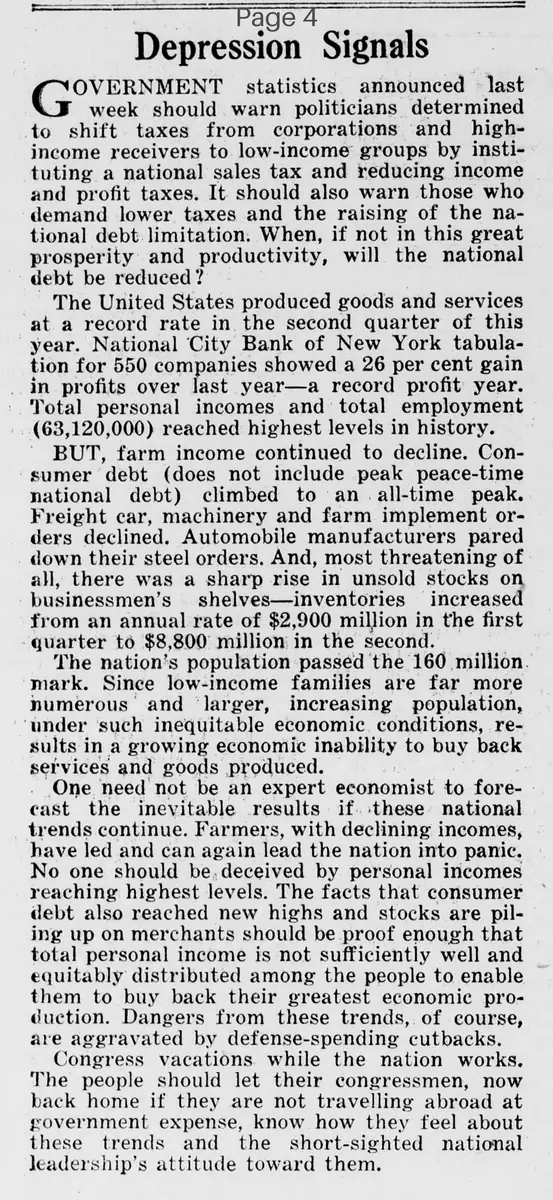
Government statistics announced last week should warn politicians determined to shift taxes from corporations and high-income receivers to low-income groups by instituting a national sales tax and reducing income and profit taxes. It should also warn those who demand lower taxes and the raising of the national debt limitation. When, if not in this great prosperity and productivity, will the national debt be reduced?
The United States produced goods and services at a record rate in the second quarter of this year. National City Bank of New York tabulation for 550 companies showed a 26 per cent gain in profits over last year--a record profit year. Total personal incomes and total employment (63,120,000) reached highest levels in history.
BUT, farm income continued to decline. Consumer debt (does not include peak peace-time national debt) climbed to an all-time peak. Freight car, machinery and farm implement orders declined. Automobile manufacturers pared down their steel orders. And, most threatening of all, there was a sharp rise in unsold stocks on businessmen's shelves--inventories increased from an annual rate of $2,900 million in the first quarter to $8,800 million in the second.
The nation's population passed the 160 million mark. Since low-income families are far more numerous and larger, increasing population, under such inequitable economic conditions, results in a growing economic inability to buy back services and goods produced.
One need not be an expert economist to forecast the inevitable results if these national trends continue. Farmers, with declining incomes, have led and can again lead the nation into panic. No one should be deceived by personal incomes reaching highest levels. The facts that consumer debt also reached new highs and stocks are piling up on merchants should be proof enough that total personal income is not sufficiently well and equitably distributed among the people to enable them to buy back their greatest economic production. Dangers from these trends, of course, are aggravated by defense-spending cutbacks.
Congress vacations while the nation works. The people should let their congressmen, now back home if they are not travelling abroad at government expense, know how they feel about these trends and the short-sighted national leadership's attitude toward them.
Government statistics announced last week should warn politicians determined to shift taxes from corporations and high-income receivers to low-income groups by instituting a national sales tax and reducing income and profit taxes. It should also warn those who demand lower taxes and the raising of the national debt limitation. When, if not in this great prosperity and productivity, will the national debt be reduced?
The United States produced goods and services at a record rate in the second quarter of this year. National City Bank of New York tabulation for 550 companies showed a 26 per cent gain in profits over last year--a record profit year. Total personal incomes and total employment (63,120,000) reached highest levels in history.
BUT, farm income continued to decline. Consumer debt (does not include peak peace-time national debt) climbed to an all-time peak. Freight car, machinery and farm implement orders declined. Automobile manufacturers pared down their steel orders. And, most threatening of all, there was a sharp rise in unsold stocks on businessmen's shelves--inventories increased from an annual rate of $2,900 million in the first quarter to $8,800 million in the second.
The nation's population passed the 160 million mark. Since low-income families are far more numerous and larger, increasing population, under such inequitable economic conditions, results in a growing economic inability to buy back services and goods produced.
One need not be an expert economist to forecast the inevitable results if these national trends continue. Farmers, with declining incomes, have led and can again lead the nation into panic. No one should be deceived by personal incomes reaching highest levels. The facts that consumer debt also reached new highs and stocks are piling up on merchants should be proof enough that total personal income is not sufficiently well and equitably distributed among the people to enable them to buy back their greatest economic production. Dangers from these trends, of course, are aggravated by defense-spending cutbacks.
Congress vacations while the nation works. The people should let their congressmen, now back home if they are not travelling abroad at government expense, know how they feel about these trends and the short-sighted national leadership's attitude toward them.
What sub-type of article is it?
Economic Policy
Agriculture
Social Reform
What keywords are associated?
Depression Signals
Tax Policy
Farm Income Decline
Consumer Debt
Inventory Buildup
National Debt
Economic Inequality
Defense Cutbacks
What entities or persons were involved?
Congress
Politicians
Farmers
National City Bank Of New York
Editorial Details
Primary Topic
Warning Of Depression Signals In Prosperous Economy
Stance / Tone
Cautionary Critique Of Tax And Debt Policies
Key Figures
Congress
Politicians
Farmers
National City Bank Of New York
Key Arguments
Government Statistics Warn Against Shifting Taxes To Low Income Groups Via Sales Tax
Demand For Lower Taxes And Higher Debt Limits Is Misguided During Prosperity
Record Production And Profits Contrast With Declining Farm Incomes
Rising Consumer Debt And Inventory Buildup Signal Overproduction
Population Growth Exacerbates Inequitable Distribution
Trends Could Lead To Panic Led By Farmers
Defense Cutbacks Aggravate Dangers
Urge Public To Contact Congressmen On These Issues