Thank you for visiting SNEWPapers!
Sign up free
The Recorder, Or, Lady's And Gentleman's Miscellany
Richmond, Virginia
What is this article about?
James T. Callender's Letter VII defends his journalistic work against Joseph Jones's accusations in the Examiner, citing Thomas Jefferson's praise, financial support for 'The Prospect,' and Republican opposition to Federalist sedition trials and policies in Richmond, Virginia, circa 1802.
Merged-components note: The table provides the expense statement referenced and included in the letter by J. T. Callender discussing the armory. Spatial overlap and sequential reading order confirm they belong together.
Clipping
OCR Quality
Full Text
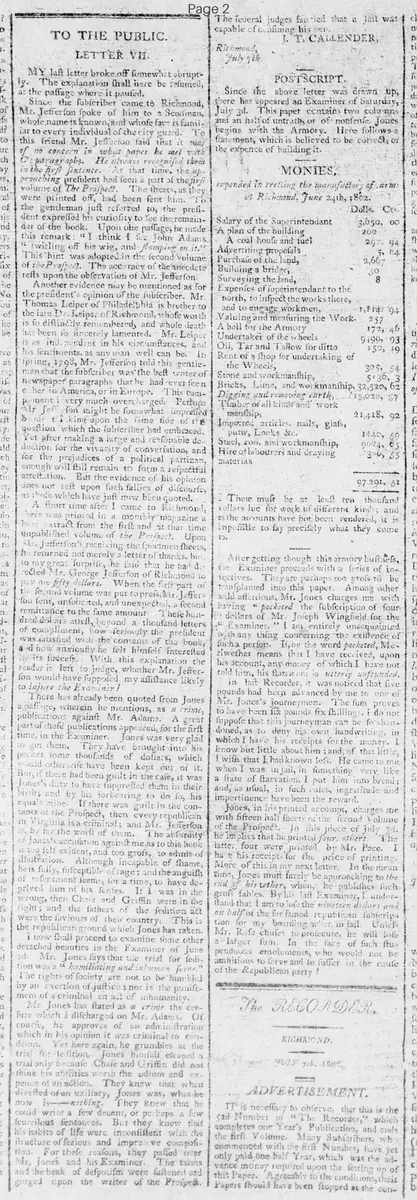
LETTER VII.
My last letter broke off somewhat abruptly. The explanation shall here be resumed, at the passage where it paused.
Since the subscriber came to Richmond, Mr. Jefferson spoke of him to a Scotsman, whose name is known, and whose face is familiar to every individual of the city guard. To this friend Mr. Jefferson said that it was of no concern in what paper he met with C's paragraphs. He always recognized them in the first sentence. At that time, the approaching president had seen a part of the first volume of The Prospect. The sheets, as they were printed off, had been sent him by the gentleman just referred to, the president expressed his curiosity to see the remainder of the book. Upon one passage he made this remark: "I think I see John Adams twirling off his wig, and stamping on it."
This hint was adopted in the second volume of the Prospect. The accuracy of the anecdote rests upon the observation of Mr. Jefferson.
Another evidence may be mentioned as for the president's opinion of the subscriber. Mr. Thomas Leiper of Philadelphia is brother to the late Dr. Leiper of Richmond, whose worth is so distinctly remembered, and whose death has been so sincerely lamented. Mr. Leiper is as independent in his circumstances, and his sentiments, as any man well can be. In spring, 1798, Mr. Jefferson told this gentleman that the subscriber was the best writer of newspaper paragraphs that he had ever seen either in America, or in Europe. This compliment is very much overcharged. Perhaps Mr. Jefferson might be somewhat impressed by his thinking upon the same side of the question which the subscriber had embraced.
Yet after making a large and reasonable deduction for the vivacity of conversation, and for the prejudices of a political partisan, enough will still remain to form a respectful attestation. But the evidence of his opinion does not rest upon such fallies of discourse as those which have just now been quoted.
A short time after I came to Richmond, there was printed in a monthly magazine a long extract from the first and at that time unpublished volume of the Prospect. Upon Mr. Jefferson's receiving the specimen sheets, he returned not merely a letter of thanks, but to my great surprise, he said that he had directed Mr. George Jefferson of Richmond to pay me fifty dollars. When the first part of the second volume was put to press, Mr. Jefferson sent, unsolicited, and unexpected, a second remittance to the same amount. These hundred dollars attest, beyond a thousand letters of compliment, how seriously the president was satisfied with the contents of the book, and how anxiously he felt himself interested in its success.
With this explanation the reader is left to judge, whether Mr. Jefferson would have supposed my assistance likely to injure the Examiner!
There has already been quoted from Jones a passage, wherein he mentions, as a crime, publications against Mr. Adams. A great part of these publications appeared for the first time, in the Examiner. Jones was very glad to get them. They have brought into his pocket some thousands of dollars, which would otherwise have been kept out of it.
But, if there had been guilt in the case, it was Jones's duty to have suppressed them in their birth; and by his forbearing to do so, his equals in office. If there was guilt in the contents of the Prospect, then every republican in Virginia is a criminal; and Mr. Jefferson is, by far the worst of them. The absurdity of Jones's accusation against me as to this book is too self-evident, and too gross, to admit of illustration. Although incapable of shame, he is silly, susceptible of rage; and the anguish of resentment seems, for a time, to have deprived him of his senses. If I was in the wrong, then Chase and Griffin were in the right; and the fathers of the sedition act were the saviours of their country. This is the republican ground which Jones has taken.
I now shall proceed to examine some other detached beauties in the Examiner of June 2d. Mr. Jones says that the trial for sedition was a degrading and inhuman scene. The rights of society are not to be humbled by an exertion of justice; nor is the punishment of a criminal an act of inhumanity.
Mr. Jones has stated as a crime the censure which I discharged on Mr. Adams. Of course, he approves of an administration which in his opinion it was criminal to condemn. Yet here again, he grumbles at the trial for sedition. Jones himself escaped a trial only because Chase and Griffin did not think his abilities worth the odium and expense of an action. They knew that when divested of an auxiliary, Jones was, what he now is--nothing. They knew that he could write a few decent, or perhaps a few scurrilous sentences. But they knew that his habits of life were inconsistent with the structure of serious and impressive composition. For these reasons, they passed over Mr. Jones and his Examiner. The talons and the beak of despotism were fastened and gorged upon the writer of the Prospect.
The federal judges finished that a jail was capable of chastising his petulance.
J. T. CALLENDER
Richmond
July
POSTSCRIPT
Since the above letter was drawn up, there has appeared an Examiner of Saturday, July 3d. This paper contains two columns and a half of untruth or of nonsense. Jones begins with the Armory. Here follows a statement, which is believed to be correct; of the expense of building it.
MONEYS expended in erecting the manufactory of arms at Richmond, June 20th, 1802.
There must be at least ten thousand dollars due for work of different kinds; and as the accounts have not been rendered, it is impossible to say precisely what they come to.
After getting through this armory business, the Examiner proceeds with a series of invectives. They are perhaps too gross to be transplanted into this paper. Among other wild assertions, Mr. Jones charges me with having pocketed the subscription of four dollars of Mr. Joseph Wingfield for the Examiner. I am entirely unacquainted with any thing concerning the existence of such a person. If by the word pocketed, Mr. Wether means that I have received, upon his account, any money of which I have not told him, his statement is utterly unfounded.
In last Recorder, it was noticed that five pounds had been advanced by me to one of Mr. Jones's journeymen. The sum proves to have been six pounds six shillings. I do not suppose that this journeyman can be so abandoned, as to deny his own handwriting, in which I have his receipts for the money. I know but little about him; and, of that little, I wish that I had known less. He came to me when I was in jail, in something very like a state of starvation. I put him into bread: and, as usual, in such cases, ingratitude and impertinence have been the reward.
Jones, in his printed account, charges me with fifteen half sheets of the second Volume of the Prospect. In this piece of July 3d. he implies that he printed four others.
The latter four were printed by Mr. Pace. I have his receipts for the price of printing.
More of this in my next letter. In the mean time, Jones must surely be approaching to the end of his tether, when, he publishes such gross fables. By his last Examiner, I understand that I am to lose the nineteen dollars and a half of the forfamed republican subscription for my boarding while in jail. Unless Mr. Rose chooses to prosecute, he will lose a larger sum. In the face of such tremendous emoluments, who would not be ambitious to serve and to suffer in the cause of the Republican party?
| Dolls Cies | |
| Salary of the Superintendent | 3,650,000 |
| A plan of the building | 200 |
| A coal houfe and fuel | 290,940 |
| Advertiting propofals | 5,840 |
| Purchase of the land, | 2,667 |
| Building a bridge, | 500 |
| Surveying the land, | 800 |
| Expenses of superintendent to the north, to inspect the works there, and to engage workmen, | 1,114,940 |
| Valuing and measuring the Work. | 257 |
| A bell for the Armory | 172,460 |
| Undertaker of the wheels | 9,199,930 |
| Oil, Tar and Tallow for ditto | 150,190 |
| Rent of a shop for undertaking of the Wheels, | 305,540 |
| Stone and workmanship, | 5136,300 |
| Bricks, Lime, and workmanship, 32,520,620 | 1,150,000 |
| Digging and removing earth, | 1,150,000 |
| Timber of all kinds and workmanship, | 21,418,920 |
| Imported articles, nails, glafs, putty, Locks &c. | 1440,500 |
| Steel, iron, and workmanship, | 900,460 |
| Hire of labourers and draying materials | 300,550 |
What sub-type of article is it?
What themes does it cover?
What keywords are associated?
What entities or persons were involved?
Letter to Editor Details
Author
J. T. Callender
Recipient
To The Public.
Main Argument
callender defends his writings against jones's accusations of disloyalty and financial misconduct, citing jefferson's praise and support for 'the prospect' as evidence of republican approval, while criticizing federalist sedition trials and jones's hypocrisy.
Notable Details