Thank you for visiting SNEWPapers!
Sign up free
Phenix Gazette
Alexandria, Virginia
What is this article about?
Summary of U.S. Congress proceedings from the previous day: Senate handled private bills and executive business; House considered reports on Indian land appropriations, resolutions on Delaware ports, military and naval officer compensation, constitutional amendments for direct presidential voting, and House seating rules; debated constitutional amendment proposal.
Clipping
OCR Quality
Full Text
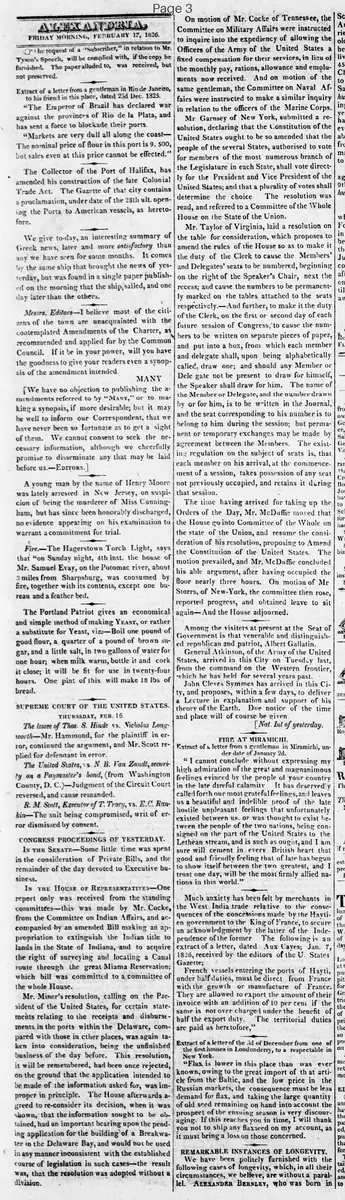
IN THE SENATE--Some little time was spent in the consideration of Private Bills, and the remainder of the day devoted to Executive business.
In the House of Representatives--One report only was received from the standing committees--this was made by Mr. Cocke, from the Committee on Indian Affairs, and accompanied by an amended Bill making an appropriation to extinguish the Indian title to lands in the State of Indiana, and to acquire the right of surveying and locating a Canal route through the great Miami Reservation; which bill was committed to a committee of the whole House.
Mr. Miner's resolution, calling on the President of the United States, for certain statements relating to the receipts and disbursements in the ports within the Delaware, compared with those in other places, was again taken into consideration, being the unfinished business of the day before. This resolution, it will be remembered, had been once rejected, on the ground that the application intended to be made of the information asked for, was improper in principle. The House afterwards agreed to re-consider its decision, when it was shown, that the information sought to be obtained, had an important bearing upon the pending application for the building of a Breakwater in the Delaware Bay, and would not be used in any manner inconsistent with the established course of legislation in such cases--the result was, that the resolution was adopted without a division.
On motion of Mr. Cocke of Tennessee, the Committee on Military Affairs were instructed to inquire into the expediency of allowing the Officers of the Army of the United States a fixed compensation for their services, in lieu of the monthly pay, rations, allowance and emoluments now received. And on motion of the same gentleman, the Committee on Naval Affairs were instructed to make a similar inquiry in relation to the officers of the Marine Corps.
Mr. Garnsey of New York, submitted a resolution, declaring that the Constitution of the United States ought to be so amended that the people of the several States, authorised to vote for members of the most numerous branch of the Legislature in each State, shall vote directly for the President and Vice President of the United States; and that a plurality of votes shall determine the choice. The resolution was read, and referred to a Committee of the Whole House on the State of the Union.
Mr. Taylor of Virginia, laid a resolution on the table for consideration, which proposes to amend the rules of the House so as to make it the duty of the Clerk to cause the Members' and Delegates' seats to be numbered, beginning on the right of the Speaker's Chair, next the recess; and cause the numbers to be permanently marked on the tables attached to the seats respectively.--And further, to make it the duty of the Clerk, on the first or second day of each future session of Congress, to cause the numbers to be written on separate pieces of paper, and put into a box, from which each member and delegate shall, upon being alphabetically called, draw one; and should any Member or Delegate not be present to draw for himself, the Speaker shall draw for him. The name of the Member or Delegate, and the number drawn by or for him, is to be written in the Journal, and the seat corresponding to his number is to belong to him during the session; but permanent or temporary exchanges may be made by agreement between the Members. The existing regulation on the subject of seats is, that each member on his arrival, at the commencement of a session, takes possession of any seat not previously occupied, and retains it during that session.
The time having arrived for taking up the Orders of the Day, Mr. McDuffie moved that the House go into Committee of the Whole on the state of the Union, and resume the consideration of his resolution, proposing to Amend the Constitution of the United States. The motion prevailed, and Mr. McDuffie concluded his able argument, after having occupied the floor nearly three hours. On motion of Mr. Storrs, of New-York, the committee then rose, reported progress, and obtained leave to sit again--And the House adjourned.
What sub-type of article is it?
What keywords are associated?
What entities or persons were involved?
Domestic News Details
Event Date
Yesterday
Key Persons
Outcome
resolution on delaware ports adopted; committees instructed on military and naval pay; resolutions on constitutional amendments and seating referred; constitutional amendment debate concluded with progress reported.
Event Details
In the Senate, time was spent on private bills and executive business. In the House, a report from the Committee on Indian Affairs on a bill for Indiana lands and Miami Canal was committed; Mr. Miner's resolution on Delaware port finances was adopted; committees instructed on fixed compensation for army and marine officers; Mr. Garnsey's resolution for direct presidential voting referred; Mr. Taylor's resolution on numbering and drawing seats proposed; House went into committee to debate Mr. McDuffie's constitutional amendment resolution.