Thank you for visiting SNEWPapers!
Sign up free
Editorial
October 5, 1836
Morning Star
Limerick, York County, Maine
What is this article about?
Dr. Beecher critiques the secrecy of Popery and Catholic institutions, contrasting republican self-governance with foreign ecclesiastical control from Austria and Rome. He advocates for equality, openness to public inspection, and legislative oversight of convents and secret societies to protect American institutions.
Clipping
OCR Quality
98%
Excellent
Full Text
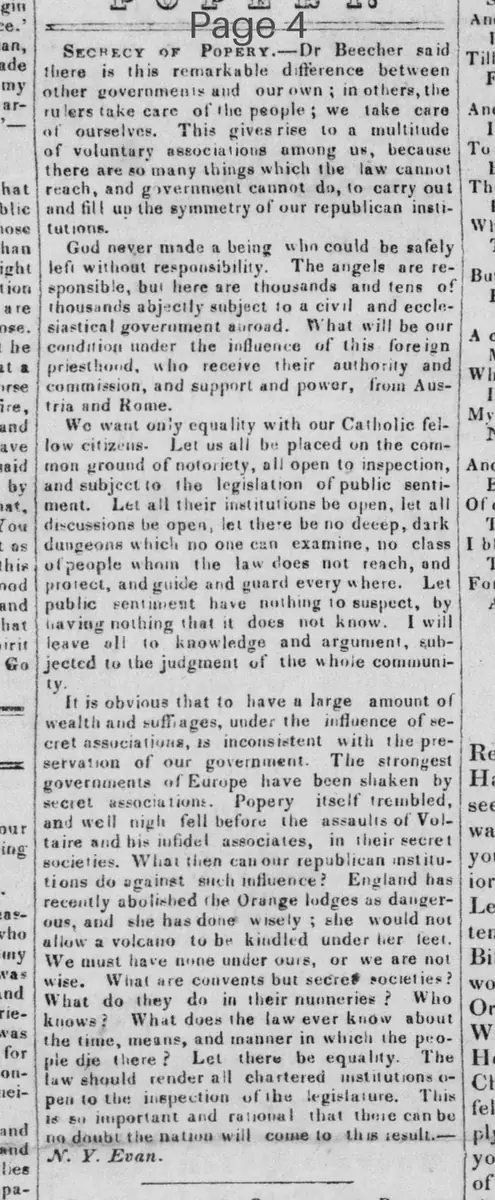
Secrecy of Popery.—Dr Beecher said there is this remarkable difference between other governments and our own; in others, the rulers take care of the people; we take care of ourselves. This gives rise to a multitude of voluntary associations among us, because there are so many things which the law cannot reach, and government cannot do, to carry out and fill up the symmetry of our republican institutions.
God never made a being who could be safely left without responsibility. The angels are responsible, but here are thousands and tens of thousands abjectly subject to a civil and ecclesiastical government abroad. What will be our condition under the influence of this foreign priesthood, who receive their authority and commission, and support and power, from Austria and Rome.
We want only equality with our Catholic fellow citizens—Let us all be placed on the common ground of notoriety, all open to inspection, and subject to the legislation of public sentiment. Let all their institutions be open, let all discussions be open, let there be no deep, dark dungeons which no one can examine, no class of people whom the law does not reach, and protect, and guide and guard every where. Let public sentiment have nothing to suspect, by having nothing that it does not know. I will leave all to knowledge and argument, subjected to the judgment of the whole community.
It is obvious that to have a large amount of wealth and suffrages, under the influence of secret associations, is inconsistent with the preservation of our government. The strongest governments of Europe have been shaken by secret associations. Popery itself trembled, and well nigh fell before the assaults of Voltaire and his infidel associates, in their secret societies. What then can our republican institutions do against such influence? England has recently abolished the Orange lodges as dangerous, and she has done wisely; she would not allow a volcano to be kindled under her feet. We must have none under ours, or we are not wise. What are convents but secret societies? What do they do in their nunneries? Who knows? What does the law ever know about the time, means, and manner in which the people die there? Let there be equality. The law should render all chartered institutions open to the inspection of the legislature. This is so important and rational that there can be no doubt the nation will come to this result.—N. Y. Evan.
God never made a being who could be safely left without responsibility. The angels are responsible, but here are thousands and tens of thousands abjectly subject to a civil and ecclesiastical government abroad. What will be our condition under the influence of this foreign priesthood, who receive their authority and commission, and support and power, from Austria and Rome.
We want only equality with our Catholic fellow citizens—Let us all be placed on the common ground of notoriety, all open to inspection, and subject to the legislation of public sentiment. Let all their institutions be open, let all discussions be open, let there be no deep, dark dungeons which no one can examine, no class of people whom the law does not reach, and protect, and guide and guard every where. Let public sentiment have nothing to suspect, by having nothing that it does not know. I will leave all to knowledge and argument, subjected to the judgment of the whole community.
It is obvious that to have a large amount of wealth and suffrages, under the influence of secret associations, is inconsistent with the preservation of our government. The strongest governments of Europe have been shaken by secret associations. Popery itself trembled, and well nigh fell before the assaults of Voltaire and his infidel associates, in their secret societies. What then can our republican institutions do against such influence? England has recently abolished the Orange lodges as dangerous, and she has done wisely; she would not allow a volcano to be kindled under her feet. We must have none under ours, or we are not wise. What are convents but secret societies? What do they do in their nunneries? Who knows? What does the law ever know about the time, means, and manner in which the people die there? Let there be equality. The law should render all chartered institutions open to the inspection of the legislature. This is so important and rational that there can be no doubt the nation will come to this result.—N. Y. Evan.
What sub-type of article is it?
Moral Or Religious
Constitutional
Social Reform
What keywords are associated?
Popery Secrecy
Republican Institutions
Foreign Priesthood
Secret Societies
Catholic Equality
Convents Inspection
Legislative Oversight
What entities or persons were involved?
Dr Beecher
Austria
Rome
Catholic Fellow Citizens
Voltaire
England
Orange Lodges
Editorial Details
Primary Topic
Secrecy Of Popery And Foreign Catholic Influence
Stance / Tone
Anti Secrecy, Advocating Openness And Legislative Inspection
Key Figures
Dr Beecher
Austria
Rome
Catholic Fellow Citizens
Voltaire
England
Orange Lodges
Key Arguments
Republican Governments Rely On Voluntary Associations Due To Self Governance
Foreign Priesthood From Austria And Rome Threatens Republican Institutions
Equality Requires All Institutions Open To Public Inspection And Sentiment
Secret Associations Undermine Government Stability, As Seen In Europe
Convents Function As Secret Societies With Unchecked Activities
Legislature Should Inspect All Chartered Institutions For National Security