Thank you for visiting SNEWPapers!
Sign up free
Story
October 2, 1924
The Milwaukee Leader
Milwaukee, Milwaukee County, Wisconsin
What is this article about?
Winifred Stuart Gibbs details five species of salmon (Chinook, pink, Chum, etc.) used in canning, their flesh colors and sizes, the fish's migratory life cycle with prolific egg-laying, and the large-scale industrial canning process from cleaning to sealing.
Clipping
OCR Quality
98%
Excellent
Full Text
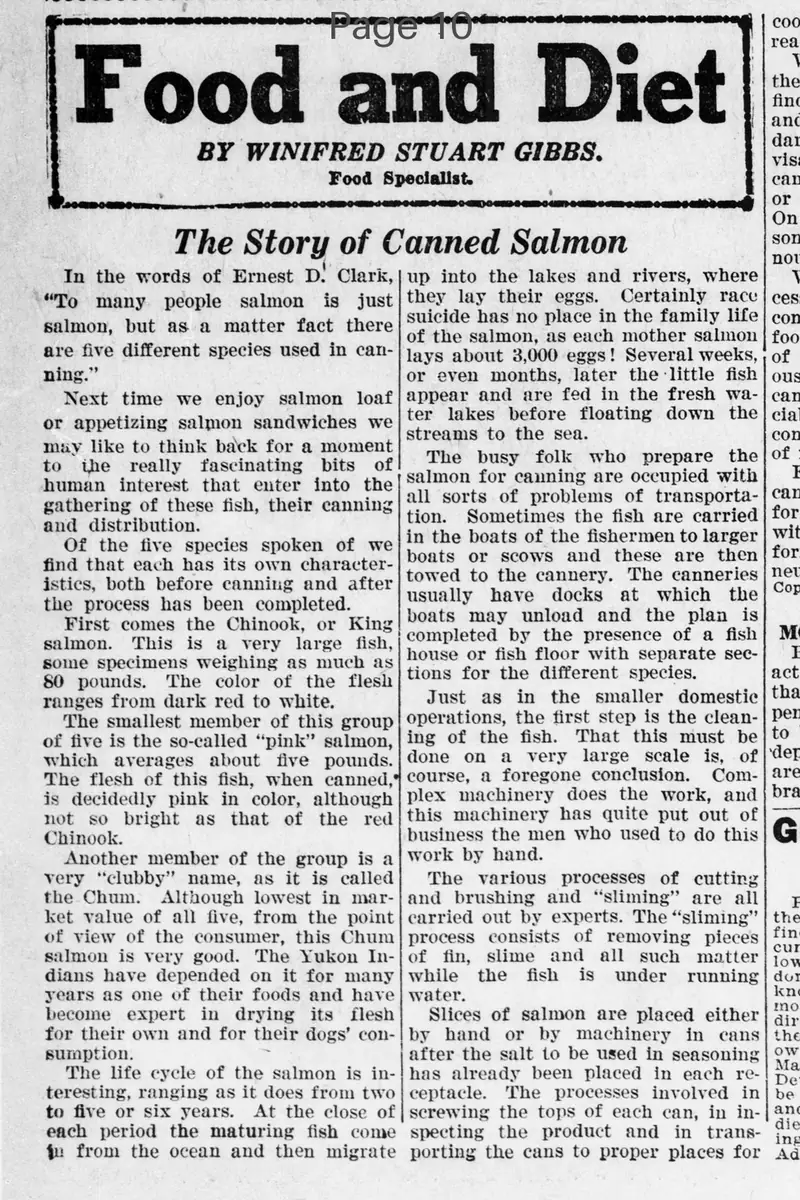
Food and Diet
BY WINIFRED STUART GIBBS.
Food Specialist.
The Story of Canned Salmon
In the words of Ernest D. Clark. "To many people salmon is just salmon, but as a matter fact there are five different species used in canning."
Next time we enjoy salmon loaf or appetizing salmon sandwiches we may like to think back for a moment to the really fascinating bits of human interest that enter into the gathering of these fish, their canning and distribution.
Of the five species spoken of we find that each has its own characteristics, both before canning and after the process has been completed.
First comes the Chinook, or King salmon. This is a very large fish, some specimens weighing as much as 80 pounds. The color of the flesh ranges from dark red to white.
The smallest member of this group of five is the so-called "pink" salmon, which averages about five pounds. The flesh of this fish, when canned, is decidedly pink in color, although not so bright as that of the red Chinook.
Another member of the group is a very "clubby" name, as it is called the Chum. Although lowest in market value of all five, from the point of view of the consumer, this Chum salmon is very good. The Yukon Indians have depended on it for many years as one of their foods and have become expert in drying its flesh for their own and for their dogs' consumption.
The life cycle of the salmon is interesting, ranging as it does from two to five or six years. At the close of each period the maturing fish come in from the ocean and then migrate up into the lakes and rivers. where they lay their eggs. Certainly race suicide has no place in the family life of the salmon, as each mother salmon lays about 3,000 eggs! Several weeks, or even months, later the little fish appear and are fed in the fresh water lakes before floating down the streams to the sea.
The busy folk who prepare the salmon for canning are occupied with all sorts of problems of transportation. Sometimes the fish are carried in the boats of the fishermen to larger boats or scows and these are then towed to the cannery. The canneries usually have docks at which the boats may unload and the plan is completed by the presence of a fish house or fish floor with separate sections for the different species.
Just as in the smaller domestic operations, the first step is the cleaning of the fish. That this must be done on a very large scale is, of course, a foregone conclusion. Complex machinery does the work, and this machinery has quite put out of business the men who used to do this work by hand.
The various processes of cutting and brushing and "sliming" are all carried out by experts. The "sliming" process consists of removing pieces of fin, slime and all such matter while the fish is under running water.
Slices of salmon are placed either by hand or by machinery in cans after the salt to be used in seasoning has already been placed in each receptacle. The processes involved in screwing the tops of each can, in inspecting the product and in transporting the cans to proper places for cooling come next and each is worth real study.
BY WINIFRED STUART GIBBS.
Food Specialist.
The Story of Canned Salmon
In the words of Ernest D. Clark. "To many people salmon is just salmon, but as a matter fact there are five different species used in canning."
Next time we enjoy salmon loaf or appetizing salmon sandwiches we may like to think back for a moment to the really fascinating bits of human interest that enter into the gathering of these fish, their canning and distribution.
Of the five species spoken of we find that each has its own characteristics, both before canning and after the process has been completed.
First comes the Chinook, or King salmon. This is a very large fish, some specimens weighing as much as 80 pounds. The color of the flesh ranges from dark red to white.
The smallest member of this group of five is the so-called "pink" salmon, which averages about five pounds. The flesh of this fish, when canned, is decidedly pink in color, although not so bright as that of the red Chinook.
Another member of the group is a very "clubby" name, as it is called the Chum. Although lowest in market value of all five, from the point of view of the consumer, this Chum salmon is very good. The Yukon Indians have depended on it for many years as one of their foods and have become expert in drying its flesh for their own and for their dogs' consumption.
The life cycle of the salmon is interesting, ranging as it does from two to five or six years. At the close of each period the maturing fish come in from the ocean and then migrate up into the lakes and rivers. where they lay their eggs. Certainly race suicide has no place in the family life of the salmon, as each mother salmon lays about 3,000 eggs! Several weeks, or even months, later the little fish appear and are fed in the fresh water lakes before floating down the streams to the sea.
The busy folk who prepare the salmon for canning are occupied with all sorts of problems of transportation. Sometimes the fish are carried in the boats of the fishermen to larger boats or scows and these are then towed to the cannery. The canneries usually have docks at which the boats may unload and the plan is completed by the presence of a fish house or fish floor with separate sections for the different species.
Just as in the smaller domestic operations, the first step is the cleaning of the fish. That this must be done on a very large scale is, of course, a foregone conclusion. Complex machinery does the work, and this machinery has quite put out of business the men who used to do this work by hand.
The various processes of cutting and brushing and "sliming" are all carried out by experts. The "sliming" process consists of removing pieces of fin, slime and all such matter while the fish is under running water.
Slices of salmon are placed either by hand or by machinery in cans after the salt to be used in seasoning has already been placed in each receptacle. The processes involved in screwing the tops of each can, in inspecting the product and in transporting the cans to proper places for cooling come next and each is worth real study.
What sub-type of article is it?
Curiosity
What themes does it cover?
Nature
What keywords are associated?
Canned Salmon
Salmon Species
Chinook Salmon
Pink Salmon
Chum Salmon
Salmon Life Cycle
Canning Process
What entities or persons were involved?
Winifred Stuart Gibbs
Ernest D. Clark
Yukon Indians
Where did it happen?
Lakes And Rivers, Ocean, Canneries
Story Details
Key Persons
Winifred Stuart Gibbs
Ernest D. Clark
Yukon Indians
Location
Lakes And Rivers, Ocean, Canneries
Story Details
Description of five species of salmon used in canning, their characteristics, life cycle involving migration and egg-laying, and the industrial processes of cleaning, cutting, and canning the fish.