Thank you for visiting SNEWPapers!
Sign up free
Story
May 10, 1956
The Lincoln Times
Lincolnton, Lincoln County, North Carolina
What is this article about?
Guide to building a compost pile in a shady spot using leaves, grass, weeds, and wastes, layered with soil and fertilizer to enrich garden soil with organic matter; avoid diseased plants; use rotted compost to improve soil structure.
Clipping
OCR Quality
100%
Excellent
Full Text
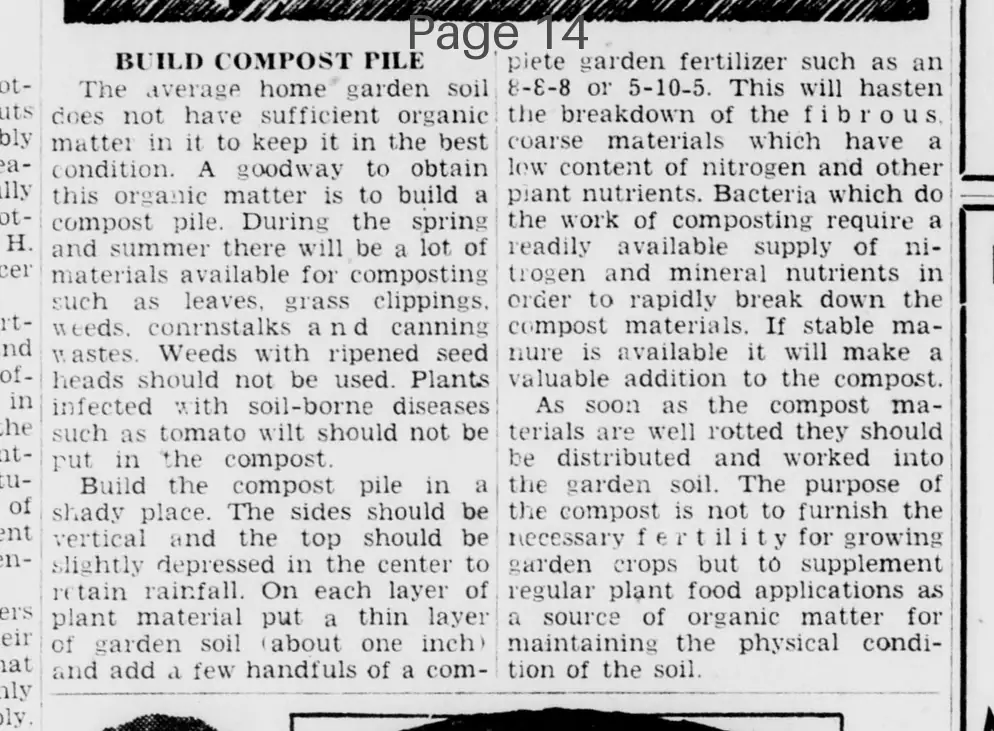
BUILD COMPOST PILE
The average home garden soil does not have sufficient organic matter in it to keep it in the best condition. A good way to obtain this organic matter is to build a compost pile. During the spring and summer there will be a lot of materials available for composting such as leaves, grass clippings, weeds, cornstalks and canning wastes. Weeds with ripened seed heads should not be used. Plants infected with soil-borne diseases such as tomato wilt should not be put in the compost.
Build the compost pile in a shady place. The sides should be vertical and the top should be slightly depressed in the center to retain rainfall. On each layer of plant material put a thin layer of garden soil (about one inch) and add a few handfuls of a complete garden fertilizer such as an 8-8-8 or 5-10-5. This will hasten the breakdown of the fibrous coarse materials which have a low content of nitrogen and other plant nutrients. Bacteria which do the work of composting require a readily available supply of nitrogen and mineral nutrients in order to rapidly break down the compost materials. If stable manure is available it will make a valuable addition to the compost.
As soon as the compost materials are well rotted they should be distributed and worked into the garden soil. The purpose of the compost is not to furnish the necessary fertility for growing garden crops but to supplement regular plant food applications as a source of organic matter for maintaining the physical condition of the soil.
The average home garden soil does not have sufficient organic matter in it to keep it in the best condition. A good way to obtain this organic matter is to build a compost pile. During the spring and summer there will be a lot of materials available for composting such as leaves, grass clippings, weeds, cornstalks and canning wastes. Weeds with ripened seed heads should not be used. Plants infected with soil-borne diseases such as tomato wilt should not be put in the compost.
Build the compost pile in a shady place. The sides should be vertical and the top should be slightly depressed in the center to retain rainfall. On each layer of plant material put a thin layer of garden soil (about one inch) and add a few handfuls of a complete garden fertilizer such as an 8-8-8 or 5-10-5. This will hasten the breakdown of the fibrous coarse materials which have a low content of nitrogen and other plant nutrients. Bacteria which do the work of composting require a readily available supply of nitrogen and mineral nutrients in order to rapidly break down the compost materials. If stable manure is available it will make a valuable addition to the compost.
As soon as the compost materials are well rotted they should be distributed and worked into the garden soil. The purpose of the compost is not to furnish the necessary fertility for growing garden crops but to supplement regular plant food applications as a source of organic matter for maintaining the physical condition of the soil.
What sub-type of article is it?
Instructional Guide
Gardening Advice
What keywords are associated?
Compost Pile
Organic Matter
Gardening
Soil Condition
Fertilizer
Where did it happen?
Home Garden
Story Details
Location
Home Garden
Story Details
Instructions for building a compost pile using plant materials, soil, and fertilizer to add organic matter to garden soil, excluding diseased plants and seeded weeds; compost should be turned into soil once rotted to maintain physical condition.