Thank you for visiting SNEWPapers!
Sign up free
The Alexandria Herald
Alexandria, Virginia
What is this article about?
Report on the recent separation of Lord and Lady Byron, including newspaper exchanges between Sir Ralph Noel and the Morning Chronicle editor, and publication of Byron's poem 'Fare Thee Well' lamenting the split.
Clipping
OCR Quality
Full Text
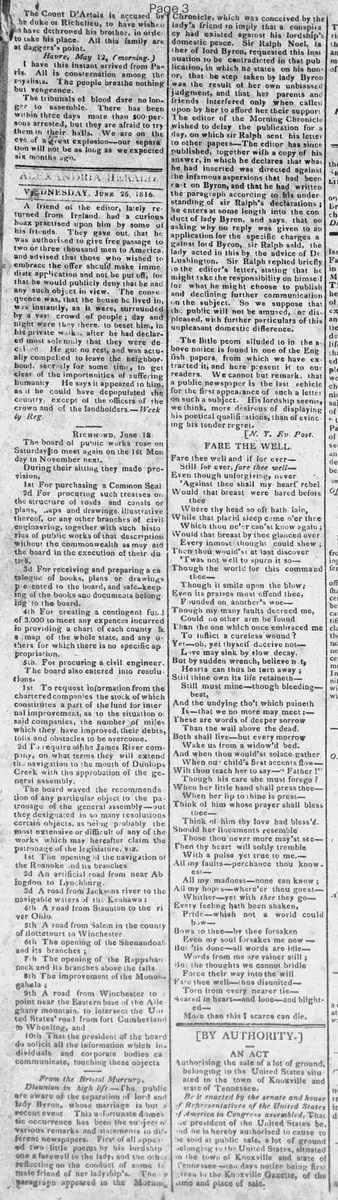
Disunion in high life.—The public are aware of the separation of lord and lady Byron, whose marriage is but a recent event. This unfortunate domestic occurrence has been the subject of various remarks and statements in different newspapers. First of all appeared two little poems by his lordship, one a farewell to the lady, and the other reflecting on the conduct of some female friend of her ladyship's. Then a paragraph appeared in the Morning Chronicle, which was conceived by the lady's friend to imply that a conspiracy had existed against his lordship's domestic peace. Sir Ralph Noel, father of lady Byron, requested this insinuation to be contradicted in that publication, in which he states on his honor, that the step taken by lady Byron was the result of her own unbiassed judgment, and that her parents and friends interfered only when called upon by her to afford her their support. The editor of the Morning Chronicle wished to delay the publication for a day, on which sir Ralph sent his letter to other papers—The editor has since published, together with a copy of his answer, in which he declares that what he had inserted was directed against the infamous aspersions that had been cast on Byron, and that he had written the paragraph according to his understanding of sir Ralph's declarations; he enters at some length into the conduct of lady Byron, and says, that on asking why no reply was given to an application for the specific charges against lord Byron, sir Ralph said, the lady acted in this by the advice of Dr. Lushington. Sir Ralph replied briefly to the editor's letter, stating that he might take the responsibility on himself for what he might choose to publish and declining further communication on the subject. So we suppose that the public will not be amused, or displeased, with further particulars of this unpleasant domestic difference.
The little poem alluded to in the above notice is found in one of the English papers from which we have extracted it, and here present it to our readers. We cannot but remark, that a public newspaper is the last vehicle for the first appearance of such a letter on such a subject. His lordship seems, we think, more desirous of displaying his poetical qualifications, than of evincing his tender regret.
N. Y. Ev. Post.
FARE THEE WELL.
Fare thee well! and if for ever—
Still for ever, fare thee well—
Even though unforgiving, never
'Gainst thee shall my heart rebel.
Would that breast were bared before thee
Where thy head so oft hath lain,
While that placid sleep came o'er thee
Which thou ne'er can'st know again;
Would that breast by thee glanced over,
Every inmost thought could shew;
Then thou would'st at last discover
'Twas not well to spurn it so—
Though the world for this commend thee—
Though it smile upon the blow;
Even its praises must offend thee,
Founded on another's woe—
Though my many faults decreed me,
Could no other arm be found,
Than the one which once embraced me,
To inflict a cureless wound?
Yet, oh, yet thyself deceive not;
Love may sink by slow decay,
But by sudden wrench, believe not
Hearts can thus be torn away:
Still thine own its life retaineth—
Still must mine—though bleeding—beat,
And the undying thought which paineth
Is—that we no more may meet.
These are words of deeper sorrow
Than the wail above the dead:
Both shall live—but every morrow
Wake us from a widow'd bed.
And when thou would'st solace gather—
When our child's first accents flow—
Wilt thou teach her to say 'Father!'
Though his care she must forego?
When her little hand shall press thee—
When her lip to thine is prest—
Think of him whose prayer shall bless thee—
Think of him thy love had bless'd.
Should her lineaments resemble
Those thou never more may'st see,
Then thy heart will softly tremble
With a pulse yet true to me.—
All my faults—perchance thou knowest—
All my madness—none can know;
All my hopes—where'er thou goest—
Wither—yet with thee they go.
Every feeling hath been shaken;
Pride—which not a world could bow—
Bows to thee—by thee forsaken,
Even my soul forsakes me now—
But 'tis done—all words are idle—
Words from me are vainer still;
But the thoughts we cannot bridle
Force their way into the will;
Fare thee well!—thus disunited—
Torn from every nearer tie—
Seared in heart—and lone—and blighted—
More than this I scarce can die.
What sub-type of article is it?
What keywords are associated?
What entities or persons were involved?
Where did it happen?
Foreign News Details
Primary Location
England
Event Date
Recent
Key Persons
Outcome
separation of lord and lady byron; public exchange of letters between sir ralph noel and the morning chronicle editor; publication of byron's poem; no further particulars expected.
Event Details
The separation of Lord and Lady Byron, a recent marriage, has sparked newspaper discussions. Byron published poems, one a farewell. A Morning Chronicle paragraph implied a conspiracy against Byron, prompting Sir Ralph Noel to deny it and affirm Lady Byron's independent decision, supported by family. The editor responded, citing advice from Dr. Lushington on not specifying charges. Sir Ralph declined further communication.