Thank you for visiting SNEWPapers!
Sign up free
Editorial
April 15, 1955
The Poplar Standard
Poplar, Roosevelt County, Montana
What is this article about?
Editorial reflects on Diogenes' ancient search for an honest man, applying it to modern challenges in finding truth amid unreliable media sources, urging caution in trusting information from newspapers and writers.
Clipping
OCR Quality
98%
Excellent
Full Text
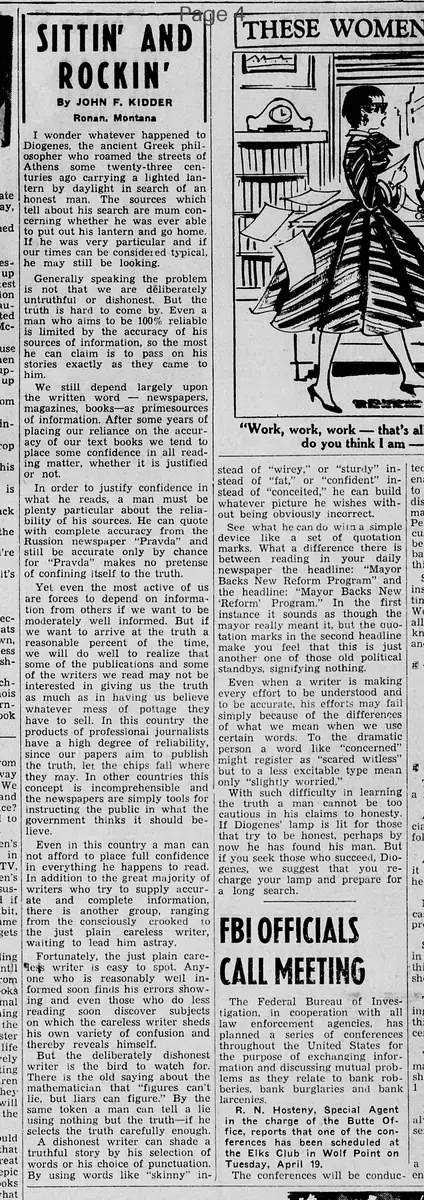
SITTIN' AND ROCKIN'
By JOHN F. KIDDER
Ronan, Montana
I wonder whatever happened to Diogenes. the ancient Greek philosopher who roamed the streets of Athens some twenty-three centuries ago carrying a lighted lantern by daylight in search of an honest man. The sources which tell about his search are mum concerning whether he was ever able to put out his lantern and go home.
If he was very particular and if our times can be considered typical, he may still be looking.
Generally speaking the problem is not that we are deliberately untruthful or dishonest. But the truth is hard to come by. Even a man who aims to be 100% reliable is limited by the accuracy of his sources of information, so the most he can claim is to pass on his stories exactly as they came to him.
We still depend largely upon the written word - newspapers, magazines. books--as prime sources of information. After some years of placing our reliance on the accuracy of our text books we tend to place some confidence in all reading matter, whether it is justified or not.
In order to justify confidence in what he reads, a man must be plenty particular about the reliability of his sources. He can quote with complete accuracy from the Russian newspaper "Pravda" and still be accurate only by chance for "Pravda" makes no pretense of confining itself to the truth.
Yet even the most active of us are forces to depend on information from others if we want to be moderately well informed. But if we want to arrive at the truth a reasonable percent of the time, we will do well to realize that some of the publications and some of the writers we read may not be interested in giving us the truth as much as in having us believe whatever mess of pottage they have to sell. In this country the products of professional journalists have a high degree of reliability, since our papers aim to publish the truth, let the chips fall where they may. In other countries this concept is incomprehensible and the newspapers are simply tools for instructing the public in what the government thinks it should believe.
Even in this country a man can not afford to place full confidence in everything he happens to read. In addition to the great majority of writers who try to supply accurate and complete information, there is another group, ranging from the consciously crooked to the just plain careless writer, waiting to lead him astray.
Fortunately, the just plain careless writer is easy to spot. Anyone who is reasonably well informed soon finds his errors showing and even those who do less reading soon discover subjects on which the careless writer sheds his own variety of confusion and thereby reveals himself.
But the deliberately dishonest writer is the bird to watch for. There is the old saying about the mathematician that "figures can't lie, but liars can figure." By the same token a man can tell a lie using nothing but the truth-if he selects the truth carefully enough.
A dishonest writer can shade a truthful story by his selection of words or his choice of punctuation.
By using words like "skinny" instead of "wirey," or "sturdy" instead of "fat," or "confident" instead of "conceited," he can build whatever picture he wishes without being obviously incorrect.
See what he can do with a simple device like a set of quotation marks. What a difference there is between reading in your daily newspaper the headline: "Mayor Backs New Reform Program" and the headline: "Mayor Backs New 'Reform' Program." In the first instance it sounds as though the mayor really meant it, but the quotation marks in the second headline make you feel that this is just another one of those old political standbys, signifying nothing.
Even when a writer is making every effort to be understood and to be accurate, his efforts may fail simply because of the differences of what we mean when we use certain words. To the dramatic person a word like "concerned" might register as "scared witless" but to a less excitable type mean only "slightly worried."
With such difficulty in learning the truth a man cannot be too cautious in his claims to honesty.
If Diogenes' lamp is lit for those that try to be honest, perhaps by now he has found his man. But if you seek those who succeed, Diogenes, we suggest that you recharge your lamp and prepare for a long search.
By JOHN F. KIDDER
Ronan, Montana
I wonder whatever happened to Diogenes. the ancient Greek philosopher who roamed the streets of Athens some twenty-three centuries ago carrying a lighted lantern by daylight in search of an honest man. The sources which tell about his search are mum concerning whether he was ever able to put out his lantern and go home.
If he was very particular and if our times can be considered typical, he may still be looking.
Generally speaking the problem is not that we are deliberately untruthful or dishonest. But the truth is hard to come by. Even a man who aims to be 100% reliable is limited by the accuracy of his sources of information, so the most he can claim is to pass on his stories exactly as they came to him.
We still depend largely upon the written word - newspapers, magazines. books--as prime sources of information. After some years of placing our reliance on the accuracy of our text books we tend to place some confidence in all reading matter, whether it is justified or not.
In order to justify confidence in what he reads, a man must be plenty particular about the reliability of his sources. He can quote with complete accuracy from the Russian newspaper "Pravda" and still be accurate only by chance for "Pravda" makes no pretense of confining itself to the truth.
Yet even the most active of us are forces to depend on information from others if we want to be moderately well informed. But if we want to arrive at the truth a reasonable percent of the time, we will do well to realize that some of the publications and some of the writers we read may not be interested in giving us the truth as much as in having us believe whatever mess of pottage they have to sell. In this country the products of professional journalists have a high degree of reliability, since our papers aim to publish the truth, let the chips fall where they may. In other countries this concept is incomprehensible and the newspapers are simply tools for instructing the public in what the government thinks it should believe.
Even in this country a man can not afford to place full confidence in everything he happens to read. In addition to the great majority of writers who try to supply accurate and complete information, there is another group, ranging from the consciously crooked to the just plain careless writer, waiting to lead him astray.
Fortunately, the just plain careless writer is easy to spot. Anyone who is reasonably well informed soon finds his errors showing and even those who do less reading soon discover subjects on which the careless writer sheds his own variety of confusion and thereby reveals himself.
But the deliberately dishonest writer is the bird to watch for. There is the old saying about the mathematician that "figures can't lie, but liars can figure." By the same token a man can tell a lie using nothing but the truth-if he selects the truth carefully enough.
A dishonest writer can shade a truthful story by his selection of words or his choice of punctuation.
By using words like "skinny" instead of "wirey," or "sturdy" instead of "fat," or "confident" instead of "conceited," he can build whatever picture he wishes without being obviously incorrect.
See what he can do with a simple device like a set of quotation marks. What a difference there is between reading in your daily newspaper the headline: "Mayor Backs New Reform Program" and the headline: "Mayor Backs New 'Reform' Program." In the first instance it sounds as though the mayor really meant it, but the quotation marks in the second headline make you feel that this is just another one of those old political standbys, signifying nothing.
Even when a writer is making every effort to be understood and to be accurate, his efforts may fail simply because of the differences of what we mean when we use certain words. To the dramatic person a word like "concerned" might register as "scared witless" but to a less excitable type mean only "slightly worried."
With such difficulty in learning the truth a man cannot be too cautious in his claims to honesty.
If Diogenes' lamp is lit for those that try to be honest, perhaps by now he has found his man. But if you seek those who succeed, Diogenes, we suggest that you recharge your lamp and prepare for a long search.
What sub-type of article is it?
Moral Or Religious
Press Freedom
What keywords are associated?
Honesty
Truth In Media
Diogenes
Journalism Reliability
Dishonest Writing
Source Accuracy
What entities or persons were involved?
Diogenes
Pravda
Professional Journalists
Editorial Details
Primary Topic
Search For Honesty In Media And Writing
Stance / Tone
Reflective Cautionary Exhortation
Key Figures
Diogenes
Pravda
Professional Journalists
Key Arguments
Truth Is Hard To Come By Due To Unreliable Sources.
Dependence On Written Media Like Newspapers Requires Caution In Source Reliability.
Some Publications Prioritize Propaganda Over Truth, Unlike Reliable U.S. Journalism.
Careless Writers Are Easy To Spot Through Errors.
Dishonest Writers Manipulate Truth Via Word Choice, Punctuation, And Selective Facts.
Differences In Word Meanings Can Lead To Misunderstandings Even In Honest Writing.
One Must Be Cautious In Claims To Honesty Given These Challenges.