Thank you for visiting SNEWPapers!
Sign up free
Gazette Of The United States
Philadelphia, Philadelphia County, Pennsylvania
What is this article about?
In the House of Commons on November 25, Mr. Fox delivered an energetic speech praising the previous speaker's principles while opposing a bill increasing government restraints. He attributed public discontent to an unjust war, corrupt administration, commercial decay, and famine, drawing historical parallels to Charles I and the American Revolution, and advocated conciliatory measures over repression.
Merged-components note: Continuation of Mr. Fox's speech in the House of Commons, text flows directly from one component to the next.
Clipping
OCR Quality
Full Text
November 25.
[Continued.]
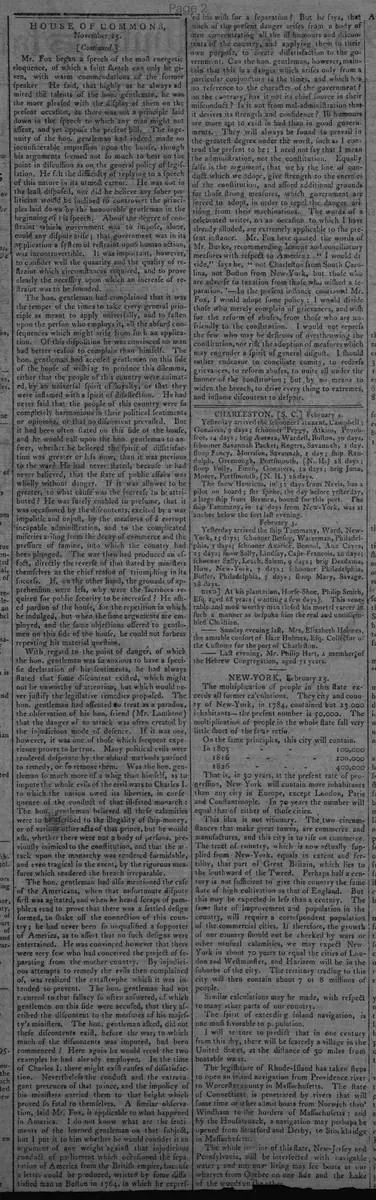
Mr. Fox began a speech of the most energetic eloquence, of which a faint sketch can only be given, with warm commendations of the former speaker. He said, that highly as he always admired the talents of the hon. gentleman, he was the more pleased with the display of them on the present occasion, as there was not a principle laid down in the speech to which any man might not assent, and yet oppose the present bill. The ingenuity of the hon. gentleman had indeed made no inconsiderable impression upon the house, though his arguments seemed not so much to bear on the point in discussion as on the general policy of legislation. He felt the difficulty of replying to a speech of this nature in its utmost extent. He was not in the least disposed, nor did he believe any sober politician would be inclined to controvert the principles laid down by the honourable gentleman in the beginning of his speech. About the degree of constraint which government was to impose, alone, could any dispute arise; that government was in its application a system of restraint upon human action, was incontrovertible. It was important, however, to consider well the quantity and the quality of restraint which circumstances required, and to prove clearly the necessity upon which an increase of restraint was to be founded.
The hon. gentleman had complained that it was the temper of the times to take every general principle as meant to apply universally, and to fasten upon the person who employs it, all the absurd consequences which might arise from such an application. Of this disposition he was convinced no man had better reason to complain than himself. The hon. gentleman had accused gentlemen on this side of the house of willing to produce this dilemma, either that the people of this country were animated by a universal spirit of loyalty, or that they were inflamed with a spirit of disaffection. He had never said that the people of this country were so completely harmonious in their political sentiments or opinions, or that no discontent prevailed. But it had been often stated on this side of the house, and he would call upon the hon. gentleman to answer, whether he believed the spirit of dissatisfaction was greater or less now, than it was previous to the war? He had never stated, because he had never believed, that the state of public affairs was wholly without danger. If it was allowed to be greater, to what cause was the increase to be attributed? He was surely enabled to presume, that it was occasioned by the discontents, excited by a war impolitic and unjust, by the measures of a corrupt incapable administration, and to the complicated miseries arising from the decay of commerce and the pressure of famine, into which the country had been plunged. The war then had produced an effect, directly the reverse of that stated by ministers themselves as the chief reason of triumphing in its success. If, on the other hand, the grounds of apprehension were less, why were the sacrifices required for public security to be increased? He asked pardon of the house, for the repetition in which he indulged, but when the same arguments are employed, and the same objections offered to gentlemen on this side of the house, he could not forbear repeating his material question.
With regard to the point of danger, of which the hon. gentleman was so anxious to have a specific declaration of his sentiments, he had always stated that some discontent existed, which might not be unworthy of attention, but which would never justify the legislative remedies proposed. The hon. gentleman had assented to treat as a paradox, the observation of his hon. friend (Mr. Lambton) that the danger of an attack was often created by the injudicious mode of defence. If it was one, however, it was one of those which frequent experience proves to be true. Many political evils were rendered desperate by the absurd methods pursued to remedy, or so remove them. Was the hon. gentleman so much more of a whig than himself, as to impute the whole evils of the civil wars to Charles I. to which the nation owed its liberties, in consequence of the conduct of that ill-fated monarch: The hon. gentleman believed all these calamities were to be ascribed to the illegality of ship-money, or of various other acts of that prince, but he would ask, whether there were not a body of persons, previously inimical to the constitution, and that the attack upon the monarchy was rendered formidable, and even tragical in the event, by the rigorous measures which rendered the breach irreparable.
The hon. gentleman had also mentioned the case of the Americans, when that unfortunate dispute first was agitated, and when he heard scraps of pamphlets read to prove that there was a settled design formed, to shake off the connection of this country; he had never been so unqualified a supporter of America, as to assert that no such designs were entertained. He was convinced however that there were very few who had conceived the project of separating from the mother country. By injudicious attempts to remedy the evils then complained of, was realized the catastrophe which it was, intended to prevent. The hon. gentleman had not recured to that fallacy so often answered, of which gentlemen on this side were accused, that they ascribed the discontent to the measures of his majesty's ministers. The hon. gentleman asked, did not these discontents exist, before the war, to which much of the discontents was imputed, had been commenced ? Here again he would recal the two examples he had already employed. In the time of Charles I. there might exist causes of dissatisfaction, Nevertheless the conduct and the extravagant pretensions of that prince, and the impolicy of his ministers carried them to that height which proved so fatal to themselves. A similar observation, said Mr. Fox, is applicable to what happened in America. I do not know what are the sentiments of the learned gentleman on that subject, but I put it to him whether he would consider it an argument of any weight against that injudicious conduct of parliament which occasioned the separation of America from the British empire, because a letter could be produced, written by some dissatisfied man in Boston in 1764, in which he expressed his wish for a separation? But he says. that much of the present danger arises from a body of men concentrating all the ill humours and discontents of the country, and applying them to their own purpose, to create dissatisfaction to the government. Can the hon. gentleman, however, maintain that this is a danger which arises only from a particular conjuncture in the times, and which has no reference to the character of the government?
On the contrary, has it not its chief source in their misconduct ? Is it not from mal-administration that it derives its strength and confidence ? Ill humours are more apt to subsist in bad than in good governments. They will always be found to prevail in the greatest degree under the worst, such as I contend the present to be; I need not say that I mean the administration, not the constitution. Equally false is the argument, that we by the line of conduct which we adopt, give strength to the enemies of the constitution, and afford additional grounds for those strong measures, which government are forced to adopt, in order to repel the danger arising from their machinations. The words of a celebrated writer, on an occasion, to which I have already alluded, are extremely applicable to the present instance. Mr. Fox here quoted the words of Mr. Burke, recommending lenient and conciliatory measures with respect to America : " I would divide," says he, " not Charleston from South Carolina, not Boston from New- York, but those who are adverse to taxation from those who wished a separation. "--In the present instance continued Mr. Fox, I would adopt some policy : I would divide those who merely complain of grievances, and wish for the reform of abuses, from those who are so friendly to the constitution. I would not repress the few who may be desirous of overthrowing the constitution, nor risk the adoption of measures which may engender a spirit of general disgust. I should rather endeavor to conciliate enmity, to redress grievances, to reform abuses, to unite all under the banner of the constitution; but by no means to widen the breach, to drive every thing to extremes, and inflame discontent to despair.
What sub-type of article is it?
What keywords are associated?
What entities or persons were involved?
Where did it happen?
Foreign News Details
Primary Location
House Of Commons
Event Date
November 25
Key Persons
Event Details
Mr. Fox delivered a speech in response to the previous speaker, agreeing on general principles of government restraint but opposing the bill's increase in constraints due to public discontent from an unjust war, corrupt administration, commercial decay, and famine. He referenced historical examples like Charles I's reign and the American Revolution to argue that injudicious measures exacerbate dangers, quoted Mr. Burke on conciliatory policies toward America, and advocated dividing complainers from revolutionaries to reform abuses and unite under the constitution rather than repress.