Thank you for visiting SNEWPapers!
Sign up free
Kentucky Gazette
Lexington, Fayette County, Kentucky
What is this article about?
In a Senate speech on December 31, 1837, Mr. Benton opposes Mr. Clay's motion to postpone bills suppressing small notes (shin-plasters) and requiring District of Columbia banks to resume specie payments by May 1. Benton argues for immediate action, citing ample hard money supply from Congress, success of Jackson's currency reforms increasing specie from 20 to 80 million dollars, and a new bill principle protecting resuming banks. He contrasts bank eras with specie import/export tables and praises Missouri's prosperity without shin-plasters.
Merged-components note: The tables detail imports and exports referenced in Mr. Benton's speech on currency policy and bank resumption.
Clipping
OCR Quality
Full Text
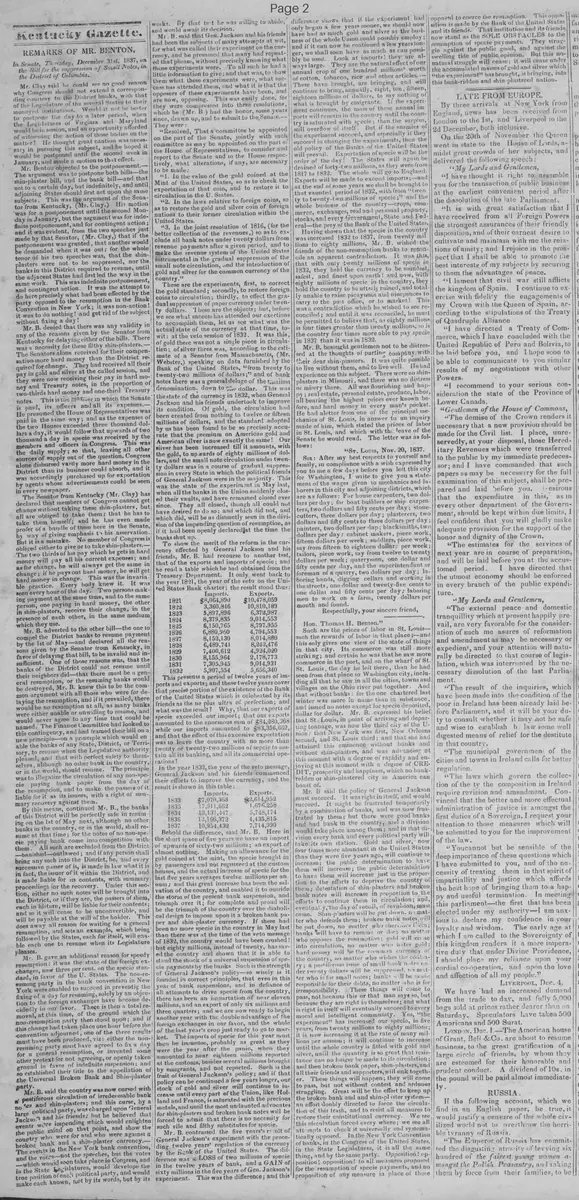
REMARKS OF MR. BENTON,
In Senate, Thursday, December 31st, 1837, on the Bill for the suppression of Small Notes, in the District of Columbia.
Mr. Clay said he could see no good reason why Congress should not extend a corresponding courtesy to the District banks, with that of the Legislatures of the several States to their moneyed institutions. Would it not be better to postpone the day to a later period, when the Legislatures of Virginia and Maryland would be in session, and an opportunity afforded of witnessing the action of those bodies on the matter? He thought great caution was necessary in pursuing this subject, and he hoped it would be postponed until the second week in January, and made a motion to that effect.
The argument was to postpone both bills—the shin-plaster bill, and the bank bill—and that not to a certain day, but indefinitely, and until the adjoining States should first act upon the same subjects. This was the argument of the Senator from Kentucky, (Mr. Clay.) His motion was for a postponement until the second Monday in January, but the argument was for indefinite postponement, and for contingent action: and it was evident, from the two speeches just made by that Senator, (Mr. Clay,) that if the postponement was granted, that another would be demanded when it was out; for the whole tenor of his two speeches was, that the shin-plasters were not to be suppressed, nor the banks in this District required to resume, until the adjacent States had first led the way in the same work. This was indefinite postponement, and contingent action. It was the attempt to do here precisely what had been effected by the party opposed to the resumption in the Bank Convention in New York; it was non-action! it was to do nothing! and get rid of the subject without fixing a day!
Mr. B. denied that there was any validity in any of the reasons given by the Senator from Kentucky for delaying either of the bills. There was a necessity for these filthy shin-plasters.—The Senators alone received for their compensation more hard money than the District required for change. They had received all their pay in gold and silver at the called session, and they were now receiving their pay in hard money and Treasury notes, in the proportion of two-thirds hard money and one-third Treasury notes. This is the manner in which the Senate is paid, its officers and all its expenses.—He presumed the House of Representatives was paid in the same way: and as the expenses of the two Houses exceeded three thousand dollars a day, it would follow that upwards of two thousand a day in specie was received by the members and officers in Congress. This was the daily supply; so that, leaving all other sources of supply out of the question, Congress alone disbursed vastly more hard money in the District than its business could absorb, and it was accordingly purchased up for exportation by agents whose advertisements could be seen in every newspaper.
The Senator from Kentucky (Mr. Clay) has declared that members of Congress cannot get change without taking these shin-plasters, but all are obliged to take them; that he has to take them himself; and he has even made a proffer of a bundle of them here in the Senate, by way of giving emphasis to his assertion. But it is a mistake. No member of Congress is obliged either to give or to take shin-plasters.—The two thirds of his pay which he gets in hard money will pay all his current expenses; and as for change, he will always get the same in change; if he pays out hard money, he will get hard money in change. This was the invariable practice. Every body knew it. It was seen every hour of the day. Two persons making payment at the same time, and to the same person, one paying in hard money, the other in shin-plasters, receive their change, in the presence of each other, in the same medium which they use.
Mr. B. adverted to the other bill—the one to compel the District banks to resume payment by the 1st of May—and declared all the reasons given by the Senator from Kentucky, in favor of delaying that bill, to be invalid and insufficient. One of those reasons was, that the banks of the District could not resume until their neighbors did—that there must be a general resumption, or the resuming banks would be destroyed. Mr. B. knew this to be the common argument with all those who were for delaying the resumption, and if it prevailed, there would be no resumption at all, as many banks were either unable or unwilling to resume, and would never agree to any time that could be named. The Finance Committee had looked to this contingency, and had framed their bill on a new principle—on a principle which would enable the banks of any State, District, or Territory, to resume when the Legislative authority pleased, and that with perfect safety to themselves, although no other bank in the country, or in the world, should resume. The principle was to illegalize the circulation of any non-specie paying bank paper from the day of the resumption, and to make the passers of it liable for it as its issuers, with a right of summary recovery against them.
By this means, continued Mr. B., the banks of this District will be perfectly safe in resuming on the 1st of May next, although no other banks in the country, or in the world, shall resume; for the notes of no non-specie paying bank come into competition with them. All such are excluded from the District—banished, outlawed; and if any person shall bring any such into the District, he, and every successive passer of it, is made in law what it is in fact, the issuer of it within the District, and is made liable for its contents, with summary proceedings for the recovery. Under this section, either no such notes will be brought into the District, or if they are, the passers of them, each in his turn, will be liable for their contents; and so it will cease to be unconvertible, and will be payable at the will of the holder. This does away all reason for waiting for a general resumption, and sets an example, which being followed by the States, each for itself, will enable each one to resume when its Legislature pleases.
Mr. B. gave an additional reason for speedy resumption: it was the state of the foreign exchanges, now three per cent. on the specie standard, in favor of the U. States. The non-resuming party in the bank convention in New York were enabled to succeed in preventing the fixing of a day for resuming, solely by an objection to the foreign exchanges have become decidedly in our favor. There is then a total removal, at this time, of the ground which the non-resumption party then stood upon; and if this change had taken place one hour before the convention adjourned, one of the three results must have been produced, viz: either the non-resuming party must have agreed to fix a day for a general resumption, or invented some other pretext for not agreeing, or openly taken ground in favor of indefinite suspension: and so established their title to the appellation of the Universal Broken Bank and Shin-plaster party.
Mr. B. said the country was now cursed with a pestiferous circulation of irredeemable bank notes and shin-plasters; and this curse, by a large political party, was charged upon General Jackson and his friends; but he believed that events were impending which would enlighten the public mind on that point, and show the country who were for and who were against a broken bank and a shin-plaster currency.—The events in the New York bank convention, and the votes—not the speeches, but the votes—which would soon take place in Congress, and in the State Legislatures, would develope the true position of each political party, and would make each known, not by its words, but by its works. By that test he was willing to abide, and would await its decision.
Mr. B. said that Gen. Jackson and his friends had been the subjects of many attempts at wit, for what was called their experiment on the currency, and he presumed that many had repeated that phrase, without precisely knowing what those experiments were. To all such he had a little information to give; and that was, to show them what these experiments were, what success has attended them, and what it is that the opposers of these experiments have been, and are now, opposing. This was easily done. for they were compressed into three resolutions, which he (Mr. B.) had the honor, some years since, drawn up, and to submit to the Senate.—They were:
"Resolved, That a committee be appointed on the part of the Senate, jointly with such committee as may be appointed on the part of the House of Representatives, to consider and report to the Senate and to the House respectively, what alterations, if any, are necessary to be made:
1. In the value of the gold coined at the Mint of the United States, so as to check the exportation of that coin, and to restore it to circulation in the U. States.
2. In the laws relative to foreign coins, so as to restore the gold and silver coin of foreign nations to their former circulation within the United States.
3. In the joint resolution of 1816, (for the better collection of the revenues,) so as to exclude all bank notes under twenty dollars from revenue payments after a given period, and to make the revenue system of the United States instrumental in the gradual suppression of the small note circulation, and the introduction of gold and silver for the common currency of the country."
These are the experiments, first, to correct the gold standard; secondly, to restore foreign coins to circulation: thirdly, to effect the gradual suppression of paper currency under twenty dollars. These are the objects; but, before we see what success has attended our exertions to accomplish them, let us see what was the actual state of the currency at that time, to-wit: at the veto session of 1832. It was this, of gold there was not a single piece in circulation: of silver there was, according to the estimate of a Senator from Massachusetts, (Mr. Webster,) speaking on data furnished by the Bank of the United States, "from twenty to twenty-two millions of dollars;" and of bank notes there was a general deluge of the smallest denomination, down to five dollars. This was the state of the currency in 1832, when General Jackson and his friends undertook to improve its condition. Of gold, the circulation had been created from nothing to twelve or fifteen millions of dollars, and the standard adopted by us has been found to be so precisely accurate that the premium on American gold and American silver is now exactly the same! Our silver has been increased till it amounts, with the gold, to upwards of eighty millions of dollars, and the small note circulation under twenty dollars was in a course of gradual suppression in every State in which the political friends of General Jackson were in the majority. This was the state of the experiment in May last, when all the banks in the Union suddenly closed their vaults, and have remained closed ever since. They all closed, though all could not have desired to do so: and which did not, and which did, will be as distinctly seen in the division of the impending question of resumption, as if it had been openly declared at the time the banks shut up.
To show the merit of the reform in the currency effected by General Jackson and his friends, Mr. B. had recourse to another test. that of the exports and imports of specie; and he read a table which he had obtained from the Treasury Department. It only went back to the year 1821, the year of the veto on the United States Bank charter; the result stood thus:
| Imports. | Exports. | |
| 1821 | $8,064,890 | $10,478,059 |
| 1822 | 3,360,846 | 10,810,189 |
| 1823 | 5,897,896 | 6,372,987 |
| 1824 | 8,379,835 | 9,014,553 |
| 1825 | 6,150,765 | 8,797,955 |
| 1826 | 6,880,960 | 4,704,553 |
| 1837 | 8,152,130 | 8,014,880 |
| 1828 | 6,489,741 | 8,242,476 |
| 1829 | 7,400,612 | 4,924,020 |
| 1830 | 8,155,964 | 2,178,773 |
| 1831 | 7,305,945 | 9,014,931 |
| 1832 | 5,907,554 | 5,656,340 |
This presents a period of twelve years of imports and exports; and these twelve years cover that precise portion of the existence of the Bank of the United States which is celebrated by its friends as the ne plus ultra of perfection; and what was the result? Why, that our exports of specie exceeded our imports; that our exports amounted to the enormous sum of $84,280,368 while our imports amounted to $83,356,662, and that the effect of this excessive exportation was to leave the country with no more than twenty or twenty-two millions of specie to sustain all its banking, and all its commercial operations?
In the year 1832, the year of the veto message. General Jackson and his friends commenced their efforts to improve the currency, and the result is shown in this table:
| Imports. | Exports. | |
| 1833 | $7,070,368 | $2,614,952 |
| 1835 | 17,911,662 | 1,676,258 |
| 1834 | 13,131,447 | 5,748,174 |
| 1836 | 12,166,372 | 4,435,815 |
| 1837 | 10,954,432 | 7,714,990 |
Behold the difference, said Mr. B. Here in the short space of five years we have an import of upwards of sixty-two millions; an export of almost nothing. Making an allowance for the gold coined at the mint, the specie brought in by passengers and not registered at the custom houses, and the actual increase of specie for the last five years averages twelve millions per annum; and this great increase has been the salvation of the country, and enabled it to outride the storm of the present bank suspension, and triumph over it; for complete and proud will be the triumph of the country over the diabolical design to impose upon it a broken bank paper and shin-plaster currency. If there had been no more specie in the country in May last than there was at the time of the veto message of 1832, the country would have been crushed! but eighty millions, instead of twenty, has saved the country and shown that it is able to stand the shock of a universal suspension of specie payments by the banks. Such is the strength of General Jackson's policy—so wisely is it founded in correct principles, that even in this year of bank suspensions. and in defiance of all attempts to drive specie from the country, there has been an importation of near eleven millions, and an export of only six millions and three quarters; and we are now ready to begin another year with the double advantage of the foreign exchanges in our favor, and the whole of the last year's crop just ready to go to market. The imports of specie for this year must then be immense, probably as great as they were the year after the panic, when they amounted to near eighteen millions reported at the customs, besides several millions brought by emigrants, and not reported. Such is the fruit of General Jackson's policy; and if that policy can be continued a few years longer, our stock of gold and silver will continue to increase until every part of the Union, like Holland and France, is saturated with the precious metals, and until the most undaunted advocates for shin-plasters and broken bank notes will be forced to admit that there is no necessity for such vile and filthy substitutes for specie.
Mr. B. contrasted the five years' result of General Jackson's experiment with the preceding twelve years' regulation of the currency by the Bank of the United States. The difference was LOSS of two millions of specie in the twelve years of bank, and a GAIN of sixty millions in the five years of Gen. Jackson's experiment. This was the difference; and this difference shows that if the experiment had only began a few years sooner, we should now have had as much gold and silver as the business of the whole Union could possibly employ: and if it can now be continued a few years longer, we shall soon have as much as can possibly be used. Look at imports! they are always large. They are the natural effect of our annual crop of one hundred millions' worth of cotton, tobacco, rice and other articles.—These have brought, are bringing, and will continue to bring, annually, eight, ten, fifteen, eighteen millions of dollars, to say nothing of what is brought by emigrants. If the experiment continues, the mass of these annual imports will remain in the country until the country is saturated with specie; then the surplus, will overflow of itself. But if the enemies of the experiment succeed, and especially if they succeed in changing the experiments, then the old policy of the Banks of the United States will prevail. Exportation of specie will be the order of the day! The States will again be drained of forty-two millions, as they were from 1817 to 1832. The whole will go to England. Exports will be made to exceed imports;—and at the end of some years we shall be brought to that vaunted period of 1832, with from "twenty to twenty-two millions of specie;" and the whole business of the country—crops, commerce, exchanges, real and personal property, stocks, and every Government, State and Federal—the prey of the Bank of the United States.
Having shown that the specie in the country was increased 1832 to 1837, from twenty millions to eighty millions, Mr. B. wished the friends of the non-resumption banks to reconcile an apparent contradiction. It was this, that with only twenty millions of specie in 1832, they held the currency to be soundest, safest, and finest upon earth! and now, with eighty millions of specie in the country, they hold the country to be utterly ruined, and totally unable to raise picayunes and ninepences to carry to the post office, or to market! This was a contradiction which he wished to see reconciled; and until it was reconciled, he must be permitted to believe that, as eighty millions is four times greater than twenty millions, so is the country four times more able to pay specie in 1837 than it was in 1832.
Mr. B. besought gentlemen not to be distressed at the thoughts of parting company with their dear shin-plasters. It was quite possible to live without them, and to live well. He had experience on this subject. There were no shin-plasters in Missouri, and there was no distress or misery there. All was flourishing and happy; real estate, personal estate, produce, labor, all bearing the highest prices ever known before, and hard money in every man's pocket. He had a letter from one of the principal mechanics of St. Louis, in answer to an inquiry made of him, which stated the prices of labor in St. Louis, and which with the leave of the Senate he would read. The letter was as follows:
"St. Louis, Nov. 20, 1837.
Sir: After my best respects to yourself and family, in compliance with a wish expressed by you to me a few days before you left this city for Washington, I write to give you a statement of the wages given to mechanics and laborers in this city and adjoining districts, which are as follows: For house carpenters, two dollars per day: for boat builders or ship carpenters, two dollars and fifty cents per day; stone-cutters, three dollars per day; plasterers, two dollars and fifty cents to three dollars per day: painters, two dollars per day: blacksmiths, two dollars per day; cabinet makers, piece work, fifteen dollars per week; saddlers, piece work, say from fifteen to eighteen dollars per week; tailors, piece work, say from twelve to twenty dollars per week; quarrymen, one dollar and fifty cents per day, and the superintendant or foreman of a quarry, two dollars per day; laboring hands, digging cellars and working in the streets, one dollar and twenty-five cents to one dollar and fifty cents per day; laboring men to work on a farm, twenty dollars per month and found.
Respectfully, your sincere friend,
Hon. Thomas H. Benton."
Such are the prices of labor in St. Louis—such the rewards of labor in that place;—and this only gives one view of the state of things in that city. Its commerce was still more striking; and certain he was that he saw more commerce in the port, and on the wharf of St. Louis, the day he left there, than he had seen from that place to Washington city, including all that he saw in all the cities, towns and villages on the Ohio river put together. And that without banks: for the one chartered last winter was more in name than in substance, and issued no notes except for specie deposited, dollar for dollar. Mr. B. expressed his belief that St. Louis, in point of arriving and departing tonnage, was now the third city of the Union: that New York was first, New Orleans second, and St. Louis third: and that she had attained this eminence without banks and without shin-plasters, and was advancing at this moment with a degree of rapidity and enjoying at this moment with a degree of credit, prosperity and happiness, which no bank-ridden or shin-plastered city in America can boast of.
Mr. B. said the policy of General Jackson must succeed. It was right in itself, and would succeed. It might be frustrated temporarily by a combination of banks, and was now frustrated by them; but there were good banks and bad banks in the country, and a division would take place among them: and in that division every bank and every political party will take its own station. Gold and silver, now four times more abundant in the United States than they were five years ago, will continue to increase; the public determination to have them will increase; the public determination to have them will increase just in the proportion to the efforts to deprive the country of them; detestation of shin-plasters and broken bank notes will increase in proportion to the efforts to continue them in circulation; and eventually, the day of recoil, of revulsion, must come. Shin-plasters will be put down, no matter who defends them; broken bank notes will be put down, no matter who cherishes them: banks will have to resume or die; no matter who opposes the resumption: gold will come into circulation, no matter who bites gold; hard money will be the common currency of the country, no matter who wishes the contrary; a pestiferous issue of small bank notes under twenty dollars will be suppressed, no matter who is for small notes; banks will be made responsible for their debts, no matter who is for irresponsibility. These things will come to pass, not because this or that man says so, but because they are right in themselves; and what is right in itself will eventually succeed to every moral and intelligent community. Yes, "the experiment" has increased our specie, in five years, from twenty millions to eighty millions; it is now increasing it at the rate of many millions per annum; it will continue to increase until the whole country is filled with gold and silver, until the quantity is so great that resistance can no longer be made to its circulation: and then broken bank paper, shin-plasters, and all their friends and supporters, will sink together. These things will happen; they will come to pass, but not without contest and arduous struggling. Great will be the effort to keep up the broken bank and shin-plaster system—an effort doubly directed to force the circulation of this trash, and to resist all measures to restore their constitutional currency. We see this circulation forced every where; we see all attempts to check it universally and systematically opposed. In the New York Convention of banks, in the Congress of the United States, in the State Legislatures, it is all the same thing, and by the same party. Opposition! opposition! opposition! to all measures proposed for the resumption of specie payments, and no proposition of any measure in place of those opposed to coerce the resumption. This opposition is made by the Bank of the United States and its friends. That institution and its friends now stand as the SOLE OBSTACLES to the resumption of specie payments. They struggle against the public good, and against the swelling tide of public opinion. But this unnatural struggle will cease; it will cease under the accumulated masses of gold and silver which "the experiment" has brought, is bringing, into this bank-ridden and shin-plastered nation.
What sub-type of article is it?
What themes does it cover?
What keywords are associated?
What entities or persons were involved?
Where did it happen?
Story Details
Key Persons
Location
Senate, District Of Columbia
Event Date
December 31st, 1837
Story Details
Mr. Benton delivers a speech opposing postponement of bills to suppress small notes and compel bank resumption, refuting Mr. Clay's arguments, highlighting ample hard money from Congress, praising Jackson's currency experiments that increased specie circulation, presenting specie import/export tables showing gains under Jackson vs. losses under the Bank of the United States, and citing Missouri's prosperity without shin-plasters.