Thank you for visiting SNEWPapers!
Sign up free
The Daily Record
Dunn, Harnett County, North Carolina
What is this article about?
US Air Force and Navy have fewer total aircraft than in mid-1950 at Korean War start (31,200), but improved modern plane proportion; under 9,000 combat planes vs Russia's 19,000+; production lags losses and aid; Truman defends expansion to 15,000 active, amid election criticism by Taft.
Clipping
OCR Quality
Full Text
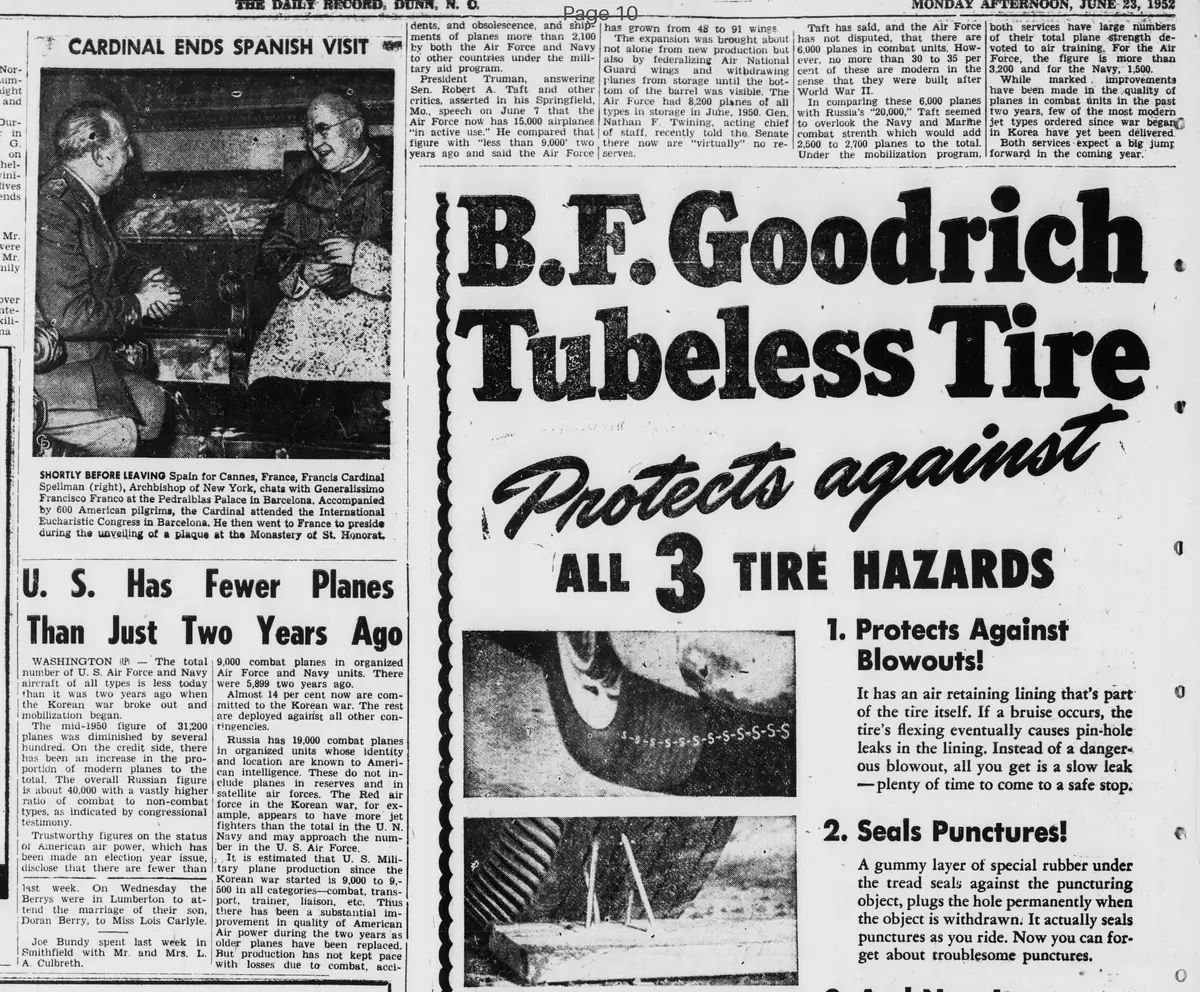
WASHINGTON (P) - The total number of U. S. Air Force and Navy aircraft of all types is less today than it was two years ago when the Korean war broke out and mobilization began.
The mid-1950 figure of 31,200 planes was diminished by several hundred. On the credit side, there has been an increase in the proportion of modern planes to the total. The overall Russian figure is about 40,000 with a vastly higher ratio of combat to non-combat types, as indicated by congressional testimony.
Trustworthy figures on the status of American air power, which has been made an election year issue, disclose that there are fewer than 9,000 combat planes in organized Air Force and Navy units. There were 5,899 two years ago.
Almost 14 per cent now are committed to the Korean war. The rest are deployed against all other contingencies.
Russia has 19,000 combat planes in organized units whose identity and location are known to American intelligence. These do not include planes in reserves and in satellite air forces. The Red air force in the Korean war, for example, appears to have more jet fighters than the total in the U. N. Navy and may approach the number in the U. S. Air Force.
It is estimated that U. S. Military plane production since the Korean war started is 9,000 to 9,500 in all categories-combat, transport, trainer, liaison, etc. Thus there has been a substantial improvement in quality of American Air power during the two years as older planes have been replaced.
But production has not kept pace with losses due to combat, accidents, and obsolescence, and shipments of planes more than 2,100 by both the Air Force and Navy to other countries under the military aid program.
President Truman, answering Sen. Robert A. Taft and other critics, asserted in his Springfield, Mo., speech on June 7 that the Air Force now has 15,000 airplanes "in active use." He compared that figure with "less than 9,000" two years ago and said the Air Force has grown from 48 to 91 wings.
The expansion was brought about not alone from new production but also by federalizing Air National Guard wings and withdrawing planes from storage until the bottom of the barrel was visible. The Air Force had 8,200 planes of all types in storage in June, 1950. Gen. Nathan F. Twining, acting chief of staff, recently told the Senate there now are "virtually" no reserves.
Taft has said, and the Air Force has not disputed, that there are 6,000 planes in combat units. However, no more than 30 to 35 per cent of these are modern in the sense that they were built after World War II.
In comparing these 6,000 planes with Russia's "20,000," Taft seemed to overlook the Navy and Marine combat strength which would add 2,500 to 2,700 planes to the total.
For the Air Force, the figure is more than 3,200 and for the Navy, 1,500.
While marked improvements have been made in the quality of planes in combat units in the past two years, few of the most modern jet types ordered since war began in Korea have yet been delivered.
Both services expect a big jump forward in the coming year.
Under the mobilization program, have been made in the quality of planes in combat units in the past two years, few of the most modern jet types ordered since war began in Korea have yet been delivered. Both services expect a big jump forward in the coming year.
What sub-type of article is it?
What keywords are associated?
What entities or persons were involved?
Where did it happen?
Domestic News Details
Primary Location
Washington
Key Persons
Outcome
us total aircraft less than 31,200 in mid-1950; fewer than 9,000 combat planes in organized units (up from 5,899 two years ago); 14% committed to korean war; production of 9,000-9,500 planes since war start; substantial improvement in quality but not keeping pace with losses and aid shipments; air force claims 15,000 in active use; virtually no reserves left.
Event Details
The US Air Force and Navy have fewer total aircraft today than two years ago at the start of the Korean War, with mid-1950 figure of 31,200 now diminished by several hundred, though proportion of modern planes has increased. Fewer than 9,000 combat planes in organized units, compared to Russia's 19,000 known plus reserves. Production since war: 9,000-9,500 planes, but losses from combat, accidents, obsolescence, and over 2,100 shipped abroad under aid. President Truman asserted 15,000 Air Force planes in active use, up from less than 9,000, with growth to 91 wings via production, federalizing National Guard, and depleting storage (from 8,200 to virtually none). Sen. Taft claimed 6,000 in combat units, 30-35% modern, overlooking Navy/Marine addition of 2,500-2,700. Few modern jets delivered yet, but expected big jump in coming year.