Thank you for visiting SNEWPapers!
Sign up free
Domestic News
June 28, 1819
Alexandria Gazette & Daily Advertiser
Alexandria, Virginia
What is this article about?
Detailed topographic and historical description of Baton Rouge from the Baton Rouge Gazette, covering its location on the Mississippi, geography, inhabitants, public buildings, parish boundaries, settlement since 1720, soil, productions, climate, and future potential as a major town.
Clipping
OCR Quality
95%
Excellent
Full Text
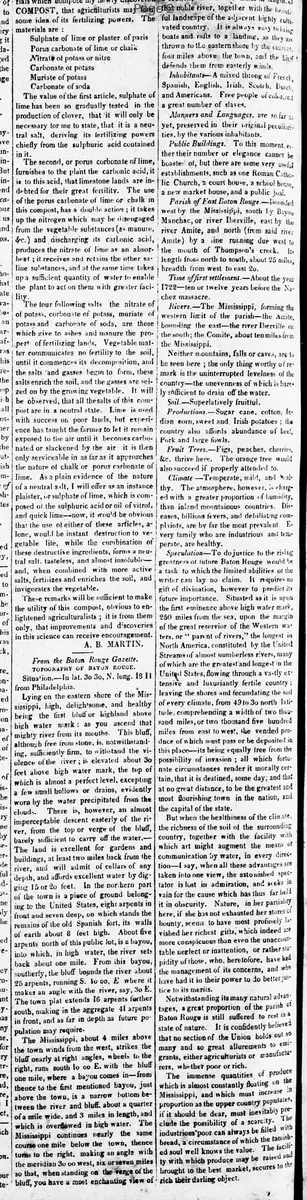
From the Baton Rouge Gazette.
TOPOGRAPHY OF BATON ROUGE.
Situation.--In lat. 30° 30', N. long. 91° 11' from Philadelphia.
Lying on the eastern shore of the Mississippi, high, delightful, and healthy being the first bluff or highland above high water mark: as you ascend that mighty river from its mouths. This bluff, although free from stone, is, notwithstanding, sufficiently firm, to withstand the violence of the river; is elevated about 30 feet above high water mark, the top of which is almost a perfect level, excepting a few small hollows or drains, evidently worn by the water precipitated from the clouds. There is, however, an almost imperceptible descent easterly of the river, from the top or verge of the bluff barely sufficient to carry off the water.-- The land is excellent for gardens and buildings, at least two miles back from the river, and will admit of cellars of any depth, and affords excellent water by digging 15 or 20 feet. In the northern part of the town is a piece of ground belonging to the United States, eight arpents in front and seven deep, on which stands the remains of the old Spanish fort, its walls of earth about 8 feet high. About five arpents north of this public lot, is a bayou, into which, in high water, the river sets back about one mile. From this bayou, southerly, the bluff bounds the river about 25 arpents, running S. 10° E where it makes an angle with the river, say, 30° E. The town plat extends 16 arpents further south, making in the aggregate 41 arpents in front, and as far in depth as future population may require.
The Mississippi, about 4 miles above the town winds from the west, strikes the bluff nearly at right angles, wheels to the right, runs south 10° E. with the bluff one mile, where a bayou comes in--from thence to the first mentioned bayou, just above the town, is a narrow bottom between the river and bluff, about a quarter of a mile wide, and 3 miles in length, and which is overflowed in high water. The Mississippi continues nearly the same course one mile below the town, thence turns to the right, making an angle with the meridian 30° west, six or seven miles so that, when standing on the verge of the bluff, you have a most enchanting view of the beautiful landscape of the adjacent country. It is always easy to bring boats and rafts to a landing, as they are thrown to the eastern shore by the current. four miles above the town, and the bluff defends them from easterly winds.
Inhabitants--A mixed throng of French, Spanish, English, Irish, Scotch, Dutch, and Americans. Free people of color, and a great number of slaves.
Manners and Languages, are so far as yet, preserved in their original peculiarities, by the various inhabitants.
Public Buildings. To this moment, either their number or elegance cannot be boasted of, but there are some very useful establishments, such as one Roman Catholic Church, a court house, a school house a new market house, and a public jail.
Parish of East Baton Rouge.--Bounded west by the Mississippi, south by Bayou Manchac, or river Iberville, east by the river Amite, and north (from said river Amite) by a line running due west to the mouth of Thompson's creek. Its length from north to south, about 25 miles, breadth from west to east 20.
Time of first settlement.--About the year 1720--ten or twelve years before the Natchez massacre.
Rivers.--The Mississippi, forming the western limit of the parish--the Amite, bounding the east--the river Iberville on the south; the Comite, about ten miles from the Mississippi.
Neither mountains, falls or caves, are to be seen here; the only thing worthy of remark is the uninterrupted levelness of the country--the unevenness of which is barely sufficient to drain off the water.
Soil.--Superlatively fruitful.
Productions.--Sugar cane, cotton, Indian corn, sweet and Irish potatoes: the country also affords abundance of beef Pork and large fowls.
Fruit Trees.--Figs, peaches, cherries &c. thrive here. The orange tree would also succeed if properly attended to.
Climate--Temperate, mild, and healthy. The atmosphere, however, is charged with a greater proportion of humidity, than in land mountainous countries. Diseases, billious fevers, and debilitating complaints, are by far the most prevalent Every family who are industrious and temperate, are healthy.
Speculation To do justice to the rising greatness of future Baton Rouge would be a task to which the limited abilities of the writer can lay no claim. It requires no gift of divination, however to predict its future importance. Situated as it is upon the first eminence above high water mark, 250 miles from the sea, upon the margin of the great reservoir of the Western waters, or "parent of rivers," the longest in North America, constituted by the United Streams of almost numberless rivers, many of which are the greatest and longest in the United States, flowing through a vast extensive and luxuriantly fertile country; leaving the shores and fecundating the soil of every climate, from 49 to 30 north latitude, comprehending a width of two thousand miles, or two thousand five hundred miles from east to west, the vendible produce of which must pass or be deposited in this place--its being equally free from the possibility of invasion; all which fortunate circumstances render it morally certain, that it is destined, some day; and that at no great distance, to be the greatest and most flourishing town in the nation, and the capital of the state.
But when the healthiness of the climate, the richness of the soil of the surrounding country, together with the facility with which art might augment the means of communication by water, in every direction I say, when all these advantages are taken into one view, the astonished spectator is lost in admiration, and seeks in vain for the cause which has thus far held it in obscurity. Nature, in her partiality here, if she has not exhausted her stores of bounty, seems to have most profusely lavished her richest gifts, which indeed are more conspicuous than even the unaccountable neglect or inattention, or rather stupidity of those, who, heretofore, have had the management of its concerns, and who have had it in their power to do better justice to its merits.
Notwithstanding its many natural advantages, a great proportion of the parish of Baton Rouge is still suffered to rest in a state of nature. It is confidently believed that no section of the Union holds out so many and so great allurements to emigrants, whether poor or rich.
The immense quantities of produce which is almost constantly floating on the Mississippi, and which must increase in proportion as the upper country populates, if it should be dear, must inevitably preclude the possibility of a scarcity. The industrious poor can always be supplied with bread, a circumstance of which the famished soul well knows the value. The facility with which produce may be raised and brought to the best market, secures to the rich their darling object.
TOPOGRAPHY OF BATON ROUGE.
Situation.--In lat. 30° 30', N. long. 91° 11' from Philadelphia.
Lying on the eastern shore of the Mississippi, high, delightful, and healthy being the first bluff or highland above high water mark: as you ascend that mighty river from its mouths. This bluff, although free from stone, is, notwithstanding, sufficiently firm, to withstand the violence of the river; is elevated about 30 feet above high water mark, the top of which is almost a perfect level, excepting a few small hollows or drains, evidently worn by the water precipitated from the clouds. There is, however, an almost imperceptible descent easterly of the river, from the top or verge of the bluff barely sufficient to carry off the water.-- The land is excellent for gardens and buildings, at least two miles back from the river, and will admit of cellars of any depth, and affords excellent water by digging 15 or 20 feet. In the northern part of the town is a piece of ground belonging to the United States, eight arpents in front and seven deep, on which stands the remains of the old Spanish fort, its walls of earth about 8 feet high. About five arpents north of this public lot, is a bayou, into which, in high water, the river sets back about one mile. From this bayou, southerly, the bluff bounds the river about 25 arpents, running S. 10° E where it makes an angle with the river, say, 30° E. The town plat extends 16 arpents further south, making in the aggregate 41 arpents in front, and as far in depth as future population may require.
The Mississippi, about 4 miles above the town winds from the west, strikes the bluff nearly at right angles, wheels to the right, runs south 10° E. with the bluff one mile, where a bayou comes in--from thence to the first mentioned bayou, just above the town, is a narrow bottom between the river and bluff, about a quarter of a mile wide, and 3 miles in length, and which is overflowed in high water. The Mississippi continues nearly the same course one mile below the town, thence turns to the right, making an angle with the meridian 30° west, six or seven miles so that, when standing on the verge of the bluff, you have a most enchanting view of the beautiful landscape of the adjacent country. It is always easy to bring boats and rafts to a landing, as they are thrown to the eastern shore by the current. four miles above the town, and the bluff defends them from easterly winds.
Inhabitants--A mixed throng of French, Spanish, English, Irish, Scotch, Dutch, and Americans. Free people of color, and a great number of slaves.
Manners and Languages, are so far as yet, preserved in their original peculiarities, by the various inhabitants.
Public Buildings. To this moment, either their number or elegance cannot be boasted of, but there are some very useful establishments, such as one Roman Catholic Church, a court house, a school house a new market house, and a public jail.
Parish of East Baton Rouge.--Bounded west by the Mississippi, south by Bayou Manchac, or river Iberville, east by the river Amite, and north (from said river Amite) by a line running due west to the mouth of Thompson's creek. Its length from north to south, about 25 miles, breadth from west to east 20.
Time of first settlement.--About the year 1720--ten or twelve years before the Natchez massacre.
Rivers.--The Mississippi, forming the western limit of the parish--the Amite, bounding the east--the river Iberville on the south; the Comite, about ten miles from the Mississippi.
Neither mountains, falls or caves, are to be seen here; the only thing worthy of remark is the uninterrupted levelness of the country--the unevenness of which is barely sufficient to drain off the water.
Soil.--Superlatively fruitful.
Productions.--Sugar cane, cotton, Indian corn, sweet and Irish potatoes: the country also affords abundance of beef Pork and large fowls.
Fruit Trees.--Figs, peaches, cherries &c. thrive here. The orange tree would also succeed if properly attended to.
Climate--Temperate, mild, and healthy. The atmosphere, however, is charged with a greater proportion of humidity, than in land mountainous countries. Diseases, billious fevers, and debilitating complaints, are by far the most prevalent Every family who are industrious and temperate, are healthy.
Speculation To do justice to the rising greatness of future Baton Rouge would be a task to which the limited abilities of the writer can lay no claim. It requires no gift of divination, however to predict its future importance. Situated as it is upon the first eminence above high water mark, 250 miles from the sea, upon the margin of the great reservoir of the Western waters, or "parent of rivers," the longest in North America, constituted by the United Streams of almost numberless rivers, many of which are the greatest and longest in the United States, flowing through a vast extensive and luxuriantly fertile country; leaving the shores and fecundating the soil of every climate, from 49 to 30 north latitude, comprehending a width of two thousand miles, or two thousand five hundred miles from east to west, the vendible produce of which must pass or be deposited in this place--its being equally free from the possibility of invasion; all which fortunate circumstances render it morally certain, that it is destined, some day; and that at no great distance, to be the greatest and most flourishing town in the nation, and the capital of the state.
But when the healthiness of the climate, the richness of the soil of the surrounding country, together with the facility with which art might augment the means of communication by water, in every direction I say, when all these advantages are taken into one view, the astonished spectator is lost in admiration, and seeks in vain for the cause which has thus far held it in obscurity. Nature, in her partiality here, if she has not exhausted her stores of bounty, seems to have most profusely lavished her richest gifts, which indeed are more conspicuous than even the unaccountable neglect or inattention, or rather stupidity of those, who, heretofore, have had the management of its concerns, and who have had it in their power to do better justice to its merits.
Notwithstanding its many natural advantages, a great proportion of the parish of Baton Rouge is still suffered to rest in a state of nature. It is confidently believed that no section of the Union holds out so many and so great allurements to emigrants, whether poor or rich.
The immense quantities of produce which is almost constantly floating on the Mississippi, and which must increase in proportion as the upper country populates, if it should be dear, must inevitably preclude the possibility of a scarcity. The industrious poor can always be supplied with bread, a circumstance of which the famished soul well knows the value. The facility with which produce may be raised and brought to the best market, secures to the rich their darling object.
What sub-type of article is it?
Topography Description
Settlement Promotion
What keywords are associated?
Baton Rouge
Topography
Mississippi River
Settlement
Climate
Agriculture
Future Prospects
Where did it happen?
Baton Rouge
Domestic News Details
Primary Location
Baton Rouge
Event Details
Descriptive article on the topography, geography, history, inhabitants, buildings, parish boundaries, settlement since about 1720, rivers, soil, productions, fruit trees, climate, and speculative future importance of Baton Rouge.