Thank you for visiting SNEWPapers!
Sign up free
Daily Globe
Saint Paul, Ramsey County, Minnesota
What is this article about?
The Minnesota House of Representatives debates charges against Judge Sherman Page of the Tenth Judicial District, votes 71-30 to impeach him for corrupt conduct and misdemeanors after committee findings of arbitrary and oppressive actions in cases involving grand jury interference, deputy sheriff Stimson, and others. Judge Page expresses readiness for trial.
Merged-components note: Merged the NAYS vote table into the main impeachment proceedings story, as it is the concluding vote tally for the article.
Clipping
OCR Quality
Full Text
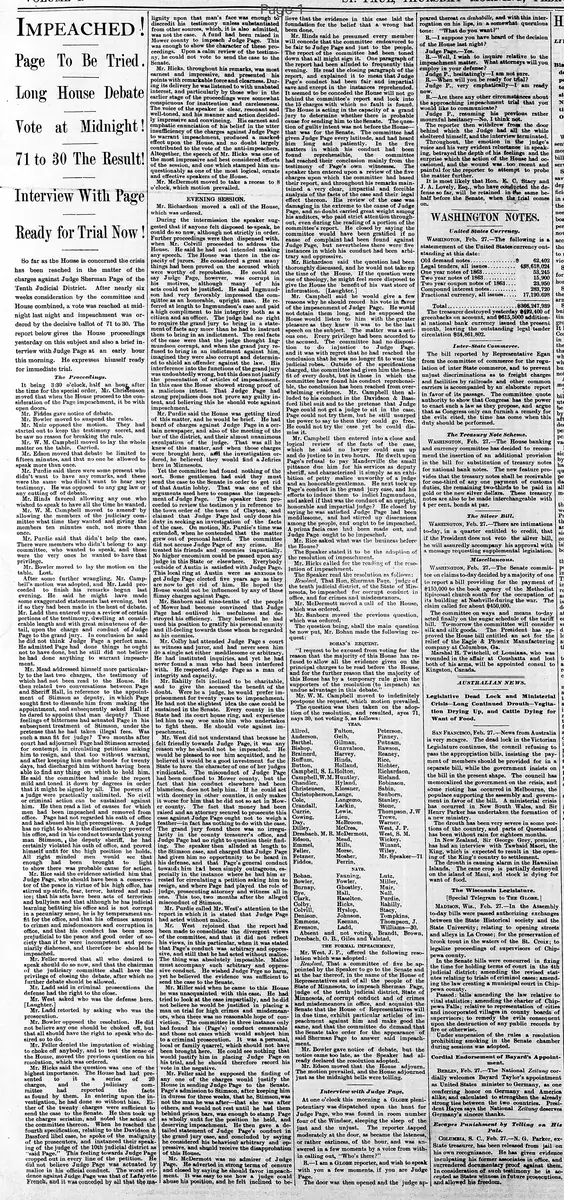
So far as the House is concerned the crisis has been reached in the matter of the charges against Judge Sherman Page of the Tenth Judicial District. After nearly six weeks consideration by the committee and House combined, a vote was reached at midnight last night and impeachment was ordered by the decisive ballot of 71 to 30. The report below gives the House proceedings yesterday on this subject and also a brief interview with Judge Page at an early hour this morning. He expresses himself ready for immediate trial.
The Proceedings.
It being 3:30 o'clock, half an hour after the time for the special order, Mr. Christenson moved that when the House proceed to the consideration of the Page impeachment, it be with open doors.
Mr. Fiddes gave notice of debate.
Mr. Bowler moved to suspend the rules.
Mr. Muir opposed the motion. They had started out to keep the testimony secret, and he saw no reason for breaking the rule.
Mr. W. M. Campbell moved to lay the whole matter on the table. Carried.
Mr. Edson moved that debate be limited to fifteen minutes, and that no one be allowed to speak more than once.
Mr. Purdie said there were some present who didn't want to have any remarks, and these were the same who didn't want to hear any testimony. He was opposed to any gag law or any cutting off of debate.
Mr. Hinds favored allowing any one who wished to speak to have all the time he wanted.
Mr. W. M. Campbell moved to amend by allowing the members of the judiciary committee what time they wanted and giving the members ten minutes each, not more than once.
Mr. Purdie said that didn't help the case. There were members who didn't belong to any committee, who wanted to speak, and these were the very ones he wanted to have that privilege.
Mr. Bowler moved to lay the motion on the table. Lost.
After some further wrangling, Mr. Campbell's motion was adopted, and Mr. Ladd proceeded to finish his remarks begun last evening. He said he might have made some exaggerated statements last evening, but if so they had been made in the heat of debate.
Mr. Ladd then entered upon a review of certain portions of the testimony, dwelling at considerable length and with great minuteness of detail, upon the charge and conduct of Judge Page to the grand jury. In conclusion he said he did not think Judge Page a perfect man. He admitted Page had done things he ought not to have done, but he still did not believe he had done anything to warrant impeachment.
Only to the last two charges, the testimony of which had not been read to the House. He then related two conversations between Page and Sheriff Hall, in reference to the appointment of Stimson as deputy, in which Page sought first to dissuade him from making the appointment, and subsequently asked Hall if he dared to appoint that man deputy? These feelings of bitterness had actuated Page in his subsequent treatment of Stimson, under the pretense that he had taken illegal fees. Was such a man fit for judge? Two months after court had adjourned Page had Stimson arrested for contempt in circulating petitions asking him to resign, and that too without warrant, and after keeping him under bonds for twenty days, had discharged him without having been able to find any thing on which to hold him.
He said the committee had made the report mild and toned it down by degrees in order that it might be signed by all. The powers of a judge were practically unlimited. No civil or criminal action can be sustained against him. He then read a list of causes for which men had been impeached and removed from office. Page had not regarded his oath of office and had abused his high prerogatives. A judge has no right to abuse the discretionary power of his office, and in his conduct towards that young man Stimson, the deputy sheriff, he had certainly violated his oath of office, and proved himself unfit for the high position he holds.
All right minded men would see that enough had been brought to light to show there was probable cause for action.
Mr. Rice said the evidence satisfied him that Judge Page, who should have been a conservator of the peace in virtue of his high office, has stirred up strife, fear, terror, hatred and malice; that his acts have been acts of terrorism and bullyism and that although he has judicial learning befitting his office and is not corrupt in a pecuniary sense, he is by temperament unfit for the office, and that his offenses amount to crimes and misdemeanors and corruption in office, and that his conduct has been more prejudicial to the peace and good order of society than if he were incompetent and pecuniarily dishonest, and therefore he should be impeached.
Mr. Feller moved that all who desired to speak should do so now, and that the chairman of the judiciary committee shall have the privilege of closing the debate, after which no further debate should be allowed.
Mr. Ladd said in criminal prosecutions the defense had the right to the close.
Mr. West asked who was the defense here. [Laughter.]
Mr. Ladd retorted by asking who was the prosecution.
Mr. Bowler opposed the resolution. He did not believe any one should be choked off, but that all should have the right to speak who desired so to do.
Mr. Feller denied the imputation of wishing to choke off anybody, and to test the sense of the House, moved the previous question on his resolution, which was ordered.
Mr. Hicks said the question was one of the highest importance. The House had had presented to it a series of twenty charges, and the judiciary committee had reported the facts as found by them. In entering upon the investigation, he had done so without bias. Either of the twenty charges were sufficient to send the case to the Senate. He then took up the charges seriatim, and noted the action of the committee thereon. When he reached the fourth specification, relating to the Davidson & Bassford libel case, he spoke of the malignity of the prosecutors, and instanced their speaking of the judge of the 10th judicial district as said Page. This feeling towards Judge Page cropped out in every line of the petition. He did not believe Judge Page was actuated by malice in his official conduct. The worst evidence against Judge Page was that of Lafayette French, and it was conceded by all that the malignity upon that man's face was enough to discredit his testimony unless substantiated from other sources, which, it is also admitted, was not the case. A fund had been raised in Mower county to impeach Judge Page. This was enough to show the character of these proceedings. Upon a calm review of the testimony, he could not vote to send the case to the Senate.
Mr. Hicks, throughout his remarks, was most earnest and impressive, and presented his points with remarkable force and clearness. During its delivery he was listened to with unabated interest, and particularly by those who in the earlier stage of the proceedings were somewhat conspicuous for inattention and carelessness. The voice of the speaker is clear, resonant and well-toned, and his manner and action decidedly impressive and convincing. His earnest and emphatic enunciation of his belief in the utter insufficiency of the charges against Judge Page to warrant impeachment, produced a marked effect upon the House, and no doubt largely contributed to the vote of the anti-impeachers. Altogether, the speech of Mr. Hicks was one of the most impressive and best considered efforts of the session, and one which stamped him unquestionably as one of the most logical, ornate and effective speakers of the House.
Mr. McDermott moved to take a recess to 7 o'clock, which motion prevailed.
EVENING SESSION.
Mr. Richardson moved a call of the House, which was ordered.
During the intermission the speaker suggested that if anyone felt disposed to speak, he could do so now, although not strictly in order.
Further proceedings were then dispensed with, when Mr. Colvill proceeded to address the House. He said he had not intended making any speech. The House was there in the capacity of jurors. He considered a great many things had been proved on the accused which were worthy of reprobation. He could not say Judge Page, however, was corrupt in his motives, although many of his acts could not be justified. He said Ingmundson had very favorably impressed the committee as an honorable, upright man. He referred at length to Ingmundson's case and paid a high compliment to his integrity both as a citizen and an officer. The judge had no right to require the grand jury to bring in a statement of facts any more than he had to instruct them to bring in an indictment. The real facts of the case were that the judge thought Ingmundson corrupt, and when the grand jury refused to bring in an indictment against him, imagined they were also corrupt and determined to shield an offender against the law. His interference into the functions of the grand jury was undoubtedly wrong, but this does not justify the presentation of articles of impeachment. In this case the House showed strong proof of a malicious intent. That Judge Page had strong prejudices does not prove any guilty intent, and believing this he should vote against impeachment.
Mr. Purdie said the House was getting tired of this matter, and he would be brief. He had heard of charges against Judge Page in a certain newspaper, and also of the meeting of the bar of the district, and their almost unanimous exculpation of the judge. That was all he knew of this matter, and when those charges were brought here, and the investigation ordered, he believed they would find a Jeffries in Minnesota.
Yet the committee had found nothing of the sort. Some gentlemen had said they must send the case to the Senate in order to get rid of that Austin lobby. That was one of the arguments used here to compass the impeachment of Judge Page. The speaker then proceeded to review the testimony in reference to the town order of the town of Clayton, and claimed that Judge Page had only done his duty in seeking an investigation of the facts of the case. On motion, Mr. Purdie's time was extended, when he contended that the matter grew out of personal hatred. The committee did not accuse Judge Page of any crime. He treated his friends and enemies impartially. No higher encomium could be passed upon any judge in this State or elsewhere. Everybody outside of Austin is satisfied with Judge Page. This local ring at Austin were as anxious to get Judge Page elected five years ago as they are now to get rid of him. He hoped the House would not be influenced by any of these flimsy charges against Page.
Mr. Sanborn said nine-tenths of the people of Mower had become convinced that Judge Page had outlived his usefulness and destroyed his efficiency. They believed he had used his position to gratify his personal enmity and ill-feeling towards those whom he regarded as his enemies.
Mr. Colby had attended Judge Page's court as witness and juror, and had never seen him do a single act either meddlesome or arbitrary. He had instituted inquiries, and yet he had never found a man who had been interfered with. He respected Judge Page as a man of integrity and capacity.
Mr. Rahilly felt inclined to be charitable, and to give the accused the benefit of the doubt. Were he a judge, he would prefer imprisonment for twenty years to impeachment. He had not the slightest idea the case could be sustained in the Senate. Every county in the State had its court house ring, and experience led him to say woe unto him who undertakes to fight them. He should vote against impeachment.
Mr. West did not understand that because he felt friendly towards Judge Page, it was any reason why he should not be impeached. He would be pleased to see him acquitted, and he believed it would be a good investment for the State to have the character of one of her judges vindicated. The misconduct of Judge Page had been confined to Mower county, but the fact that his conduct elsewhere had been blameless, does not help him. If he could act with decency in other counties, it only makes it worse for him that he did not so act in Mower county.
The fact that money had been raised and an attorney secured to prosecute this case against Judge Page ought not to weigh a feather - in fact has nothing to do with the case. The grand jury found there was no irregularity in the county treasurer's office, and Judge Page had no right to question their finding. The speaker then alluded at length to the Stimson case, and charged that Judge Page had given him no opportunity to be heard in his defense, and that Page's general conduct towards him had been simply outrageous, especially in the instance where he had him arrested for circulating a petition asking him to resign, and where Page had played the role of judge, prosecuting attorney and witness all in one. This too, two months after the alleged misconduct of Stimson.
Mr. Purdie called Mr. West's attention to the report in which it is stated that Judge Page had acted without malice.
Mr. West rejoined that the report had been made to consolidate the divergent views of the committee, and that it did not reflect his views in this particular, when it was stated that Page's conduct was arbitrary and oppressive, and still that he had acted without malice. The thing was absolutely impossible. Malice must accompany such arbitrary and oppressive conduct. He wished Judge Page no harm, yet he believed the evidence was sufficient to send the case to the Senate.
Mr. Miller said when he came to this House he was unacquainted with this case. He had tried to look at the case impartially, and he did not believe he would be justified in placing a man on trial for high crimes and misdemeanors, when there was no reasonable hope of conviction. The committee in three instances only had found his (Page's) conduct censurable and those not cases which would subject him to a criminal prosecution. It was a personal, local or family quarrel, which should not have been brought here. He could see nothing that would justify him in placing Judge Page on his trial, and he should therefore record his vote in the negative.
Mr. Feller said he supposed the finding of any one of the charges would justify the House in sending Judge Page to the Senate. Page's admission to Stimson, after keeping him in duress for three weeks, that he, Stimson, was not the man he was after that she was after others, and would not rest until he had them behind prison bars, was enough to stamp Page as wholly unfit for the position he held, and deserving impeachment. He then gave a detailed statement of Judge Page's conduct in the grand jury case, and concluded by saying he considered his behaviour arbitrary and oppressive, and should receive the disapprobation of this House.
Mr. McDermott was no admirer of Judge Page. He adverted in strong terms of censure and closed by saying he should favor impeachment. It was easy to see how a judge could abuse his position, and he felt inclined to believe that the evidence in this case laid the foundation for the belief that a wrong had been done.
Mr. Hinds said he presumed every member will concede that the committee endeavored to be fair to Judge Page and just to the people. The report of the committee had been toned down that all might sign it. One paragraph of the report had been alluded to frequently this evening. He read the closing paragraph of the report, and explained it to mean that Judge Page's conduct had been fair and impartial save and except in the instances reprehended. It seemed to be conceded the House will not go behind the committee's report and look into the 15 charges with which no fault is found. The House is acting in the capacity of a grand jury to determine whether there is probable cause for sending him to the Senate. The question of guilty intent was not before the House that was for the Senate. The committee had given Judge Page every latitude, and had heard him long and patiently. In the five matters in which his conduct had been found reprehensible, the committee had reached their conclusion mainly from the testimony of Page's own witnesses. The speaker then entered upon a review of the five charges upon which the committee had based their report, and throughout his remarks maintained a very clear, impartial and forcible analysis of the facts of the case and their legal effect thereon. His review of the case was damaging in the extreme to the cause of Judge Page, and no doubt carried great weight among his auditors, who paid strict attention throughout, even during the reading of a portion of the committee's report. He closed by saying the committee would have been gratified if no cause of complaint had been found against Judge Page, but nevertheless there were five instances in which his conduct had been arbitrary and oppressive.
Mr. Richardson said the question had been thoroughly discussed, and he would not take up the time of the House. If the question were one of theology, he might feel more disposed to give the House the benefit of his vast store of information. Laughter.
Mr. Campbell said he would give a few reasons why he should record his vote in favor of the impeachment of Judge Page. He would not detain them long, and he supposed the House would listen to him with the greater pleasure as they knew it was to be the last speech on the subject. The matter was a serious one. Every privilege had been accorded to the accused. The committee had no disposition to do injustice to Judge Page, and it was with regret that he had reached the conclusion that he was no longer fit to wear the judicial robes. Outside of the specifications charged, the committee had given him the benefit of every doubt, but in those in which the committee have found his conduct reprehensible, the conclusion has been reached from overwhelming evidence. Mr. Campbell then alluded to his conduct in the Davidson & Bassford libel suit and to the pretense that Judge Page could not get a judge to sit in the cases. Page could not try them, but he still usurped the power to say to them they could go free. He could not try the case yet he could dismiss it.
Mr. Campbell then entered into a close and logical review of the facts of the case, which he said no lawyer could sum up and do justice to in two hours. He dwelt upon Page's refusal to pay Manderville the small pittance due him for his services as deputy sheriff, and characterized it simply as an exhibition of petty malice unworthy of a judge and an honorable gentleman. He next took up Page's conduct in the grand jury case, and his efforts to induce them to indict Ingmundson, and asked if that was the conduct of an upright, honorable and impartial judge? He closed by saying he was satisfied Judge Page had been meddlesome, and had stirred up dissensions among the people, and ought to be impeached. A prima facie case had been made out, and Judge Page ought to be impeached.
Mr. Rice asked what was the business before the House?
The Speaker stated it to be the adoption of the resolution of impeachment.
Mr. Hicks called for the reading of the resolution of impeachment.
The Speaker read the resolution as follows:
Resolved, That Hon. Sherman Page, judge of the tenth judicial district, of the State of Minnesota, be impeached for corrupt conduct in office, and for crimes and misdemeanors.
Mr. McDermott moved a call of the House, which was ordered.
Mr. Sanborn moved the previous question, which was ordered.
The question being, shall the main question be now put, Mr. Bohan made the following request:
BOHAN'S REQUEST.
"I request to be excused from voting for the reason that the majority of this House has refused to allow all the evidence given on the principal charges to be read before the House, and for the further reason that the majority of this House has by a temporary rule given the supporters of the resolution (to impeach) an undue advantage in this debate."
Mr. W. M. Campbell moved to indefinitely postpone the request, which motion prevailed.
The question was then taken on the adoption of the resolution, and resulted, ayes 71, nays 30, not voting 5, as follows:
YEAS.
Allred, Fulton, Peterson,
Anderson, Geib, Pinney,
Barthel, Gilman, Putnam,
Bishop, Gunvalson, Rawson,
Brainerd, Harvey, Reaney,
Ruffum, Hinds, Rice,
Bulton, Holland, Richter,
Campbell, S. L. Holton, Richardson,
Campbell, W. M. Huntley, Rieland,
Chandler, Hyland, Robinson,
Christensen, Kloesner, Sabin,
Christopher son, Lauge, Sanborn,
Cole, Langemo, Stanley,
Crandall, Larkin, Stone,
Currie, Lewis, Thompson, J. W.
Cowing, Lien, Trew,
Day, McBroom, Warner,
Dilley, McCrea, West, J. P.
Dresbach, M. R. McDermott, West, S. M.
Edson, Mead, Wickey.
Emmel, Mills, Winant,
Feller, Morse, Wiley,
Fetzner, Mother, Mr. Speaker—71
Fiddes, Perrin,
NAYS.
| Bohan, | Fanning, | Lutz, |
| Bowler, | Fowler, | Miller, |
| Burnap, | Ghostley, | Muir, |
| Bye, | Hall, | Null, |
| Clark, | Haselton, | Purdie, |
| Colby, | Hicks, | Rahilly, |
| Colvill, | Hyslop, | Stacy, |
| Denison, | Johnson, | Tompkins, |
| Emmons, | Keenan, | Thompson, J. |
| Evenson, | Ladd, | Williams-30. |
| Absent and not voting. | Brandt, Brown |
Dresbach, G. B., Giles and Valstad,
THE FORMAL IMPEACHMENT,
Mr. West, J. P., offered the following resolution which was adopted:
Resolved, That a committee of five be appointed by the Speaker to go to the Senate and at the bar thereof, in the name of the House of Representatives and of all the people of the State of Minnesota, to impeach Sherman Page, judge of the tenth judicial district, State of Minnesota, of corrupt conduct and of crimes and misdemeanors in office, and acquaint the Senate that the House of Representatives will in due time, exhibit particular articles of impeachment against him and make good the same, and that the committee do demand that the Senate take order for the appearance of said Sherman Page to answer said impeachment.
Mr. Bowler gave notice of debate, but the notice came too late, as the Speaker had already declared the resolution adopted.
Mr. Edson moved that the House adjourn.
The motion prevailed, and the House adjourned just as the midnight bells were tolling.
Interview with Judge Page.
At one o'clock this morning a Globe plenipotentiary was dispatched upon the hunt for Judge Page, who was found in room number four of the Windsor, sleeping the sleep of the just and the unjust. The reporter tapped moderately at the door, as became the lateness, or rather earliness, of the hour, and was answered in a few moments by a voice from within calling out, "Who's there?"
R. I am a Globe reporter, and wish to speak with you a few moments, if you are Judge Page.
The door was then opened and the judge appeared thereat en deshabille, and with this interrogation on his lips, in a somewhat querulous tone: "What do you want?"
R. - I suppose you have heard of the decision of the House last night?
Judge Page. Yes.
R. Well, I wish to inquire relative to the impeachment matter. What attorneys will you employ in your defense?
Judge P., hesitatingly I am not sure.
R. When will you be ready for trial?
Judge P., very emphatically - I am ready now.
R. - Are there any other circumstances about the approaching impeachment trial that you would like to communicate?
Judge P., resuming his previous rather mournful hesitancy - No, I think not.
The reporter then withdrew from the door behind which the Judge had all the while sheltered himself, and the interview terminated.
Throughout, the emotion in the judge's voice and his very evident reluctance in speaking, betrayed the depth of his feelings and the surprise which the action of the House had occasioned, and the wound was too recent and painful for the reporter to attempt to probe the matter further.
It is most likely that Hon. E. C. Stacy and J. A. Lovely, Esq., who have conducted the defense so far, will be retained in the same behalf before the Senate, when the trial comes on.
What sub-type of article is it?
What themes does it cover?
What keywords are associated?
What entities or persons were involved?
Where did it happen?
Story Details
Key Persons
Location
Minnesota House Of Representatives, Tenth Judicial District, Mower County
Story Details
After six weeks of consideration, the House debates charges of arbitrary and oppressive conduct by Judge Sherman Page, including interference with grand jury, mistreatment of deputy Stimson, and other cases; votes 71-30 to impeach him for corrupt conduct and misdemeanors; Page states readiness for trial.