Thank you for visiting SNEWPapers!
Sign up free
The National Intelligencer And Washington Advertiser
Washington, District Of Columbia
What is this article about?
On February 12, 1802, New York Bar members met at Little's Hotel to discuss responding to Philadelphia Bar's memorial against repealing the Judiciary Act. Debates featured Gen. Hamilton advocating a supportive letter, opposed by Mr. Wortman and others favoring non-interference. Majority adopted Hamilton's letter; minority issued a resolution of confidence in Congress.
Clipping
OCR Quality
Full Text
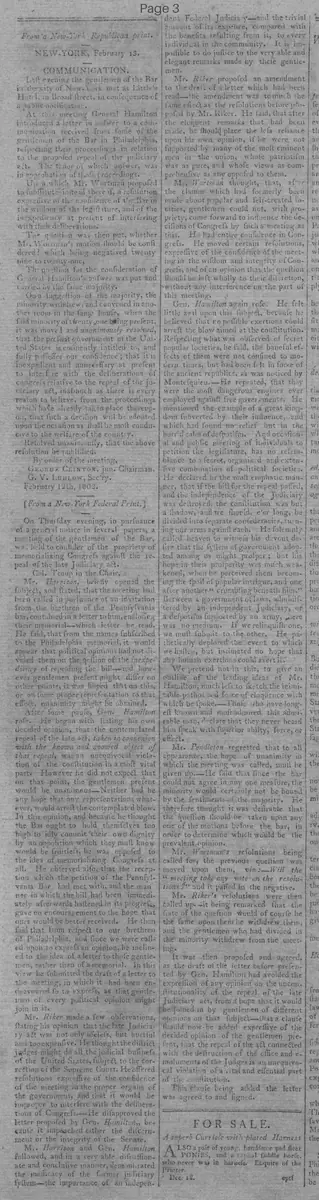
NEW-YORK, February 13.
COMMUNICATION.
Last evening the gentlemen of the Bar in the city of New-York met at Little's Hotel in Broad street, in consequence of a public notification.
At this meeting General Hamilton introduced a letter in answer to a communication received from one of the gentlemen of the Bar in Philadelphia, respecting their proceedings in relation to the proposed repeal of the judiciary act. The tenor of which answer, was in approbation of those proceedings.
Upon which Mr. Wortman proposed to substitute instead thereof, a resolution expressive of the confidence of the Bar in the wisdom of the legislature, and of the inexpediency at present of interfering with their deliberations.
The question was then put, whether Mr. Wortman's motion should be considered? which being negatived twenty nine to twenty-one,
The question for the consideration of General Hamilton's answer was put and Carried by the same majority.
On a suggestion of the majority, the minority withdrew, and convened in another room in the same house, when the said minority of twenty-one being present, it was moved and unanimously resolved,
that the present government of the United States is eminently entitled to, and fully possesses our confidence; that it is inexpedient and unnecessary at present to interfere with the deliberations of congress relative to the repeal of the judiciary act, inasmuch as there is every reason to believe, from the proceedings which have already taken place thereon, that such a decision will be adopted upon the occasion as shall be most conducive to the welfare of the country.
Resolved unanimously, that the above resolution be published.
By order of the meeting.
GEORGE CLINTON, Jun. Chairman,
G. V. Ludlow, Secretary.
February 12th, 1802.
[From a New-York Federal Print.]
On Thursday evening, in pursuance of a general notice in several papers, a meeting of the gentlemen of the Bar, was held to consider of the propriety of memorializing Congress against the repeal of the late Judiciary act.
Col. Troup in the Chair,
Mr. Harrison, briefly opened the subject, and stated, that the meeting had been called in pursuance of an invitation from the brethren of the Pennsylvania bar, contained in a letter to him, enclosing their memorial--which letter he read.
He said, that from the names subscribed to the Philadelphia memorial, it would appear that political opinions had not divided them on the question of the inexpediency of repealing the bill--and however gentlemen present might differ on other points, it was hoped that on this, or on some proper representation to that effect, unanimity might be obtained.
After some pause, Gen. Hamilton rose. He began with stating his own decided opinion, that the contemplated repeal of the late act, taken in connexion with the known and avowed object of that repeal, was an unequivocal violation of the constitution in a most vital part. However he did not expect that on that point, the gentlemen present would be unanimous--Neither had he any hope that any representations whatever, would arrest the contemplated blow.
In this opinion, and because he thought the Bar ought to hold themselves too high to idly commit their own dignity by an opposition which they must know would be fruitless, he was opposed to the idea of memorializing Congress at all. He observed also, that the reception which the petition of the Pennsylvania Bar had met with, and the manner in which the bill had been immediately afterwards hastened in its progress, gave no encouragement to the hope that ours would be better received. He then said that from respect to our brethren of Philadelphia, and Since we were called upon to express an opinion, he inclined to the idea of a letter to those gentlemen, rather than of a memorial. In this view he submitted the draft of a letter to the meeting, in which it had been endeavoured so to express, as that gentlemen of every political opinion might join in it.
Mr. Riker made a few observations, stating his opinion that the late Judiciary act was not only useless, but hurtful and too expensive. He thought the district judges might do all the judicial business of the United States, subject to the correction of the Supreme Court. He offered resolutions expressive of the confidence of the meeting in the proper organs of the government, and that it would be improper to interfere with the deliberations of Congress.--He disapproved the letter proposed by Gen. Hamilton, because it impeached either the discernment or the integrity of the Senate.
Mr. Harrison and Gen. Hamilton followed, and in a very able, diffuse and conclusive manner, demonstrated the inefficacy of the former judiciary system-the importance of an independent Federal Judiciary-and the trivial amount of its expense, compared with the benefits resulting from it, to every individual in the community. It is impossible to do justice to the very able and elegant remarks made by these gentlemen.
Mr. Riker proposed an amendment to the draft of a letter which had been read-the amendment was to much the same effect as the resolutions before proposed by Mr. Riker. He said, that after the eloquent remarks that had been made, he should place the less reliance upon his own opinion, if he were not supported by many of the most eminent men in the union, whose patriotism was as pure, and whose views as comprehensive as any opposed to them.
Mr. Wortman thought, that, after the clamor which had formerly been made about popular and self-created societies, gentlemen could not, with propriety, come forward to influence the decisions of Congress by such a meeting as this. He had entire confidence in Congress. He moved certain resolutions, expressive of the confidence of the meeting in the wisdom and integrity of Congress, and of an opinion that the question should be left wholly to their discretion, without any interference on the part of this meeting.
Gen. Hamilton again rose. He felt little zeal upon this subject, because he believed that no possible exertions could arrest the blow aimed at the constitution. Respecting what was observed of secret popular societies, he said, the baneful effects of them were not confined to modern times, but had been felt in some of the ancient republics, as was noticed by Montesquieu.--He repeated, that they were the most dangerous engines ever employed against free governments. He mentioned the example of a great kingdom subverted by their influence, and which had found no relief but in the horrid calm of despotism. And occasional and public meeting of individuals to petition the legislature, has no resemblance to a secret, organized and extensive combination of political societies.
He declared in the most emphatic manner, that if the bill for the repeal passed, and the independence of the Judiciary was destroyed, the constitution was but a shadow, and we should, ere long, be divided into separate confederacies, turning our arms against each other. He solemnly called heaven to witness his devout desire that the system of government adopted among us might prosper; but his hope in their prosperity was much weakened, when he perceived them becoming the spoil of popular intrigue, and one after another crumbling beneath him.
Between a government of laws, administered by an independent Judiciary, or a despotism supported by an army, here was no medium. If we relinquish one, we must submit to the other. He pathetically deplored the event to which we hasten, but intimated no hope that any British exertions could avert it.
We pretend not in this, to give an outline of the leading ideas of Mr. Hamilton, much less to sketch the inimitable pathos and force of eloquence with which he spoke. Those who have longest known and most admired this admirable man, declare that they never heard him speak with superior ability, force, or effect.
Mr. Pendleton regretted that to all appearance, the hope of unanimity in which the meeting was called, must be given up.-He said that since the bar could not agree in any one measure, the minority would certainly not be bound by the sentiments of the majority. He therefore thought it was desirable that the question should be taken upon any one of the motions before the bar, in order to determine which would be the prevalent opinion.
Mr. Wortman's resolutions being called for, the previous question was moved upon them, viz:-Will the meeting take any vote on the resolutions? and it passed in the negative.
Mr. Riker's resolutions were then called up. -it being remarked that the state of the question would of course be the same upon them he withdrew them, and the gentlemen who had divided in the minority withdrew from the meeting.
It was then proposed and agreed. as the draft of the letter before presented by Gen. Hamilton had avoided the expression of any opinion on the unconstitutionality of the repeal of the late Judiciary act, from a hope that it would be joined in by gentlemen of different opinions on that subject-that a clause should now be added expressive of the decided opinion of the gentlemen present, that the repeal of the act connected with the destruction of the office and emoluments of the Judges is an unequivocal violation of a vital and essential part of the constitution.
This clause being added the letter was agreed to and signed.
What sub-type of article is it?
What themes does it cover?
What keywords are associated?
What entities or persons were involved?
Where did it happen?
Story Details
Key Persons
Location
Little's Hotel In Broad Street, New York
Event Date
February 12th, 1802
Story Details
New York Bar met to consider response to Philadelphia Bar's memorial against Judiciary Act repeal. Hamilton proposed approving letter; Wortman and others favored resolution of confidence in Congress. Majority adopted amended letter declaring repeal unconstitutional; minority resolved non-interference.