Thank you for visiting SNEWPapers!
Sign up free
Story
August 31, 1887
The Columbus Journal
Columbus, Platte County, Nebraska
What is this article about?
Article on advancements in exploration gear, highlighting French explorer Savorgnan de Brazza's plan to use patented portable bridges in the French Congo to cross rivers easily, alongside other comforts like tents, canned foods, and photography to reduce hardships in tropical Africa.
Clipping
OCR Quality
95%
Excellent
Full Text
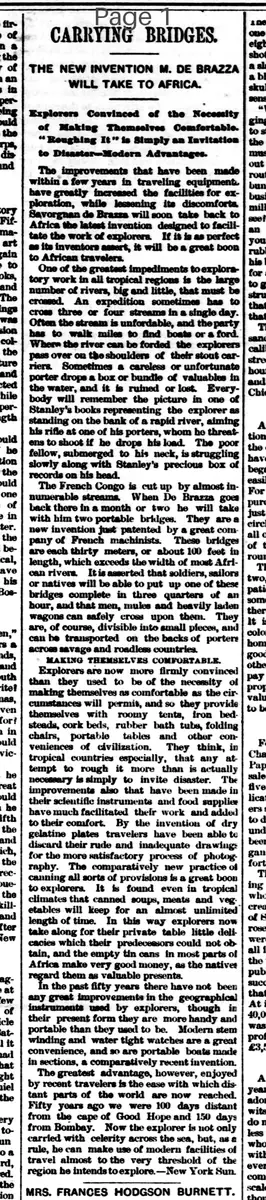
CARRYING BRIDGES
The New Invention M. de Brazza
WILL TAKE TO AFRICA.
Explorers Convinced of the Necessity
of
Making Themselves Comfortable
"Roughing It" is Simply an Invitation
to Disaster—Modern Advantages.
The improvements that have been made within a few years in traveling equipments have greatly increased the facilities for exploration, while lessening its discomforts. Savorgnan de Brazza will soon take back to Africa the latest invention designed to facilitate the work of explorers. If it is as perfect as its inventors assert, it will be a great boon to African travelers.
One of the greatest impediments to exploratory work in all tropical regions is the large number of rivers, big and little, that must be crossed. An expedition sometimes has to cross three or four streams in a single day. Often the stream is unfordable, and the party has to walk miles to find boats or a ford. When the river can be forded the explorers pass over on the shoulders of their stout carriers. Sometimes a careless or unfortunate porter drops a box or bundle of valuables in the water, and it is ruined or lost. Everybody will remember the picture in one of Stanley's books representing the explorer as standing on the bank of a rapid river, aiming his rifle at one of his porters, whom he threatens to shoot if he drops his load. The poor fellow, submerged to his neck, is struggling slowly along with Stanley's precious box of records on his head.
The French Congo is cut up by almost innumerable streams. When De Brazza goes back there in a month or two he will take with him two portable bridges. They are a new invention just patented by a great company of French machinists. These bridges are each thirty meters, or about 100 feet in length, which exceeds the width of most African rivers. It is asserted that soldiers, sailors or natives will be able to put up one of these bridges complete in three quarters of an hour, and that men, mules and heavily laden wagons can safely cross upon them. They are, of course, divisible into small pieces, and can be transported on the backs of porters across savage and roadless countries.
MAKING THEMSELVES COMFORTABLE
Explorers are now more firmly convinced than they used to be of the necessity of making themselves as comfortable as the circumstances will permit, and so they provide themselves with roomy tents, iron bedsteads, cork beds, rubber bath tubs, folding chairs, portable tables and other conveniences of civilization. They think, in tropical countries especially, that any attempt to rough it more than is actually necessary is simply to invite disaster. The improvements also that have been made in their scientific instruments and food supplies have much facilitated their work and added to their comfort. By the invention of dry gelatine plates travelers have been able to discard their rude and inadequate drawings for the more satisfactory process of photography. The comparatively new practice of canning all sorts of provisions is a great boon to explorers. It is found even in tropical climates that canned soups, meats and vegetables will keep for an almost unlimited length of time. In this way explorers now take along for their private table little delicacies which their predecessors could not obtain, and the empty tin cans in most parts of Africa make very good money, as the natives regard them as valuable presents.
In the past fifty years there have not been any great improvements in the geographical instruments used by explorers, though in their present form they are more handy and portable than they used to be. Modern stem winding and water tight watches are a great convenience, and so are portable boats made in sections, a comparatively recent invention. The greatest advantage, however, enjoyed by recent travelers is the ease with which distant parts of the world are now reached. Fifty years ago we were 100 days distant from the cape of Good Hope and 150 days from Bombay. Now the explorer is not only carried with celerity across the sea, but, as a rule, he can make use of modern facilities of travel almost to the very threshold of the region he intends to explore.—New York Sun
The New Invention M. de Brazza
WILL TAKE TO AFRICA.
Explorers Convinced of the Necessity
of
Making Themselves Comfortable
"Roughing It" is Simply an Invitation
to Disaster—Modern Advantages.
The improvements that have been made within a few years in traveling equipments have greatly increased the facilities for exploration, while lessening its discomforts. Savorgnan de Brazza will soon take back to Africa the latest invention designed to facilitate the work of explorers. If it is as perfect as its inventors assert, it will be a great boon to African travelers.
One of the greatest impediments to exploratory work in all tropical regions is the large number of rivers, big and little, that must be crossed. An expedition sometimes has to cross three or four streams in a single day. Often the stream is unfordable, and the party has to walk miles to find boats or a ford. When the river can be forded the explorers pass over on the shoulders of their stout carriers. Sometimes a careless or unfortunate porter drops a box or bundle of valuables in the water, and it is ruined or lost. Everybody will remember the picture in one of Stanley's books representing the explorer as standing on the bank of a rapid river, aiming his rifle at one of his porters, whom he threatens to shoot if he drops his load. The poor fellow, submerged to his neck, is struggling slowly along with Stanley's precious box of records on his head.
The French Congo is cut up by almost innumerable streams. When De Brazza goes back there in a month or two he will take with him two portable bridges. They are a new invention just patented by a great company of French machinists. These bridges are each thirty meters, or about 100 feet in length, which exceeds the width of most African rivers. It is asserted that soldiers, sailors or natives will be able to put up one of these bridges complete in three quarters of an hour, and that men, mules and heavily laden wagons can safely cross upon them. They are, of course, divisible into small pieces, and can be transported on the backs of porters across savage and roadless countries.
MAKING THEMSELVES COMFORTABLE
Explorers are now more firmly convinced than they used to be of the necessity of making themselves as comfortable as the circumstances will permit, and so they provide themselves with roomy tents, iron bedsteads, cork beds, rubber bath tubs, folding chairs, portable tables and other conveniences of civilization. They think, in tropical countries especially, that any attempt to rough it more than is actually necessary is simply to invite disaster. The improvements also that have been made in their scientific instruments and food supplies have much facilitated their work and added to their comfort. By the invention of dry gelatine plates travelers have been able to discard their rude and inadequate drawings for the more satisfactory process of photography. The comparatively new practice of canning all sorts of provisions is a great boon to explorers. It is found even in tropical climates that canned soups, meats and vegetables will keep for an almost unlimited length of time. In this way explorers now take along for their private table little delicacies which their predecessors could not obtain, and the empty tin cans in most parts of Africa make very good money, as the natives regard them as valuable presents.
In the past fifty years there have not been any great improvements in the geographical instruments used by explorers, though in their present form they are more handy and portable than they used to be. Modern stem winding and water tight watches are a great convenience, and so are portable boats made in sections, a comparatively recent invention. The greatest advantage, however, enjoyed by recent travelers is the ease with which distant parts of the world are now reached. Fifty years ago we were 100 days distant from the cape of Good Hope and 150 days from Bombay. Now the explorer is not only carried with celerity across the sea, but, as a rule, he can make use of modern facilities of travel almost to the very threshold of the region he intends to explore.—New York Sun
What sub-type of article is it?
Curiosity
Journey
What themes does it cover?
Exploration
Triumph
What keywords are associated?
Portable Bridges
African Exploration
De Brazza
Travel Equipment
Inventions
Tropical Rivers
Explorer Comforts
What entities or persons were involved?
Savorgnan De Brazza
Stanley
Where did it happen?
French Congo, Africa
Story Details
Key Persons
Savorgnan De Brazza
Stanley
Location
French Congo, Africa
Event Date
In A Month Or Two
Story Details
Savorgnan de Brazza plans to take two portable bridges, a new French invention, to the French Congo to ease river crossings during exploration; the article also covers broader improvements in explorer comforts like tents, canned foods, photography, and faster global travel reducing hardships.