Thank you for visiting SNEWPapers!
Sign up free
The Pensacola Journal
Pensacola, Escambia County, Florida
What is this article about?
Letter to the Pensacola Journal editor from G.A. Waterman, treasurer of the Gulf Coast Inland Waterway Association, urging locals to join for promoting an inland waterway linking Apalachicola, Pensacola, and Mobile. Highlights benefits, refutes biases, cites endorsements from engineers, senators, and strategic interests to secure congressional funding.
Clipping
OCR Quality
Full Text
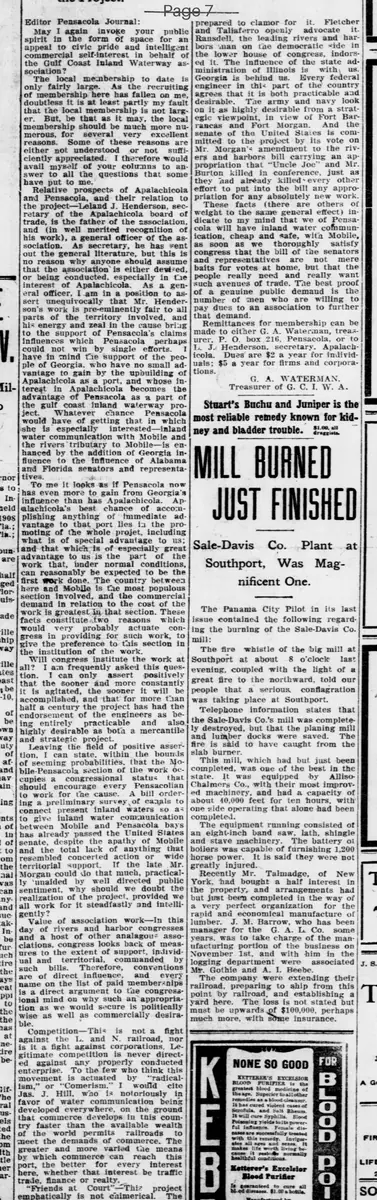
May I again invoke your public spirit in the form of space for an appeal to civic pride and intelligent commercial self-interest in behalf of the Gulf Coast Inland Waterway association?
The local membership to date is only fairly large. As the recruiting of membership here has fallen on me, doubtless it is at least partly my fault that the local membership is not larger. But, be that as it may, the local membership should be much more numerous, for several very excellent reasons. Some of these reasons are either not understood or not sufficiently appreciated. I therefore would avail myself of your columns to answer to all the questions that some have put to me.
Relative prospects of Apalachicola and Pensacola, and their relation to the project—Leland J. Henderson, secretary of the Apalachicola board of trade, is the father of the association, and (in well merited recognition of his work), a general officer of the association. As secretary, he has sent out the general literature, but this is no reason why anyone should assume that the association is either devoted, or being conducted, especially in the interest of Apalachicola. As a general officer, I am in a position to assert unequivocally that Mr. Henderson's work is pre-eminently fair to all parts of the territory involved, and his energy and zeal in the cause bring to the support of Pensacola's claims influences which Pensacola perhaps could not win by single efforts. I have in mind the support of the people of Georgia, who have no small advantage to gain by the upbuilding of Apalachicola as a port, and whose interest in Apalachicola becomes the advantage of Pensacola as a part of the gulf coast inland waterway project. Whatever chance Pensacola would have of getting that in which she is especially interested—inland water communication with Mobile and the rivers tributary to Mobile—is enhanced by the addition of Georgia influence to the influence of Alabama and Florida senators and representatives.
To me it looks as if Pensacola now has even more to gain from Georgia's influence than has Apalachicola. Apalachicola's best chance of accomplishing anything of immediate advantage to that port lies in the promoting of the whole project, including what is of special advantage to us; and that which is of especially great advantage to us is the part of the work that, under normal conditions, can reasonably be expected to be the first work done. The country between here and Mobile is the most populous section involved, and the commercial demand in relation to the cost of the work is greatest in that section. These facts constitute two reasons which would very probably actuate congress in providing for such work, to give the preference to this section in the institution of the work.
Will congress institute the work at all? I am frequently asked this question. I can only assert positively that the sooner and more constantly it is agitated, the sooner it will be accomplished, and that for more than half a century the project has had the endorsement of the engineers as being entirely practicable and also highly desirable as both a mercantile and strategic project.
Leaving the field of positive assertion, I can state, within the bounds of seeming probabilities, that the Mobile-Pensacola section of the work occupies a congressional status that should encourage every Pensacolian to work for the cause.
A bill ordering a preliminary survey of canals to connect present inland waters so as to give inland water communication between Mobile and Pensacola bays has already passed the United States senate, despite the apathy of Mobile and the total lack of anything that resembled concerted action or wide territorial support. If the late Mr. Morgan could do that much, practically unaided by well directed public sentiment, why should we doubt the realization of the project, provided we all work for it steadfastly and intelligently?
Value of association work—In this day of rivers and harbor congresses and a host of other analogous associations, congress looks back of measures to the extent of support, individual and territorial, commanded by such bills. Therefore, conventions are of direct influence, and every name on the list of paid memberships is a direct argument to the congressional mind on why such an appropriation as we would secure is politically wise as well as commercially desirable.
Competition—This is not a fight against the L. and N. railroad, nor is it a fight against corporations. Legitimate competition is never directed against any properly conducted enterprise. To the few who think this movement is actuated by "radicalism," or "Comerism," I would cite Jas. J. Hill, who is notoriously in favor of water communication being developed everywhere, on the ground that commerce develops in this country faster than the available wealth of the world permits railroads to meet the demands of commerce. The greater and more varied the means by which commerce can reach this port, the better for every interest here, whether that interest be traffic, trade, finance or realty.
"Friends at Court"—This project emphatically is not chimerical. The late S. R. Mallory's worst enemies never accused him of being a dreamer. We know his utter confidence in the commercial merits of inland water communication between Mobile and Apalachicola. Morgan and Wiley wanted the work done. Bankhead is prepared to clamor for it. Fletcher and Taliaferro openly advocate it. Ransdell, the leading rivers and harbors man on the democratic side in the lower house of congress, indorses it. The influence of the state administration of Illinois is with us. Georgia is behind us. Every federal engineer in this part of the country agrees that it is both practicable and desirable. The army and navy look on it as highly desirable from a strategic viewpoint, in view of Fort Barrancas and Fort Morgan. And the senate of the United States is committed to the project by its vote on Mr. Morgan's amendment to the rivers and harbors bill carrying an appropriation that "Uncle Joe" and Mr. Burton killed in conference, just as they had already killed every other effort to put into the bill any appropriation for any absolutely new work.
These facts (there are others of weight to the same general effect) indicate to my mind that we of Pensacola will have inland water communication, cheap and safe, with Mobile, as soon as we thoroughly satisfy congress that the bills of the senators and representatives are not mere baits for votes at home, but that the people really need and really want such avenues of trade. The best proof of a genuine public demand is the number of men who are willing to pay dues to an association to further that demand.
Remittances for membership can be made to either G. A. Waterman, treasurer, P. O. box 216, Pensacola, or to L. J. Henderson, secretary, Apalachicola. Dues are $2 a year for individuals; $5 a year for firms and corporations.
G. A. WATERMAN,
Treasurer of G. C. I. W. A.
What sub-type of article is it?
What themes does it cover?
What keywords are associated?
What entities or persons were involved?
Where did it happen?
Story Details
Key Persons
Location
Pensacola, Florida; Apalachicola, Florida; Mobile, Alabama; Gulf Coast
Story Details
G. A. Waterman writes to the Pensacola Journal appealing for increased local membership in the Gulf Coast Inland Waterway Association, emphasizing benefits to Pensacola from the inland waterway project connecting Apalachicola, Pensacola, and Mobile. He addresses concerns about favoritism toward Apalachicola, highlights congressional and strategic support, and explains the value of association membership in influencing legislation.