Thank you for visiting SNEWPapers!
Sign up free
The National Intelligencer And Washington Advertiser
Washington, District Of Columbia
What is this article about?
In summer 1800, Ned Langley, comatose for over 14 months after a head injury from a shipyard arm off Port Mahon, is discovered at Deptford hospital by Mr. Davy and transferred to St. Thomas's. Surgeon Mr. Cline performs trephine surgery to remove depressed skull bone, leading to Langley's immediate awakening and full recovery within seven weeks.
Clipping
OCR Quality
Full Text
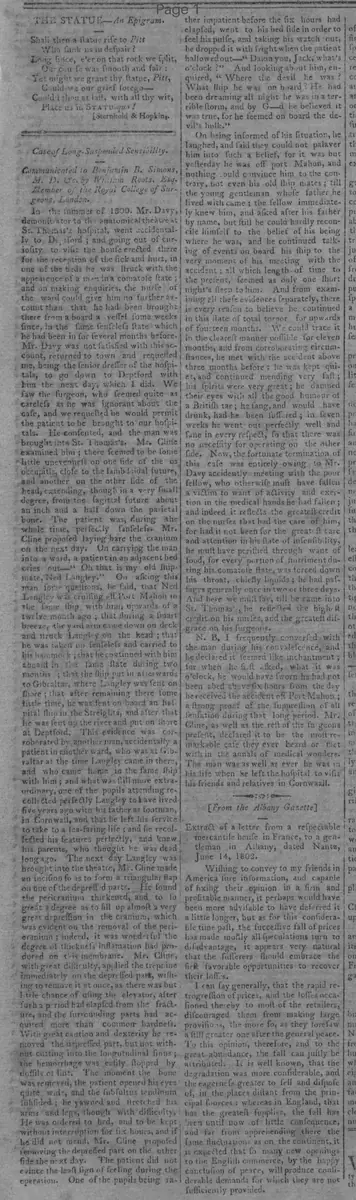
Communicated to Benjamin B. Simons, M. D. &c. by William Roots, Esq. Member of the Royal College of Surgeons, London.
In the summer of 1800, Mr. Davy, demonstrator to the anatomical theatre at St. Thomas's Hospital, went accidentally to Deptford; and going out of curiosity to visit the house erected there for the reception of the sick and hurt, in one of the beds he was struck with the appearance of a man in a comatose state; and on making enquiries, the nurse of the ward could give him no further account than that he had been brought there from on board a vessel some weeks since, in the same senseless state which he had been in for several months before. Mr. Davy was not satisfied with this account, returned to town and requested me, being the senior dresser of the hospitals, to go down to Deptford with him the next day, which I did. We saw the surgeon, who seemed quite as careless as he was ignorant about the case, and we requested he would permit the patient to be brought to our hospitals. He consented, and the man was brought into St. Thomas's. Mr. Cline examined him; there seemed to be some little unevenness on one side of the os occipitis, close to the lambdoidal suture, and another on the other side of the head, extending, though in a very small degree, from the sagittal suture about an inch and a half down the parietal bone. The patient was, during the whole time, perfectly senseless. Mr. Cline proposed laying bare the cranium on the next day. On carrying the man into a ward, a patient in an adjacent bed cries out—"Oh that is my old shipmate, Ned Langley." On asking this man some questions, he said, that Ned Langley was cruising off Port Mahon in the same ship with him, upwards of a twelve month ago; that during a smart breeze, the yard arm came down on deck and struck Langley on the head; that he was taken up senseless and carried to his hammock; that he continued with him aboard in the same state during two months; that the ship put in afterwards to Gibraltar, where Langley was sent on shore; that after remaining there some little time, he was sent on board a hospital ship in the Straits, and after that he was sent up the river and put on shore at Deptford. This evidence was corroborated by another man, accidentally a patient in another ward, who was at Gibraltar at the time Langley came in there, and who came home in the same ship with him; and what was still more extraordinary, one of the pupils attending recollected perfectly Langley to have lived five years ago with his father as footman, in Cornwall, and that he left his service to take to a sea-faring life; and he recollected his features perfectly, and knew his parents, who thought he was dead long ago. The next day Langley was brought into the theatre, Mr. Cline made an incision so as to form a triangular flap on one of the depressed parts. He found the pericranium thickened, and to so great a degree as to fill up almost a very great depression in the cranium, which was evident on the removal of the pericranium; indeed, it was wonderful the degree of thickness inflammation had produced on this membrane. Mr. Cline, with great difficulty, applied the trephine immediately on the depressed part, willing to remove it at once, as there was but little chance of using the elevator, after such a period had elapsed from the fracture, and the surrounding parts had acquired more than common hardness. With great caution and dexterity he removed the depressed part, but not without cutting into the longitudinal sinus; the hemorrhage was easily stopped by doublings of lint. The moment the bone was removed, the patient opened his eyes quite wide, and the subitus tremendum subsided; he yawned and stretched his arms and legs, though with difficulty. He was ordered to bed, and to be kept without interruption for six hours, and if he did not mend, Mr. Cline proposed removing the depressed part on the other side the next day. The patient did not evince the least sign of feeling during the operation. One of the pupils being rather impatient before the six hours had elapsed, went to his bed side in order to feel his pulse, and taking his watch out, he dropped it with fright when the patient hallooed out "Damn you, Jack, what's o'clock?" And looking about him, enquired, "Where the devil he was? What ship he was on board? He had been dreaming all night he was in a terrible storm, and by G-d he believed it was true, for he seemed on board the devil's hulk."
On being informed of his situation, he laughed, and said they could not palaver him into such a belief, for it was but yesterday he was off Port Mahon, and nothing could convince him to the contrary, not even his old ship mates; till the young gentleman whose father he lived with came; the fellow immediately knew him, and asked after his father by name, but till he could hardly reconcile himself to the belief of his being where he was, and he continued talking of events on board his ship to the very moment of his meeting with the accident: all which length of time to the present, seemed as only one short night's sleep to him. And from examining all these evidences separately, there is every reason to believe he continued in this state of total torpor for upwards of fourteen months. We could trace it in the clearest manner possible for eleven months, and from corroborating circumstances, he met with the accident above three months before: he was kept quiet, and continued mending very fast; his spirits were very great; he damned their eyes with all the good humour of a British tar; he sang, and would have drunk, had he been suffered; in seven weeks he went out perfectly well and sane in every respect, so that there was no necessity for operating on the other side. Now, the fortunate termination of this case was entirely owing to Mr. Davy accidentally meeting with the poor fellow, who otherwise must have fallen a victim to want of activity and exertion in the medical hands he had fallen; and indeed it reflects the greatest credit on the nurses that had the care of him, for had it not been for the greatest care and attention in his state of insensibility, he must have perished through want of food, for every portion of nutriment during his comatose state, was forced down his throat, chiefly liquids; he had passages generally once in two or three days. And here we must say, till he came into St. Thomas's, he reflected the highest credit on his nurses, and the greatest disgrace on his surgeons. N. B. I frequently conversed with the man during his convalescence, and he declared it seemed like enchantment; for when he asked, what it was o'clock, he would have sworn he had not been a-bed above six hours from the day he received the accident off Port Mahon: a strong proof of the suppression of all sensation during that long period. Mr. Cline, as well as the rest of the surgeons present, declared it to be the most remarkable case they ever heard or met with in the annals of medical wonders. The man was as well as ever he was in his life when he left the hospital to visit his friends and relatives in Cornwall.
What sub-type of article is it?
What themes does it cover?
What keywords are associated?
What entities or persons were involved?
Where did it happen?
Story Details
Key Persons
Location
St. Thomas's Hospital, London; Deptford; Off Port Mahon; Gibraltar
Event Date
Summer Of 1800
Story Details
Ned Langley suffers head injury from falling yard arm off Port Mahon, remains comatose for over 14 months across ships and hospitals until discovered at Deptford by Mr. Davy, transferred to St. Thomas's where Mr. Cline performs trephine surgery removing depressed bone, leading to immediate awakening and full recovery in seven weeks.