Thank you for visiting SNEWPapers!
Sign up free
Constitutional Whig
Richmond, Virginia
What is this article about?
On December 20, 1827, delegates from 13 electoral districts in North Carolina convened in Raleigh to form an electoral ticket supporting John Quincy Adams' re-election to the presidency. The convention, chaired by Hon. Wm. Davidson, featured an address by Mr. Gaston and nominated 15 electors, one per district, while passing resolutions for an address, printing, and committees.
Clipping
OCR Quality
Full Text
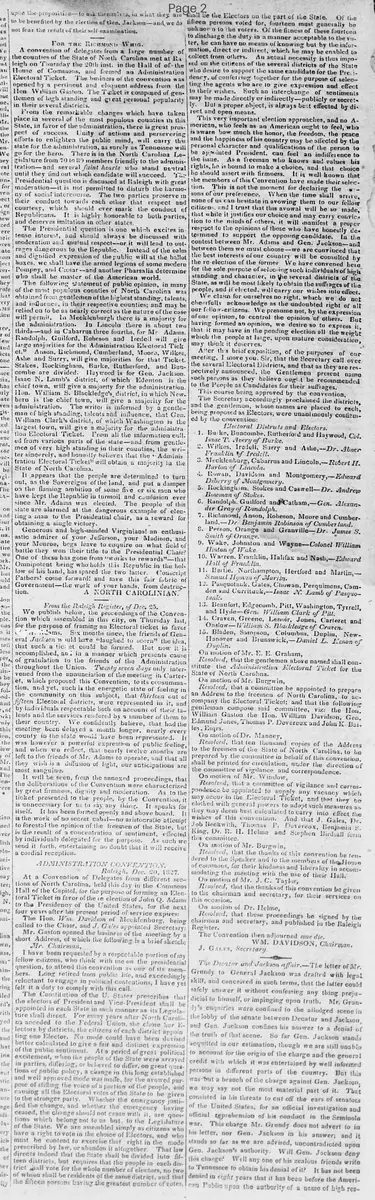
We publish below, the proceedings of the Convention which assembled in this city, on Thursday last, for the purpose of framing an Electoral ticket in favor of J. Q. Adams. Six months since, the friends of General Jackson would have "laughed to scorn" the idea, that such a ticket could be formed. But now it is accomplished, and in a manner which presents cause of gratulation to the friends of the Administration throughout the Union. Twenty seven days only intervened from the annunciation of the meeting in Carteret, which proposed this Convention, to its consummation, and yet, such is the energetic state of feeling in the community on this subject, that thirteen out of fifteen Electoral districts, were represented in it, and by individuals respectable both on account of their talents and the services rendered by a number of them to their country. We confidently believe, that had the meeting been delayed a month longer, nearly every county in the state would have been represented. It was however a powerful expression of public feeling, and when we reflect, that nearly twelve months are left to the friends of Mr. Adams to operate, and that all they wish is a diffusion of light, our anticipations are most sanguine.
It will be seen, from the annexed proceedings, that the deliberations of the Convention were characterized by great firmness, dignity and moderation. As to the ticket presented to the people, by the Convention, it is unnecessary for us to say any thing. It speaks for itself. It has been formed openly and above board. It is the work of no secret cabal--no aristocratic attempt to forestal the opinion of the freemen of the State, but is the result of a concentration of sentiment, effected by individuals delegated for the purpose. As such we send it forth, entertaining no doubt that it will receive a cordial reception.
ADMINISTRATION CONVENTION.
Raleigh, Dec. 20, 1827.
At a Convention of Delegates from different sections of North Carolina, held this day in the Commons Hall of the Capitol, for the purpose of forming an Electoral Ticket in favor of the re-election of John Q. Adams to the Presidency of the United States, for the next four years after his present period of service expires:
The Hon. Wm. Davidson of Mecklenburg, being called to the Chair, and J. Gales appointed Secretary:
Mr. Gaston opened the business of the meeting by a short Address, of which the following is a brief sketch;
Mr. Chairman,
I have been requested by a respectable portion of my fellow citizens, who think with me on the presidential question, to attend this convention as one of its members. Long retired from public life, and exceedingly reluctant to engage in political conventions, I have yet felt it a duty to comply with this call.
The Constitution of the U. States prescribes that the electors of President and Vice-President shall be appointed in each State in such manner as its Legislature shall direct. For many years after North Carolina acceded to the Federal Union, she chose her Electors by districts, the citizens of each district appointing one Elector. No mode could have been devised better calculated to give a fair and distinct expression of the public sentiment. At a period of great political excitement, when the people of the State were arrayed in parties, differing, or believed to differ, on great questions of public policy, a change in this long established and well approved mode was made, for the avowed purpose of stifling the voice of a portion of the people, and causing all the Electoral votes of the State to be given to the stronger party. Whether the emergency justified the change, and whether the emergency having ceased, the change should not cease with it, are questions which belong not to us but to the Legislature of the State. We are assembled simply as citizens who have a right to vote in the choice of Electors, and who must be content to exercise that right in the mode prescribed by law, or abandon it altogether. That law directs indeed that the State shall be divided into fifteen districts, but requires that the people in each district shall vote for the whole number of electors, no two of whom shall be residents of the same district, and that the fifteen persons having the greatest number of votes, shall be the Electors on the part of the State. Of the fifteen persons voted for, fourteen must generally be unknown to the voters. Of the fitness of these fourteen to discharge the duty in a manner acceptable to the voter, he can have no means of knowing but by the information, direct or indirect, which he may be enabled to collect from others. An actual necessity is thus imposed on the citizens of the several districts of the State who desire to support the same candidate for the Presidency, of conferring together for the purpose of selecting the agents who are to give expression and effect to their wishes. Such an interchange of sentiments may be made directly or indirectly--publicly or secretly. But a proper object, is always best effected by direct and open means.
This very important election approaches, and no American, who feels as an American ought to feel, who is aware how much the honor, the freedom, the peace and the happiness of his country may be affected by the personal character and qualifications of the person to be appointed President, can feel an indifference to the issue. As a freeman who knows and values his rights, he is bound to make a choice, and that choice he should assert with firmness. It is well known that the members of this Convention have made their selection. This is not the moment for declaring the reasons of our preference. When the time shall arrive, none of us can hesitate in avowing them to our fellow citizens, and I trust that this avowal will be so made, that while it justifies our choice and may carry conviction to the minds of others, it will manifest a proper respect to the opinions of those who have honestly determined to support the opposing candidate. In the contest between Mr. Adams and Gen. Jackson--and between them we must choose--we are convinced that the best interests of our country will be consulted by the re-election of the former We have convened here for the sole purpose of selecting such individuals of high standing and character, in the several districts of the State, as will be most likely to obtain the suffrages of the people, and if elected, will carry our wishes into effect.
We claim for ourselves no right, which we do not cheerfully acknowledge as the undoubted right of all our fellow-citizens. We presume not, by the expression of our opinion, to control the opinion of others. But having formed an opinion, we desire so to express it, that it may have in the pending election all the weight which the people at large, upon mature consideration, may think it deserves.
After this brief exposition, of the purposes of our meeting, I move you, Sir, that the Secretary call over the several Electoral Districts, and that as they are respectively announced, the Gentlemen present name such persons as they believe ought be recommended to the People as Candidates for their suffrages.
This course being approved by the convention,
The Secretary accordingly proclaimed the districts, and the gentlemen, whose names are placed to each, being proposed as Electors, were unanimously confirmed by the convention:
Electoral Districts and Electors.
1. Burke, Buncombe, Rutherford and Haywood, Col. Isaac T. Avery of Burke.
2. Wilkes, Iredell, Surry and Ashe,--Dr. Abner Franklin of Iredell.
3. Mecklenburg, Cabarrus and Lincoln,--Robert H. Burton of Lincoln.
4. Rowan, Davidson and Montgomery,--Edward Deberry of Montgomery.
5. Rockingham, Stokes and Caswell--Dr. Andrew Bowman of Stokes.
6. Randolph, Guilford and Chatham,--Gen. Alexander Gray of Randolph.
7. Richmond, Anson, Robeson, Moore and Cumberland.--Dr. Benjamin Robinson of Cumberland.
8. Person, Orange and Granville--Dr. James S. Smith of Orange.
9. Wake, Johnston and Wayne--Colonel William Hinton of Wake.
10. Warren, Franklin, Halifax and Nash,--Edward Hall of Franklin.
11. Bertie, Northampton, Hertford and Martin,--Samuel Myatt of Martin.
12. Pasquotank, Gates, Chowan, Perquimons, Camden and Currituck,--Isaac N. Lamb of Pasquotank.
13. Beaufort, Edgecombe, Pitt, Washington, Tyrrell, and Hyde--Gen. William Clark of Pitt.
14. Craven, Greene, Lenoir, Jones, Carteret and Onslow--William S. Blackledge of Craven.
15. Bladen, Sampson, Columbus, Duplin, New Hanover and Brunswick,--Daniel L. Kenan of Duplin.
On motion of Mr. E. E. Graham,
Resolved, that the gentlemen above named shall constitute the Administration Electoral Ticket of the State of North Carolina.
On motion of Mr. Burgwin,
Resolved, that a committee be appointed to prepare an Address to the freemen of North Carolina, to accompany the Electoral Ticket; and that the following gentlemen compose said committee, viz: the Hon. William Gaston the Hon. William Davidson, Gen. Edmund Jones, Thomas P. Devereux and John K. Barnes, Esqrs.
On motion of Dr. Manney,
Resolved, that ten thousand copies of the Address to the freemen of the State of North Carolina, to be prepared by the committee in behalf of this convention, shall be printed for circulation, under the direction of the committee of vigilance and correspondence.
On motion of Mr. Winslow,
Resolved, that a committee of vigilance and correspondence be appointed to supply any vacancy which may occur in the Electoral Ticket, and that they be clothed with general powers to adopt such measures as they may deem best calculated to carry into effect the wishes of this convention. And that J. Gales, Dr. Job Beckwith, Thomas P. Devereux, Benjamin S. King, Dr. R. H. Helme and Stephen Birdsall form this committee.
On motion of Mr. Burgwin.
Resolved, that the thanks of this convention be tendered to the Speaker and to the members of the House of Commons, for their kindness and liberality in accommodating the meeting with the use of their Hall.
On motion of Mr. J. C. Taylor,
Resolved, that the thanks of this convention be given to the chairman and secretary, for their services on this occasion.
On motion of Dr. Helme,
Resolved, that these proceedings be signed by the chairman and secretary, and published in the Raleigh Register.
The Convention then adjourned sine die.
WM. DAVIDSON, Chairman.
J. GALES, Secretary
What sub-type of article is it?
What keywords are associated?
What entities or persons were involved?
Where did it happen?
Domestic News Details
Primary Location
Raleigh, North Carolina
Event Date
Dec. 20, 1827
Key Persons
Outcome
electoral ticket formed with 15 nominees unanimously confirmed; committees appointed for address preparation, printing 10,000 copies, and vigilance; proceedings published.
Event Details
Delegates from 13 of 15 electoral districts met in Raleigh's Capitol Commons Hall to nominate electors supporting John Q. Adams' re-election. After an address by Mr. Gaston on the election process and importance, districts were called, and electors proposed and confirmed. Resolutions established the ticket, appointed committees, and arranged for circulation and publication.