Thank you for visiting SNEWPapers!
Sign up free
Pine Bluff Daily Graphic
Pine Bluff, Jefferson County, Arkansas
What is this article about?
In Washington on August 23, members of Congress complain about the extended summer session due to hot weather and the need to pass tariff and currency bills before adjournment, as insisted by President Wilson, disrupting their personal and professional lives.
Clipping
OCR Quality
Full Text
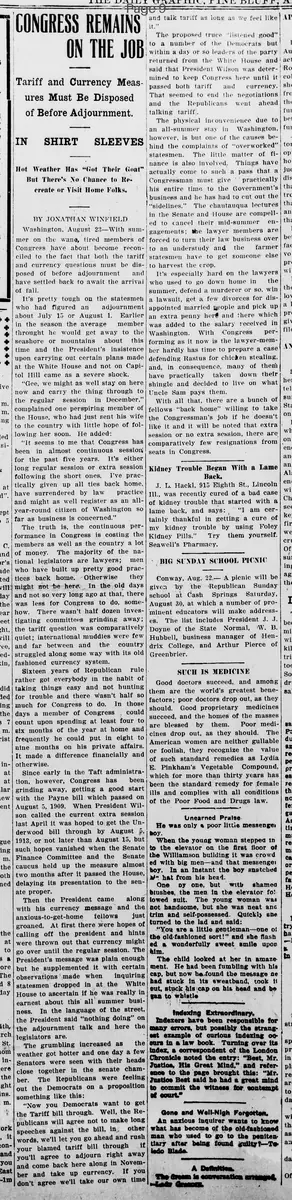
Tariff and Currency Measures Must Be Disposed of Before Adjournment.
IN SHIRT SLEEVES
Hot Weather Has "Got Their Goat"
But There's No Chance to Recreate or Visit Home Folks.
BY JONATHAN WINFIELD
Washington, August 23-With summer on the wane, tired members of Congress have about become reconciled to the fact that both the tariff and currency questions must be disposed of before adjournment and have settled back to await the arrival of fall.
It's pretty tough on the statesmen who had figured an adjournment about July 15 or August 1. Earlier in the season the average member thought he would get away to the seashore or mountains about this time and the President's insistence upon carrying out certain plans made at the White House and not on Capitol Hill came as a severe shock.
"Gee, we might as well stay on here now and carry the thing through to the regular session in December." complained one perspiring member of the House. who had just sent his wife to the country with little hope of following her soon. He added:
"It seems to me that Congress has been in almost continuous session for the past five years. It's either long regular session or extra session following the short ones. I've practically given up all ties back home, have surrendered by law practice and might as well register as an all-year-round citizen of Washington so far as business is concerned."
The truth is, the continuous performance in Congress is costing the members as well as the country a lot of money. The majority of the national legislators are lawyers; men who have built up pretty good practices back home. -Otherwise they might not be here. In the old days and not so very long ago at that, there was less for Congress to do, somehow. There wasn't half dozen investigating committees grinding away; the tariff question was comparatively quiet; international muddles were few and far between and the country struggled along some way with its old fashioned currency system.
Sixteen years of Republican rule rather got everybody in the habit of taking things easy and not hunting for trouble and there wasn't half so much for Congress to do. In those days a member of Congress . could count upon spending at least four to six months of the year at home and frequently he could put in eight to nine months on his private affairs.
It made a difference financially and otherwise.
Since early in the Taft administration, however, Congress has been grinding away, getting a good start with the Payne bill which passed on August 5. 1909. When President Wilson called the current extra session last April it was hoped to get the Underwood bill through by August 5. 1913, or not later than August 15, but such hopes vanished when the Senate Finance Committee and the Senate caucus held up the measure almost two months after it passed the House, delaying its presentation to the senate proper.
Then the President came along with his currency message and the anxious-to-get-home fellows just groaned. At first there were hopes of calling off the president and hints were thrown out that currency might go over until the regular session. The President's message was plain enough but he supplemented it with certain observations'made when inquiring statesmen'dropped in at the White House to ascertain if he was really in earnest about this' all'summer business. In the language of the street, the President said "nothing doing" on the adjournment talk and here the legislators are.
The grumbling increased as the weather got hotter and one day a few Senators were seen with their heads close together in the senate chamber.
The Republicans were feeling out the Democrats on a proposition something like this:
"Now you Democrats want to get the Tariff bill through. Well, the Republicans will agree not to make long speeches against the bill, in other your blamed tariff bill through if words, we'll let you go ahead and rush you'll agree to adjourn right away and come back here along in November and take up currency. If you don't agree we'll take our own time and talk tariff as long as we feel like it."
The proposed truce "listened good" to a number of the Democrats but within a day or so leaders of the party returned from the White House and said that President Wilson was determined to keep Congress here until it passed both tariff and currency.
That seemed to end the negotiations and the Republicans went ahead talking tariff.
The physical inconvenience due to an all-summer stay in Washington, however. is but one of the causes behind the complaints of "overworked" statesmen. The little matter of finance is also involved. Things have actually come to such a pass that a Congressman must give ': practically his entire time to the Government's business and he has had to cut out the "sidelines." The chautauqua lectures in the Senate and House are compelled to cancel their mid-summer engagements; the lawyer members are forced to turn their law business over to an understudy and the farmer statesmen have to get someone else to harvest the crop.
It's especially hard on the lawyers who used to go down home in the summer, defend a murderer or so, win a lawsuit, get a few divorces for disappointed married people and pick up an extra penny her and there which was added to the salary received in Washington. With Congress per- forming as it now is the lawyer-member hardly has time to prepare a case defending Rastus for chicken stealing. and, in consequence, many of them have practically taken down their shingle and decided to live on what Uncle Sam pays them.
With all that. there are a bunch of fellows "back home" willing to take the Congressman's job if he doesn't like it and it will be noted that extra session or no extra session, there are comparatively few resignations from seats in Congress.
What sub-type of article is it?
What keywords are associated?
What entities or persons were involved?
Where did it happen?
Domestic News Details
Primary Location
Washington
Event Date
August 23
Key Persons
Outcome
congress must remain in session until tariff and currency bills are passed, leading to financial and personal hardships for members but few resignations.
Event Details
Tired members of Congress reconcile to extended summer session due to hot weather and President's insistence on passing tariff (Underwood bill) and currency measures before adjournment; Republicans propose truce but Democrats refuse; impacts lawyers, farmers, and others' private affairs.