Thank you for visiting SNEWPapers!
Sign up free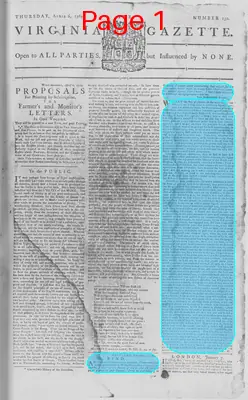
The Virginia Gazette
Williamsburg, Virginia
What is this article about?
A letter from E.B. in Maryland to printer M. Rind urges Virginians to steadfastly assert their constitutional rights against British ministerial pressures, warning that silence implies concession and risks enslaving posterity. It emphasizes Virginia's leadership in colonial liberty.
Merged-components note: The first component is the dateline and introduction to the letter, while the second is the body of the same letter signed E.B.; they form a single logical letter to the editor.
Clipping
OCR Quality
Full Text
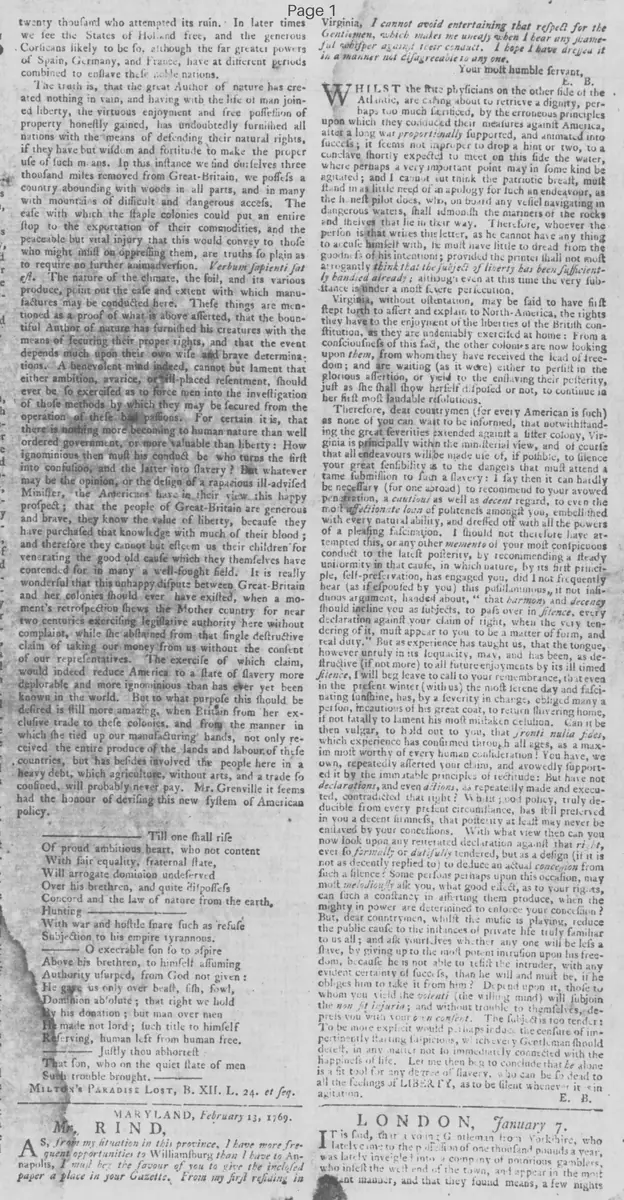
M. RIND,
SIR, Since my situation in this province, I have more frequent opportunities to Williamsburg than I have to Annapolis, I must beg the favour of you to give the inclosed paper a place in your Gazette. From my first residing in Virginia, I cannot avoid entertaining that respect for the Gentlemen, which makes me uneasy when I hear any justified whisper against their conduct. I hope I have dressed it in a manner not disagreeable to any one.
Your most humble servant,
E. B.
WHILST the late physicians on the other side of the Atlantic, are busying about to retrieve a dignity, perhaps too much sacrificed, by the erroneous principles upon which they conducted their measures against America, after a long war proportionally supported, and animated into success: it seems not improper to drop a hint or two, to a conclave shortly expected to meet on this side the water, where perhaps a very important point may in some kind be agitated; and I cannot think the patriotic breast, must stand in as little need of an apology for such an endeavour, as the honest pilot does, who, on board any vessel navigating in dangerous waters, hails from the mariners of the rocks and shelves that lie in their way. Therefore, whoever the person is that writes this letter, as he cannot have any thing to accuse himself with, he must have little to dread from the goodness of his intentions; provided the printer shall not most arrogantly think that the subject of liberty has been sufficiently bandied already; although even at this time the very substance is under a most severe persecution.
Virginia, without ostentation, may be said to have first stepped forth to assert and explain to North-America, the rights they have to the enjoyment of the liberties of the British constitution, as they are undeniably exercised at home: From a consciousness of this fact, the other colonies are now looking upon them, from whom they have received the lead of freedom: and are waiting (as it were) either to persist in the glorious assertion, or yield to the enslaving their posterity, just as she shall show herself disposed or not, to continue in her first most laudable resolutions.
Therefore, dear countrymen (for every American is such) as none of you can want to be informed, that notwithstanding the great severities extended against a sister colony, Virginia is principally within the ministerial view, and of course that all endeavours will be made use of, if possible, to silence your great sensibility as to the dangers that must attend a tame submission to such a slavery: I say then it can hardly be necessary (for one abroad) to recommend to your avowed penetration, a cautious as well as decent regard, to even the most affectionate sounds of politeness amongst you, embellished with every natural ability, and dressed off with all the powers of a pleasing fascination. I should not therefore have attempted this, or any other memento of your most conspicuous conduct to the latest posterity, by recommending a steady uniformity in that cause, in which nature, by its first principle, self-preservation, has engaged you, did I not frequently hear (as if espoused by you) this pusillanimous, if not insidious argument, handed about, "that harmony and decency should incline you as subjects, to pass over in silence, every declaration against your claim of right, when the very tendering of it, must appear to you to be a matter of form, and real duty." But as experience has taught us, that the tongue, however unruly in its loquacity, may, and has been, as destructive (if not more) to all future enjoyments by its ill timed silence, I will beg leave to call to your remembrance, that even in the present winter (with us) the most serene day and fascinating sunshine, has, by a severity in charge, obliged many a person, incautious of his great coat, to return shivering home, if not fatally to lament his most mistaken delusion. Can it be then vulgar, to hold out to you, that fronti nulla fides, which experience has confirmed through all ages, as a maxim most worthy of every human consideration! You have, we own, repeatedly asserted your claim, and avowedly supported it by the immutable principles of rectitude: But have not declarations, and even actions, as repeatedly made and executed, contradicted that oath? What good policy, truly deducible from every present circumstance, has still preserved in you a decent silence, that posterity at least may never be enslaved by your concessions. With what view then can you now look upon any reiterated declaration against that right, ever so formally; or dutifully tendered, but as a design (if it is not as decently replied to) to deduce an actual concession from such a silence? Some persons perhaps upon this occasion, may most melodiously ask you, what good effect, as to your rights, can such a constancy in asserting them produce, when the mighty in power are determined to enforce your concession? But, dear countrymen, whilst the music is playing, reduce the public cause to the instances of private life truly familiar to us all: and ask yourselves whether any one will be less a slave, by giving up to the most potent intrusion upon his freedom, because he is not able to resist the intruder, with any evident certainty of success, than he will and must be, if he obliges him to take it from him? Depend upon it, those to whom you yield the olenti (the willing mind) will subjoin the non sibi injuria; and without trouble to themselves, depress you with your own consent. The subject is too tender: To be more explicit would perhaps incur the censure of impertinently starting suspicions, which every Gentleman should detest, in any matter not so immediately connected with the happiness of life. Let me then beg to conclude that he alone is fit for any degree of slavery, who can be so dead to all the feelings of LIBERTY, as to be silent whenever its agitation.
E. B.
What sub-type of article is it?
What themes does it cover?
What keywords are associated?
What entities or persons were involved?
Letter to Editor Details
Author
E. B.
Recipient
M. Rind
Main Argument
virginians must continue to assert their rights to british liberties and respond to ministerial declarations against them, as silence would imply concession and lead to the enslavement of posterity.
Notable Details