Thank you for visiting SNEWPapers!
Sign up free
Story
July 8, 1938
White Bluffs Spokesman
White Bluffs, Benton County, Washington
What is this article about?
Dr. W. C. Thompson from New Jersey Agricultural Experiment Station advises monitoring chick growth rates using standard weights for healthy development and optimal egg production in pullets.
Clipping
OCR Quality
95%
Excellent
Full Text
FARM TOPICS
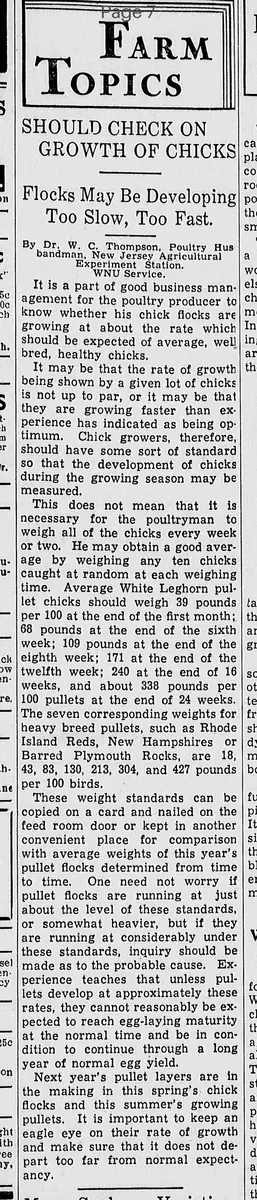
SHOULD CHECK ON
GROWTH OF CHICKS
Flocks May Be Developing
Too Slow, Too Fast.
By Dr. W. C. Thompson, Poultry Husbandman, New Jersey Agricultural Experiment Station.
WNU Service.
It is a part of good business management for the poultry producer to know whether his chick flocks are growing at about the rate which should be expected of average, well bred, healthy chicks.
It may be that the rate of growth being shown by a given lot of chicks is not up to par, or it may be that they are growing faster than experience has indicated as being optimum. Chick growers, therefore, should have some sort of standard so that the development of chicks during the growing season may be measured.
This does not mean that it is necessary for the poultryman to weigh all of the chicks every week or two. He may obtain a good average by weighing any ten chicks caught at random at each weighing time. Average White Leghorn pullet chicks should weigh 39 pounds per 100 at the end of the first month; 68 pounds at the end of the sixth week; 109 pounds at the end of the eighth week; 171 at the end of the twelfth week; 240 at the end of 16 weeks, and about 338 pounds per 100 pullets at the end of 24 weeks.
The seven corresponding weights for heavy breed pullets, such as Rhode Island Reds, New Hampshires or Barred Plymouth Rocks, are 18, 43, 83, 130, 213, 304, and 427 pounds per 100 birds.
These weight standards can be copied on a card and nailed on the feed room door or kept in another convenient place for comparison with average weights of this year's pullet flocks determined from time to time. One need not worry if pullet flocks are running at just about the level of these standards, or somewhat heavier, but if they are running at considerably under these standards, inquiry should be made as to the probable cause. Experience teaches that unless pullets develop at approximately these rates, they cannot reasonably be expected to reach egg-laying maturity at the normal time and be in condition to continue through a long year of normal egg yield.
Next year's pullet layers are in the making in this spring's chick flocks and this summer's growing pullets. It is important to keep an eagle eye on their rate of growth and make sure that it does not depart too far from normal expectancy.
SHOULD CHECK ON
GROWTH OF CHICKS
Flocks May Be Developing
Too Slow, Too Fast.
By Dr. W. C. Thompson, Poultry Husbandman, New Jersey Agricultural Experiment Station.
WNU Service.
It is a part of good business management for the poultry producer to know whether his chick flocks are growing at about the rate which should be expected of average, well bred, healthy chicks.
It may be that the rate of growth being shown by a given lot of chicks is not up to par, or it may be that they are growing faster than experience has indicated as being optimum. Chick growers, therefore, should have some sort of standard so that the development of chicks during the growing season may be measured.
This does not mean that it is necessary for the poultryman to weigh all of the chicks every week or two. He may obtain a good average by weighing any ten chicks caught at random at each weighing time. Average White Leghorn pullet chicks should weigh 39 pounds per 100 at the end of the first month; 68 pounds at the end of the sixth week; 109 pounds at the end of the eighth week; 171 at the end of the twelfth week; 240 at the end of 16 weeks, and about 338 pounds per 100 pullets at the end of 24 weeks.
The seven corresponding weights for heavy breed pullets, such as Rhode Island Reds, New Hampshires or Barred Plymouth Rocks, are 18, 43, 83, 130, 213, 304, and 427 pounds per 100 birds.
These weight standards can be copied on a card and nailed on the feed room door or kept in another convenient place for comparison with average weights of this year's pullet flocks determined from time to time. One need not worry if pullet flocks are running at just about the level of these standards, or somewhat heavier, but if they are running at considerably under these standards, inquiry should be made as to the probable cause. Experience teaches that unless pullets develop at approximately these rates, they cannot reasonably be expected to reach egg-laying maturity at the normal time and be in condition to continue through a long year of normal egg yield.
Next year's pullet layers are in the making in this spring's chick flocks and this summer's growing pullets. It is important to keep an eagle eye on their rate of growth and make sure that it does not depart too far from normal expectancy.
What sub-type of article is it?
Agricultural Advice
Poultry Guide
What keywords are associated?
Chick Growth
Poultry Weights
Pullet Development
Farm Standards
Egg Production
What entities or persons were involved?
Dr. W. C. Thompson
Where did it happen?
New Jersey
Story Details
Key Persons
Dr. W. C. Thompson
Location
New Jersey
Story Details
Poultry producers should monitor chick flock growth rates against standard weights for White Leghorn and heavy breed pullets to ensure they develop properly for egg-laying maturity.